_Polyommatus_amandus_-_Lublin_Poland_-_male_ZAcsPi.webp)
Contents
Amanda’s blue, Polyommatus amandus, is a butterfly of the family Lycaenidae found across much of Europe and Asia, first described by Schneider in 1792. The species ranges from Spain, Scandinavia and Denmark through central and northern Europe and the Palearctic to the Russian Far East, Central Asia and Greece and Asia Minor in the south and east, giving it one of the broader distributions among the blues, and it has accumulated a long list of historical synonyms, including Papilio amandus and Polyommatus icarius, along with numerous named forms reflecting geographic variation across that range.
Identification
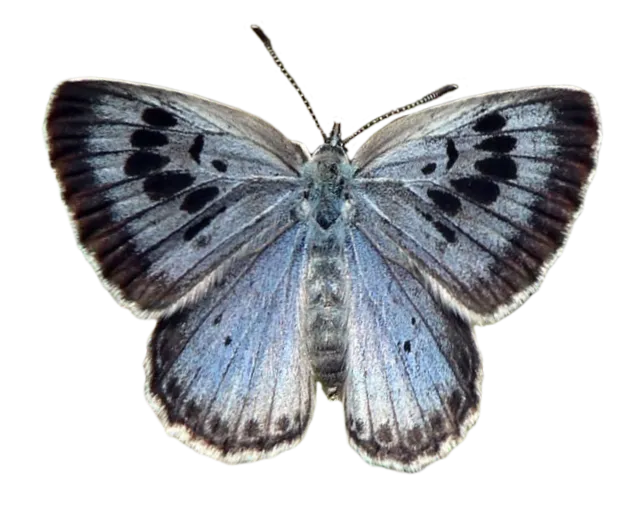
With a wingspan of 28–36 mm, Amanda’s blue is noticeably larger than most other “blue” butterflies. The sexes look quite different above. A male is silvery blue or sky blue, often but not always with a broad dark border and a narrow black marginal line edged by an outermost white line, while a female’s upperside varies by population: dark blue edged with brown in some, medium brown with a row of orange half-moon lunules near the edges in others, with red blotches along the hind margin. The underside tells the sexes apart too: a male is light grey with white-edged black blotches, while a female shows a rich creamy-brown colour with red blotches, especially on the margins of the hindwings; both sexes carry a turquoise tint at the base of the underwings. A field mark worth checking against the common blue, which it otherwise resembles closely in size and colour, is the forewing underside: in Amanda’s blue the basal ocelli are always absent from the forewing, a spot pattern the common blue does show.
Range and habitat
Amanda’s blue favours meadows, heaths, grassland, roadsides and other open ground where its larval food plants grow, and it is typically found at elevations of at least 1,000 m. That preference for open, flower-rich ground at altitude, repeated across its huge range from Iberia to the Russian Far East, points to a butterfly that tracks its host plants rather than any one climate.
Life cycle and host plants
Caterpillars feed on vetches, particularly meadow vetchling (Lathyrus pratensis) and tufted vetch (Vicia cracca), and like many of its relatives they carry glands that secrete a sugary fluid attracting ants, which in turn offer the caterpillar some protection from predators. Mating starts with the male rather than the female: he patrols the host plants waiting for a female, who afterwards lays her eggs singly on the leaves.
Behaviour and flight period
Adults are on the wing from May to August, though the exact timing shifts with latitude: flight starts as early as May in southern Europe, such as Greece, and only from July in eastern populations, a spread that mirrors the species’ long diagonal range from the Mediterranean to the Russian Far East.
Similar species
- Common blue (Polyommatus icarus): males of Amanda’s blue look like gigantic Polyommatus icarus, from which they are distinguished at a glance by the costal margin being broadly shaded with black; on the underside, Amanda’s blue further lacks the basal ocelli on the forewing that the common blue carries.
- Damon blue (Polyommatus damon): Amanda’s blue resembles this species in shape and size.
_male_Turna_Ewa2f.webp)
_07-05-2006_1_ZJyP4Y.webp)
_Lycaena_virgaureae_-_Radawa_Poland_-_male_Z25L2d2.webp)