_Z2vsEF2.webp)
Contents
The Alcon blue, Phengaris alcon, is a blue butterfly of the family Lycaenidae, found across Europe and the Palearctic to Siberia and Mongolia, from the North Sea coast at Hamburg, Bremen and Belgium south to the Mediterranean, and from France east to the Altai. Like its close relative the Large blue, it belongs to a small group of Lycaenids whose caterpillars spend most of their lives not on a plant but inside the nest of a single ant genus, fed by workers that mistake them for their own brood.
Identification
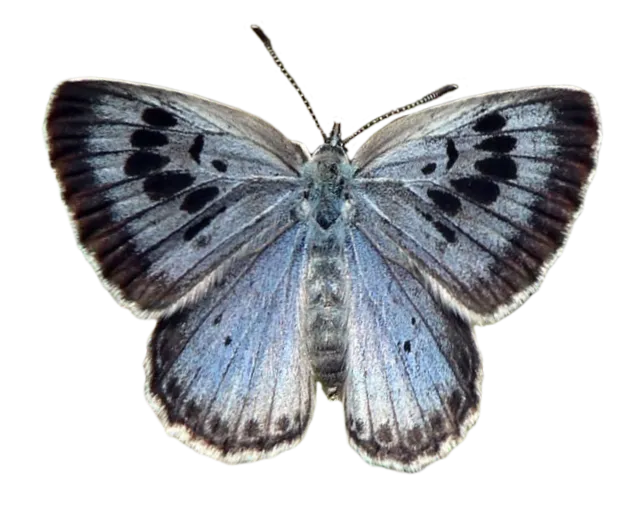
On the upperside, males are deep blue without the brilliant gloss some related blues show, while females are black-brown with a dusting of dark blue near the wing base. A detail used to separate the male from similar species is that its forewing disc carries no black spots other than the discocellular lunule, the short dark mark that crosses the cell. The underside is dark violet-grey and carries numerous eye-spots (ocelli), though some populations show these reduced or missing. A reliable wingspan figure could not be confirmed from an openable source this run.
Range and habitat
The Alcon blue lives in damp meadows and bogs, from sea level up into the Alps, wherever its host plant marsh gentian grows. That habitat has to supply two separate things at once: a stand of flowering gentian for the egg and young caterpillar, and, within reach of it, a nest of the right Myrmica ant for everything that follows. Where either is missing, or where the two are not close enough together, the butterfly cannot complete its life cycle even if the other is abundant.
Life cycle and host plants
Eggs are laid on marsh gentian (Gentiana pneumonanthe), or in the Alps sometimes on willow gentian (Gentiana asclepiadea), and the caterpillar eats no other plant. For its first three instars it feeds openly on the gentian flowers, but in its fourth instar its whole way of life changes: it leaves the food plant and gives off surface chemicals that mimic those of ant larvae, so that worker ants carry it into their nest and place it among their own brood. Once inside, the caterpillar does not prey on the ant brood but begs for food and receives regurgitated meals from nurse ants mouth to mouth, a “cuckoo strategy” of being fed rather than feeding itself.
The trick works with several Myrmica species, among them M. scabrinodis, M. ruginodis, M. rubra, M. sabuleti and M. schencki, with M. lonae and M. specioides used only rarely, and different host ants are used in different parts of Europe, so the same butterfly can depend on a different partner species from one region to the next. The butterfly’s closest relative, Phengaris rebeli, looks all but identical but parasitises a different combination of host ant and food plant, which is why the two are still argued over as either separate species or forms of one.
Behaviour and flight period
Adults are on the wing from the end of May into July in Central Europe, and not before the end of June further north. Away from the brief adult stage spent flying over the gentian meadows, almost the whole life of this butterfly is hidden: as an egg and young caterpillar on the flower head, then as an older caterpillar, and eventually a pupa, underground in an ant nest it never built and whose owners it has spent its entire larval life deceiving.
Similar species
- Large blue (Phengaris arion): the better-known relative, with the same ant-nest life cycle but a different host ant, Myrmica sabuleti, and a food plant of wild thyme rather than gentian.
- Phengaris rebeli: morphologically indistinguishable from the Alcon blue in the field, but tied to a different host ant and food plant, and treated by some authorities as a separate species rather than a form of P. alcon.
_Phengaris_nausithous_nausithous_-_Mokra_Poland_-_male_11VJ8p.webp)
_male_Turna_Ewa2f.webp)
_07-05-2006_1_ZJyP4Y.webp)