Contents
The brown hairstreak, Thecla betulae, is a butterfly of hedgerows and woodland edges, named for the thin tail streaks on its hindwings and for a habit of staying out of sight. It belongs to the family Lycaenidae, and its caterpillars feed almost entirely on blackthorn. The species ranges across most of Europe, including the southern half of England, Wales and the Burren in Ireland, and through temperate Asia to China, Korea and the Russian Far East, making it one of the most widely distributed hairstreaks in the Palaearctic.
Identification
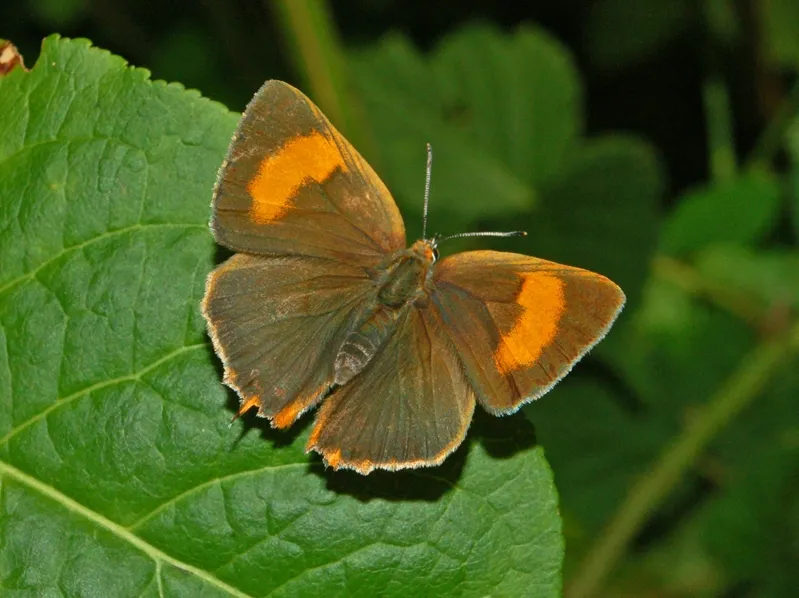
The sexes look quite different from above. Males have uniform brown wings, 36 to 41 mm across, while females are larger, 39 to 45 mm, and carry large orange patches on the forewings so striking that the female was once thought to be a separate species, the “Golden Hairstreak”. The underside tells a different story: both sexes show a bright orange ground colour crossed by two white, dark-edged streaks, the pattern that gives the hairstreaks their name, finished off with the short, thin tails on each hindwing.
Range and habitat
Within Britain the species is concentrated in the southern half of England and Wales, with strongholds in West Sussex, Surrey, Oxfordshire, Buckinghamshire and North and South Devon, Welsh colonies in Cardiganshire and Carmarthenshire, and an Irish population centred on the Burren limestones of Clare and south-east Galway; a few sites reach as far north as North Lincolnshire. It favours hedgerows, scrub and woodland edges where blackthorn, its main larval foodplant, grows abundantly.
Life cycle and host plants
Blackthorn (Prunus spinosa) is the main foodplant, with cherries and other Prunus species also used. Eggs are white and rough-surfaced, standing out clearly against bare winter twigs and making them the easiest life stage to find; the species overwinters as an egg, with the larva partially developing inside it before hibernating through the winter. After hatching in spring the caterpillar passes through four instars before pupating; the pupa is smooth and rounded, pale brown with fine lighter and darker markings, and although it spins no silk girdle it stays firmly attached to its support, where ants are often drawn to it and may bury it in a shallow cell. The pupal stage lasts around four weeks, and the butterfly completes a single generation each year.
Behaviour and flight period
This is among the hardest British butterflies to see on the wing, since it spends much of its time resting and basking high up in tall shrubs and trees and comes down only to feed or lay eggs. Males gather instead around ash “master trees” at the edges of the breeding area, where both sexes feed mainly on honeydew and will also visit umbellifer flowers or bait, rather than nectaring widely like most butterflies. Adults are warmth-loving and rarely seen on overcast days. Egg-laying females range more widely, seeking sheltered spots at the edges of woodland or hedgerows, favouring younger, south-facing growth, and crawling among the branches feeling for a suitable crevice to lay in. Flight starts late in the season: in Britain adults are first seen on the wing in late July or early August, among the latest-emerging of all the native species, with sightings continuing into October further east across its range.
Conservation
The species is listed by the IUCN under the category shown in the facts box. In Britain the picture is less reassuring than that global rating suggests: the long-term trend shows a severe decline, making the brown hairstreak a priority species for conservation. The main pressure is agricultural: because eggs are laid on the youngest shoots, routine hedge-trimming over winter destroys them before they can hatch, so colonies depend on hedges being cut in rotation rather than every year.
Similar species
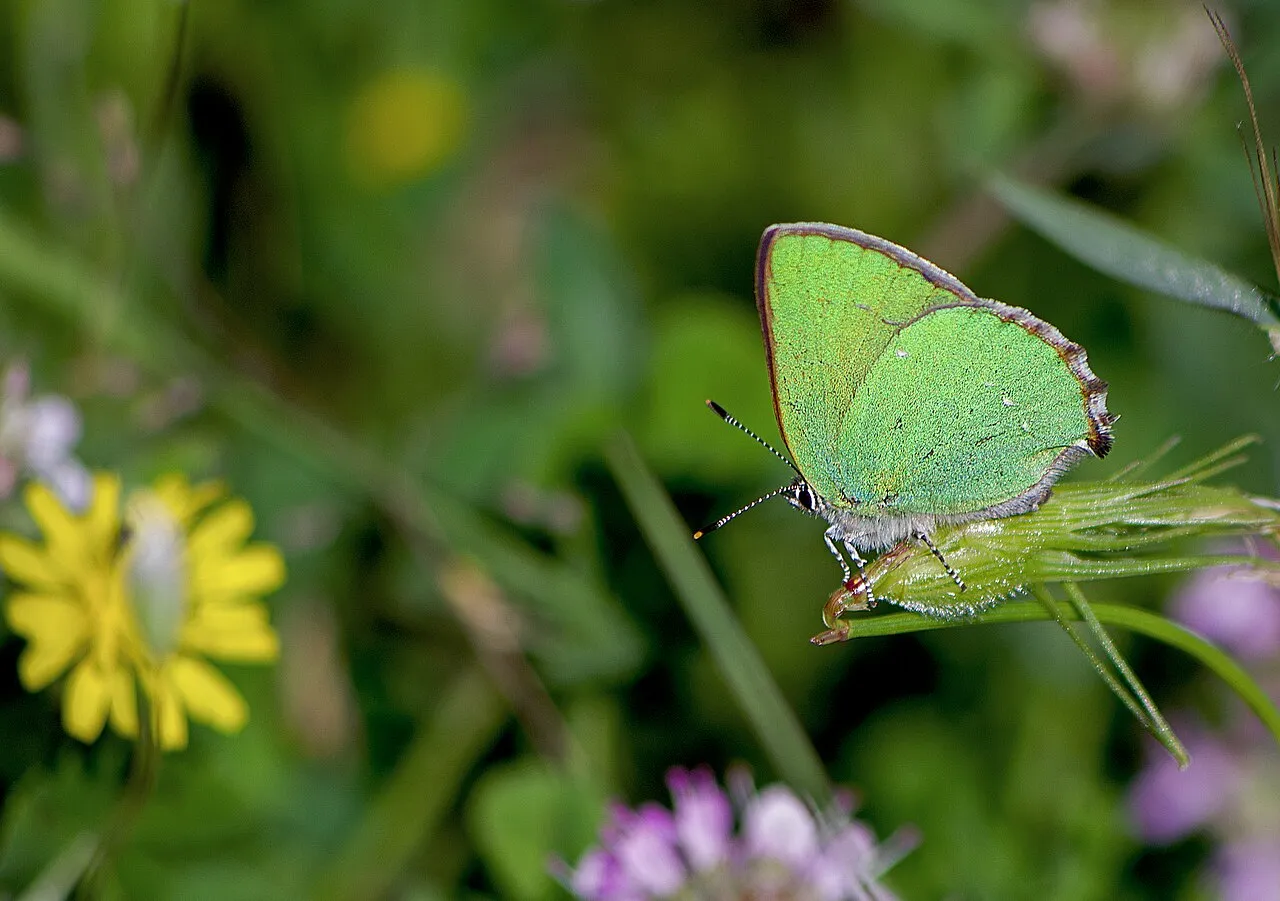
- Green hairstreak (Callophrys rubi): the only other hairstreak likely to be confused with it at rest, though its underside is plain green rather than orange and white-streaked, and it flies months earlier in spring.
- Black hairstreak (Satyrium pruni): another blackthorn-feeding hairstreak with a similar orange-banded underside, but with a shorter flight period in June and July and a much more local distribution.
- White-letter hairstreak (Satyrium w-album): feeds on elm rather than blackthorn and shows a fine white “W” mark on the underside hindwing instead of the brown hairstreak’s plain double streak.
_male_Turna_Ewa2f.webp)
_07-05-2006_1_ZJyP4Y.webp)
_Lycaena_virgaureae_-_Radawa_Poland_-_male_Z25L2d2.webp)