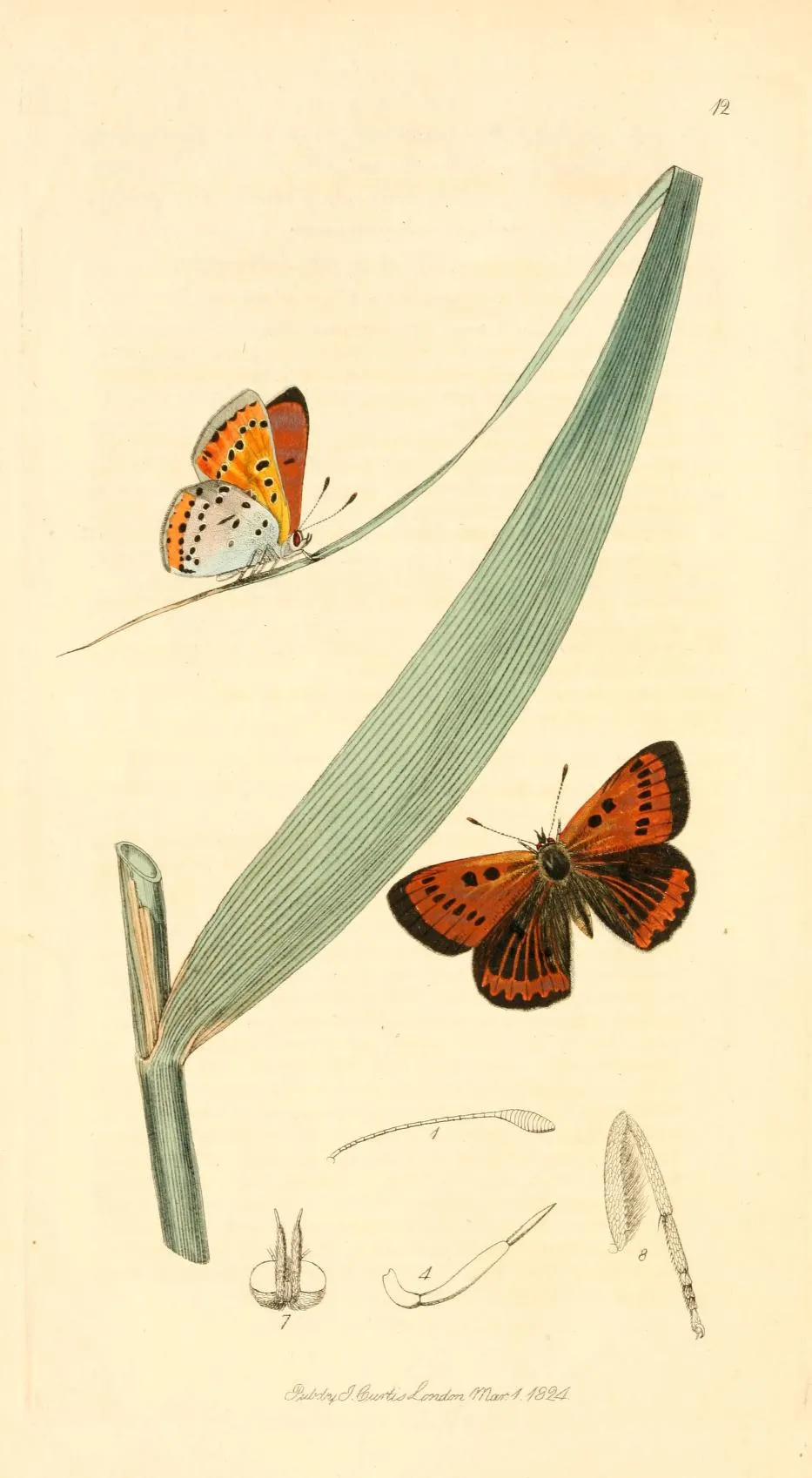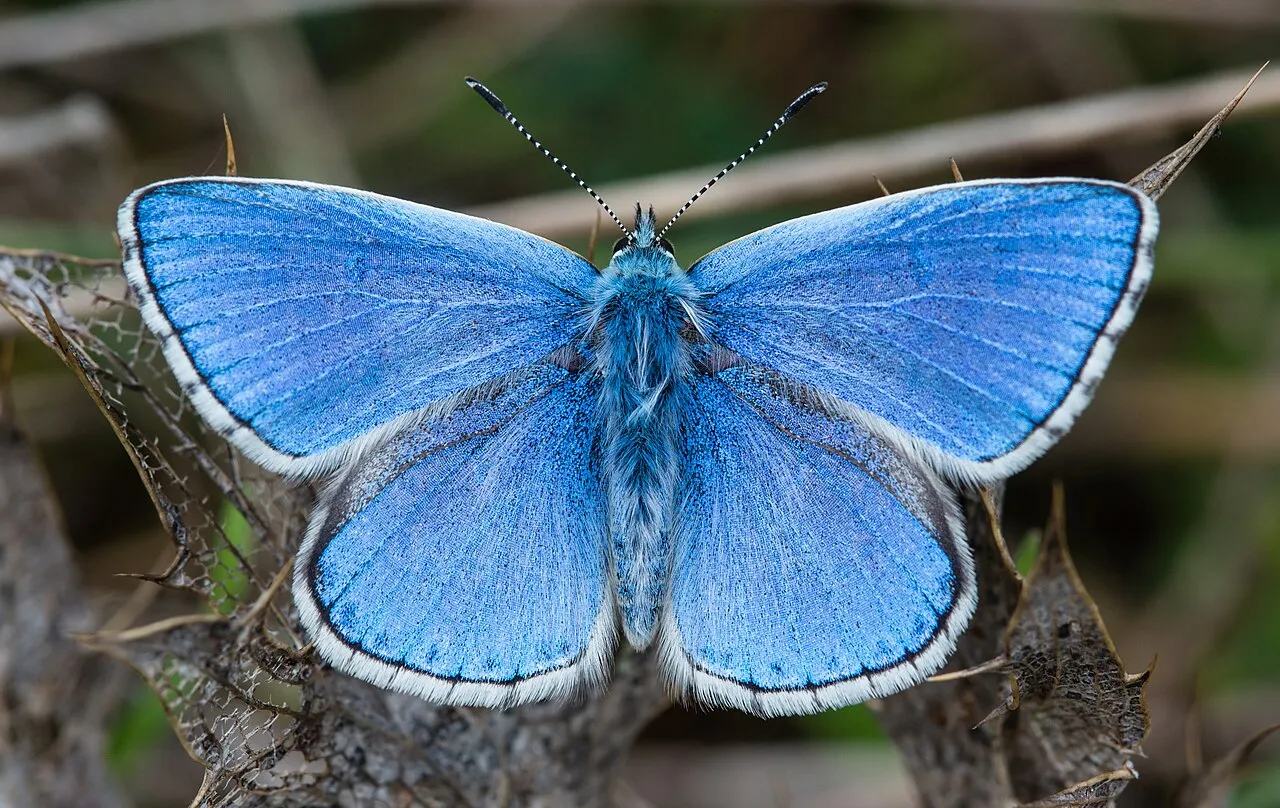
The Adonis blue, Lysandra bellargus, is a small butterfly of the family Lycaenidae, named for the brilliant colour of the male. The species ranges across Western, Central and Southern Europe, into southern Russia, the Caucasus and Transcaucasus, Turkey, Iraq and Iran. In Britain it sits at the edge of that range and is restricted to southern England, following the distribution of its one host plant.
Identification
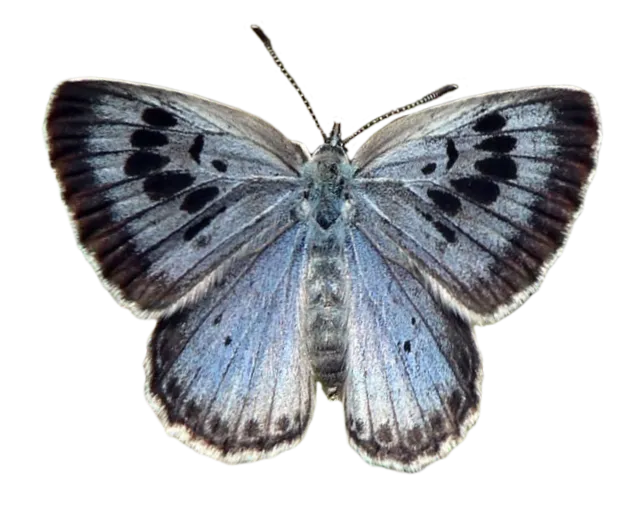
Wingspan runs to 30–40 mm. The sexes could hardly look more different above: a male is a magnificent electric blue, while the female is chocolate brown. Seen up close, the male’s upperside is a brilliant sky-blue edged with a fine black border and a white margin, while the female carries scattered blue scales near the wing base and orange spots rimmed with blue scales along the hindwing edge. Both sexes share one useful field mark: the wing fringes are chequered black and white, unlike the plain white fringe of the common blue. The underside is quieter and shared more closely between the sexes, a brownish grey ground colour marked with black, white-ringed ocelli and orange crescent spots.
Range and habitat
The butterfly keeps to warm, dry calcareous grassland on chalk and limestone, with closely-cropped turf, typically on sheltered, south-facing slopes. That short turf is usually kept down by rabbit grazing or active management, conditions that also suit its host plant. In Britain the species forms discrete colonies, often in large numbers where it does occur, on chalk downs such as those of Dorset, South Wiltshire, West Sussex, East Sussex and East Kent; it is absent from central and northern England, Wales, Scotland and Ireland.
The caterpillar feeds on a single plant, horseshoe vetch (Hippocrepis comosa), its sole larval food. The egg is semiglobular, with the top somewhat flattened, pale green and reticulated with white. The caterpillar that hatches from it is dark green with dark spines and yellow bands, reaching about 1.6 cm, and passes through five instars before pupating at ground level, with the adult emerging about three weeks later. Winter is spent as a small, early-instar caterpillar that resumes feeding in spring. The species fits in two generations a year, with a possible third in warmer parts of its range further south.
Behaviour and flight period
In Britain the adults are on the wing in two broods, from May to September, the first peaking in late May and June and the second in late August and September; in the warmer south of its range a possible third brood can fly into October. A male spends much of the day on the wing, seeking out females, which are easy to pick out by their rich chocolate-brown colour against his own electric blue. By day the butterflies otherwise rest with their wings open, and when disturbed drop suddenly into the grass. At night they roost communally, sometimes in colonies numbering in the hundreds, and adults generally have limited powers of dispersal, which helps explain why the species persists as separate colonies rather than spreading freely between sites.
Similar species
- Common blue (Polyommatus icarus): close in size, but the male’s colour is light and glittering sky-blue rather than the Adonis blue’s deeper electric tone, and its wing fringes are plain white rather than chequered.
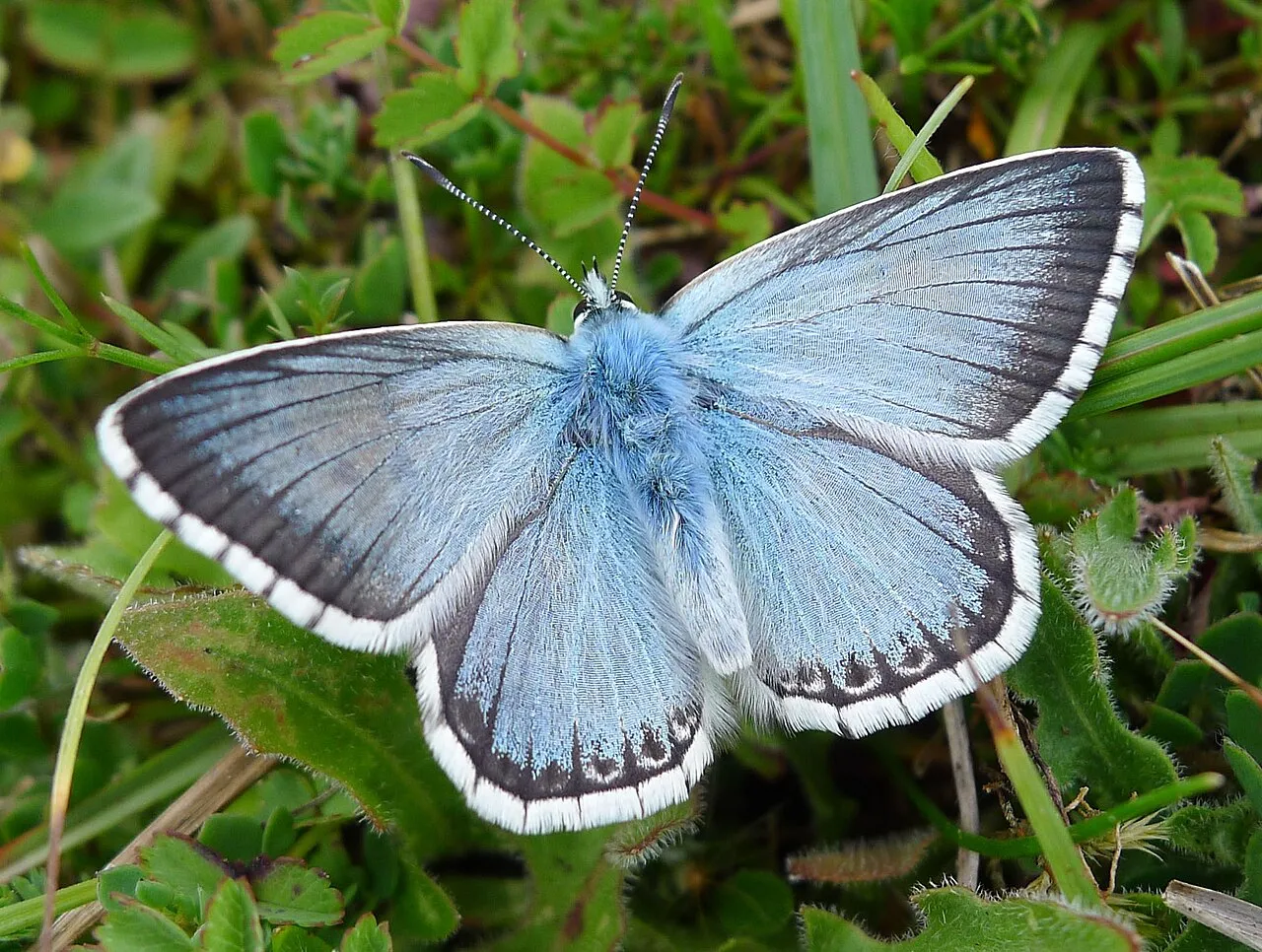
- Chalkhill blue (Lysandra coridon): shares much of the Adonis blue’s chalk grassland habitat, and its underside bears some resemblance, though the ocelli and ground colour differ in intensity.
_male_Turna_Ewa2f.webp)
_07-05-2006_1_ZJyP4Y.webp)