Contents
The Silver-studded blue, Plebejus argus, is a small butterfly of the family Lycaenidae, named for the row of tiny metallic scales on its hindwing underside that flash silver as light catches them. It is found across the Palearctic, through Europe and eastward, and in Britain most colonies are in southern England, with further colonies in the east of England and Wales, and a single isolated site at Prees Heath in Shropshire. The species keeps close company with ants throughout its life cycle.
Identification
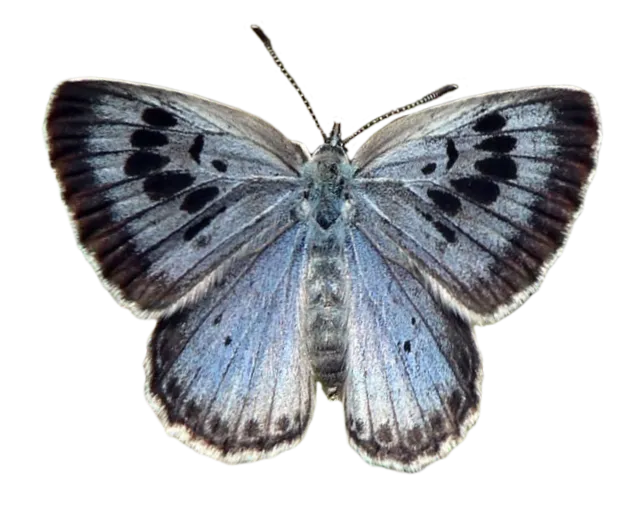
The wingspan runs 26–32 mm. The male’s upperside is royal blue with a black border and a wispy white fringe, a shade described as deeper, darker and duller than its close relative Reverdin’s blue, with a slight violet tint. The female’s upperside is brown and more subdued, though some subspecies, notably the Welsh caernensis, show significant blue across the hindwings and wing bases while the nominate form’s females mostly lack it. Both sexes carry the metallic silver spots on the hindwing that give the species its name.
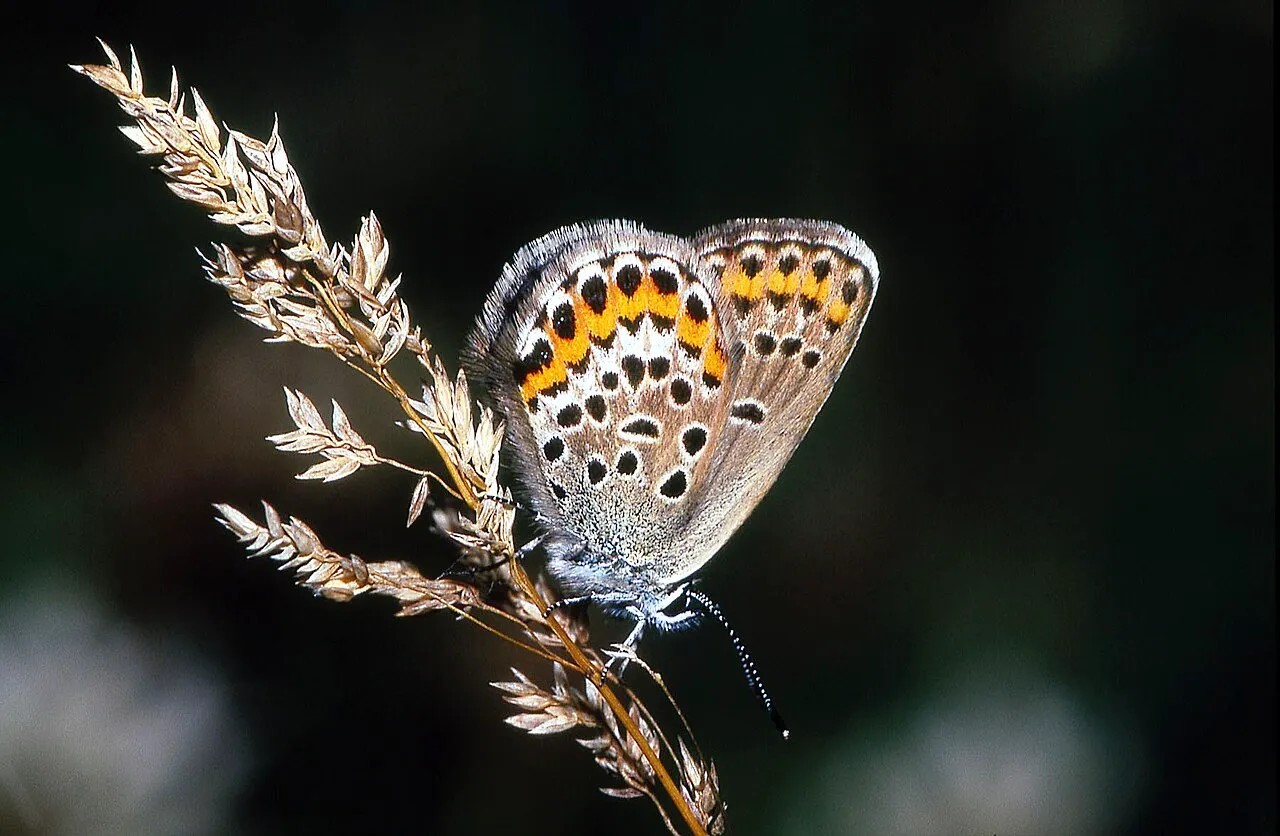
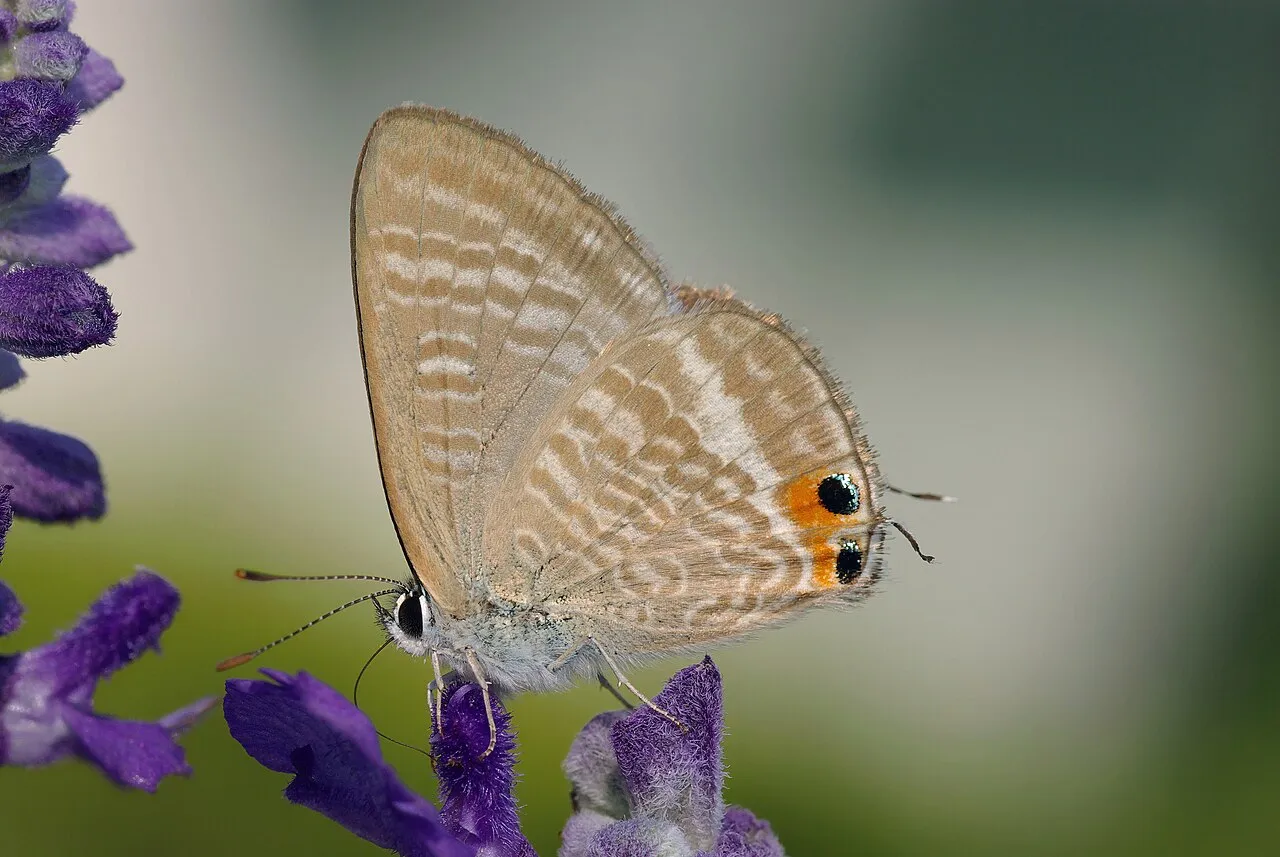
The underside is pale grey or taupe, ringed with dark spots in transverse bands and set off by orange marginal lunules and white banding between the spot rows. A strongly glittering blue-green dusting at the base of the underside helps separate it from look-alike blues. The species is also variable between populations in border width, underside grey tone and how much blue the females show.
Range and habitat
Beyond its broad Palearctic and European range, British colonies favour heathland, mossland and calcareous (limestone and chalk) grassland, typically sheltered and south-facing, with patches of bare ground for egg-laying. Shrub-dense patches within these sites also serve colonies for roosting, resting, basking, finding mates and sheltering.
Life cycle and host plants
Caterpillars feed on a range of low-growing plants, including black medick, common bird’s-foot-trefoil, common rock-rose, gorse and heathers, hoary rock-rose and horseshoe vetch, with limestone populations favouring rock-rose (Helianthemum). The species overwinters as an egg, already containing a fully developed caterpillar. Britain and other northern populations produce one generation a year, while southern European populations can manage two.
The caterpillar’s relationship with ants, chiefly Lasius niger and Lasius alienus, runs through the whole early life cycle. Females seek out egg-laying sites with strong pheromone trails left by these ants, and once hatched, the ants guard the caterpillars and pupae from predators and parasites. In return, the larvae produce a sugary secretion enriched with amino acids from a gland on their back, which the ants feed on.
Behaviour and flight period
In Britain the species is on the wing from mid-June to early August, with the Welsh subspecies caernensis flying earlier, from late May to early July; southern European populations can fly in two broods, from May and again from July onward. Adults are notably sedentary, rarely moving more than about 20 metres in a day. Males patrol low over vegetation in search of females, and both sexes roost communally, opening their wings to the morning sun to warm up. The butterfly flies even in overcast weather, provided the temperature is high enough.
Similar species
- Common blue (Polyommatus icarus): lacks the Silver-studded blue’s metallic hindwing spots and the blue-green dusting at the underside base, and is a far less sedentary flier.
- Adonis blue (Lysandra bellargus): the male’s upperside is a brighter, more electric blue than the Silver-studded blue’s deeper, violet-tinted shade, and it shares a liking for chalk grassland.
_2fwkHU.webp)
_male_Turna_Ewa2f.webp)
_07-05-2006_1_ZJyP4Y.webp)