_..._Chambers_Farm_Wood___Linc_(53841524491)_(cropped)_25dC3i.webp)
Contents
The black hairstreak, Satyrium pruni, is a small brown butterfly of the family Lycaenidae, found from Scandinavia to Ukraine and east to Mongolia, Korea and Japan1; in Great Britain it is restricted to a line of clay soils between Oxfordshire and Cambridgeshire2. It is one of the hardest British butterflies to see well, spending much of its short flight period resting high in trees.
A dealer named Seaman2 first collected it in the British Isles at Monks Wood, Cambridgeshire, in 1828, but the specimens were taken for white-letter hairstreaks until the entomologist Edward Newman recognised them as a distinct species.
Identification
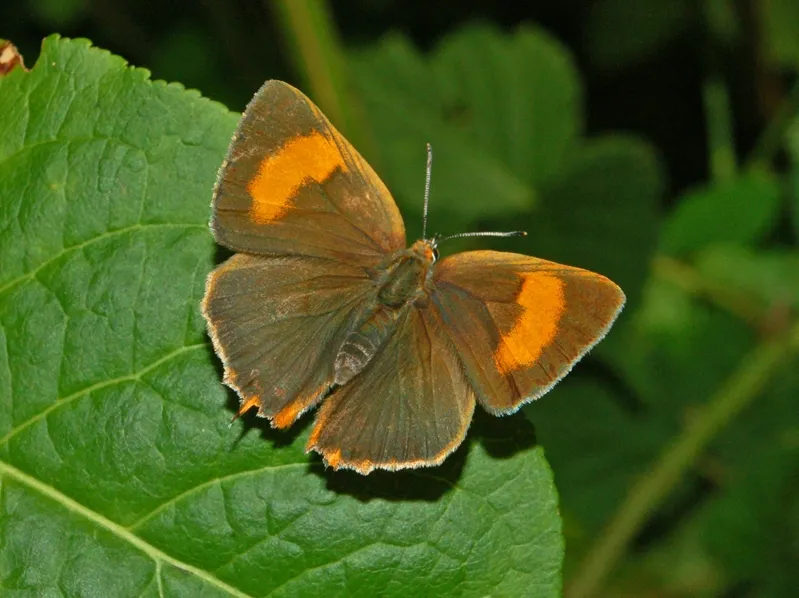
The wingspan runs 34 to 39 mm in males and 35 to 40 mm in females. Both sexes show a row of orange spots along the hindwing upperside; the sexes differ in how far this spotting reaches: males carry only a few anal spots, while females show an anal halfband, sometimes a brick-red discal spot, and orange spots that extend onto the forewings as well as the hindwings. On the underside, the white line crossing the wing is straighter than on the white-letter hairstreak, the orange border continues onto the forewings, and that orange band is flanked by black spots1 that the white-letter hairstreak never has; this underside black-and-orange combination is the surest way to tell the two species apart. The butterfly always settles with its wings closed2, so a resting individual shows only the underside markings just described.
Range and habitat
In Britain, colonies are typically located in small woods or nearby hedgerows with a southerly aspect, wherever blackthorn grows, and are confined to a line of clays between Oxfordshire and Cambridgeshire2, making it one of the country’s most local butterflies. On the European mainland it also breeds in moderately dry woodland, hedgerows or on a woodbank3 wherever blackthorn is present.
Life cycle and host plants
Caterpillars feed on blackthorn (Prunus spinosa), occasionally wild plum and cherries, other Prunus species. The butterfly overwinters as an egg, laid singly in twig forks on blackthorn, where it is blue-green at first, gradually turning dark brown and then, by the time winter sets in, a pale grey. The larva stays nine months in the egg state, hatching about the end of March, and passes through four instars: the first exactly resembles the outer sheath of a blackthorn bud on which it hatched, the second turns purplish-rose with pale green and pink on the central segments, the third is a deeper rose with a pale yellowish-green centre, and the final instar is clear green with four pale yellow-green stripes. The chrysalis, about 9.5 mm long and camouflaged to resemble a bird dropping, stays fixed to a leaf or twig for roughly three weeks before the adult emerges. The species completes a single generation each year1. Adults spend much of their time resting high in trees such as maple, ash or blackthorn, crawling over leaves and twigs in search of aphid honeydew, and also take nectar from bramble, dog-rose and wild privet2.
Behaviour and flight period
The flight period is short and single-peaked, running from late June to mid-July in Britain1. Hairstreaks are notoriously hard to follow once airborne, and this species is no exception: when active, the butterflies are extremely difficult to follow in flight, a trait shared by all hairstreaks. During courtship, a male and female will whirl around each other in a tireless dance2 lasting several minutes before the pair mates.
Conservation
As of the 2022 IUCN Red List, the species is assessed as Least Concern4. British monitoring between 1976 and 2019 found a 33% long-term decline in occurrence, with a further 19% fall between 2010 and 2019, even as abundance at the sites that remain rose by 348% overall and 76% in the most recent decade. UK Butterflies judges the British status stable overall, though its future depends on protection and habitat management2 of its remaining colonies.
Similar species
- White-letter hairstreak (Satyrium w-album): the closest look-alike, told apart by the black spots flanking the underside orange band1, which the white-letter hairstreak never has, and by the straighter white underside line.
- Ilex hairstreak (Satyrium ilicis): a similar brownish, orange-marked relative of southern and central Europe, whose caterpillars feed mainly on oaks, as well as elms, buckthorn and Prunus species, and whose flight period runs longer, from late May to early August5.
_1rhaFj.webp)
_Z2vsEF2.webp)
_Polyommatus_amandus_-_Lublin_Poland_-_male_ZAcsPi.webp)
_male_2_27BcuK.webp)
_Scolitantides_orion_orion_-_Yantyshevo_Sakmara_River_Russia_female_1otonA.webp)