_Scolitantides_orion_orion_-_Yantyshevo_Sakmara_River_Russia_female_1otonA.webp)
Contents
The chequered blue, Scolitantides orion, is a small butterfly of the family Lycaenidae, named for the dense black spotting that covers its wings. It is found across Europe and Russia through the Palearctic as far as Japan, ranging from Scandinavia south to the Mediterranean, with further populations in northern China, Siberia and the Russian Far East. Its scientific name recalls Orion, the legendary hunter of Greek myth who was turned into a constellation after his death.
Identification
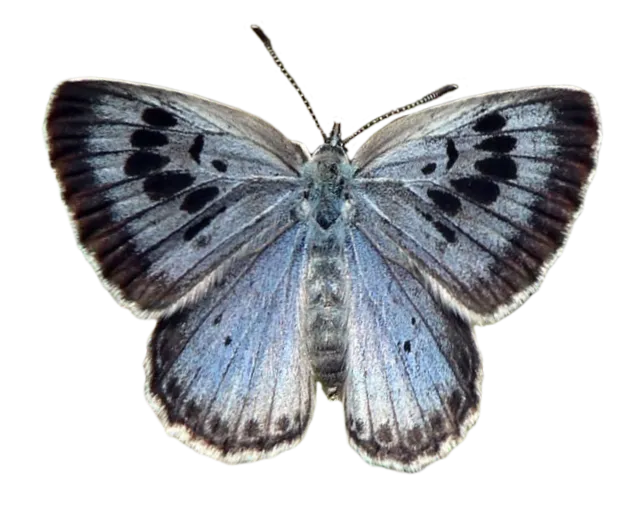
The chequered blue is a small species, with males having a forewing length of 13 to 16 mm. It is rather similar to Pseudophilotes baton but larger and darker, and can be told apart by its fringes, which are very distinctly spotted. The underside is the more striking surface: white, heavily and abundantly spotted with black, with the hindwing beneath carrying a bright orange-red submarginal band. The species is not uniform everywhere it flies: an all-dark form, with the upperside almost entirely blackish apart from the discocellular spot, occurs among ordinary specimens throughout the range and is the commoner form in some districts, such as the Valais, while a strongly blue-toned form turns up singly across Europe and as a regular spring form further east in Asia. The egg is flattened and white.
Range and habitat
The species lives in rocky and stony places, including chalk areas, up to about 1000 m altitude, wherever its Sedum host plants grow. Its range from Scandinavia to the Mediterranean and east across Russia to Japan and the Russian Far East means it turns up in a wide range of climates, always tied to the bare, stony ground its caterpillars’ food plants prefer. The species is split into several named subspecies across this range: S. o. orion in Greece, North Macedonia, Bulgaria, Russia, the Caucasus, central Siberia, Transbaikalia and the Russian Far East; S. o. jezoensis in Amur Oblast, Ussuri and Sakhalin; S. o. johanseni in northern China, the Altai Mountains, the northern Tien Shan, the Dzungarian Alatau and the Sayan Mountains; S. o. lariana from the French Alps and Corsica to northern Italy and Greece; S. o. parvula in Spain and France; and S. o. ultraornata in Scandinavia. In China, Korea and the Amur region the species is more generally distributed than in Europe, though always confined to rocky localities of its food plant.
Life cycle and host plants
Caterpillars feed on stonecrops, Sedum telephium and Sedum album. The larva is light green with a black head and black spiracles, marked with a stripe on the first ring, a lateral stripe, a dorsal line and a row of spots, feeding on its Sedum host in autumn, and again in June further south, and it is often attended and guarded by ants while it feeds. It pupates before winter: the pupa is dirty yellow, greenish at the wing cases, and is fastened either on the ground or above it on the host plant, sometimes a number of pupae together, and it is this pupal stage that overwinters, sheltered under stones or in small ground cavities near the host plant.
Behaviour and flight period
Adults fly from May to August, from sea level up to about 2000 m, with one or two generations a year depending on the location of the colony. In France, there is usually a single generation in May and June, though sometimes a second appears in May and again in September. Where a second generation occurs, the earliest adults of the year emerge in early spring, timed to the growth of the Sedum plants their caterpillars depend on. Despite its wide range, the chequered blue is very local wherever it flies, absent across large districts even within otherwise suitable country, though generally not rare where it does occur; this patchiness tracks the uneven distribution of the bare, rocky ground its Sedum hosts need.
Conservation
The species as a whole is listed by the IUCN under the category shown in the facts box, taken from its Wikidata record.
Similar species
- Pseudophilotes baton (Baton blue): the closest look-alike, smaller and paler, lacking the chequered blue’s very distinctly spotted fringes.
- Small blue (Cupido minimus): another small Lycaenidae sharing much of the chequered blue’s European range, without its heavily spotted underside.
- Green-underside blue (Glaucopsyche alexis): also found on rocky and scrubby ground within the same range, but lacking the chequered blue’s dense black underside spotting.
_male_Turna_Ewa2f.webp)
_07-05-2006_1_ZJyP4Y.webp)
_Lycaena_virgaureae_-_Radawa_Poland_-_male_Z25L2d2.webp)