Contents
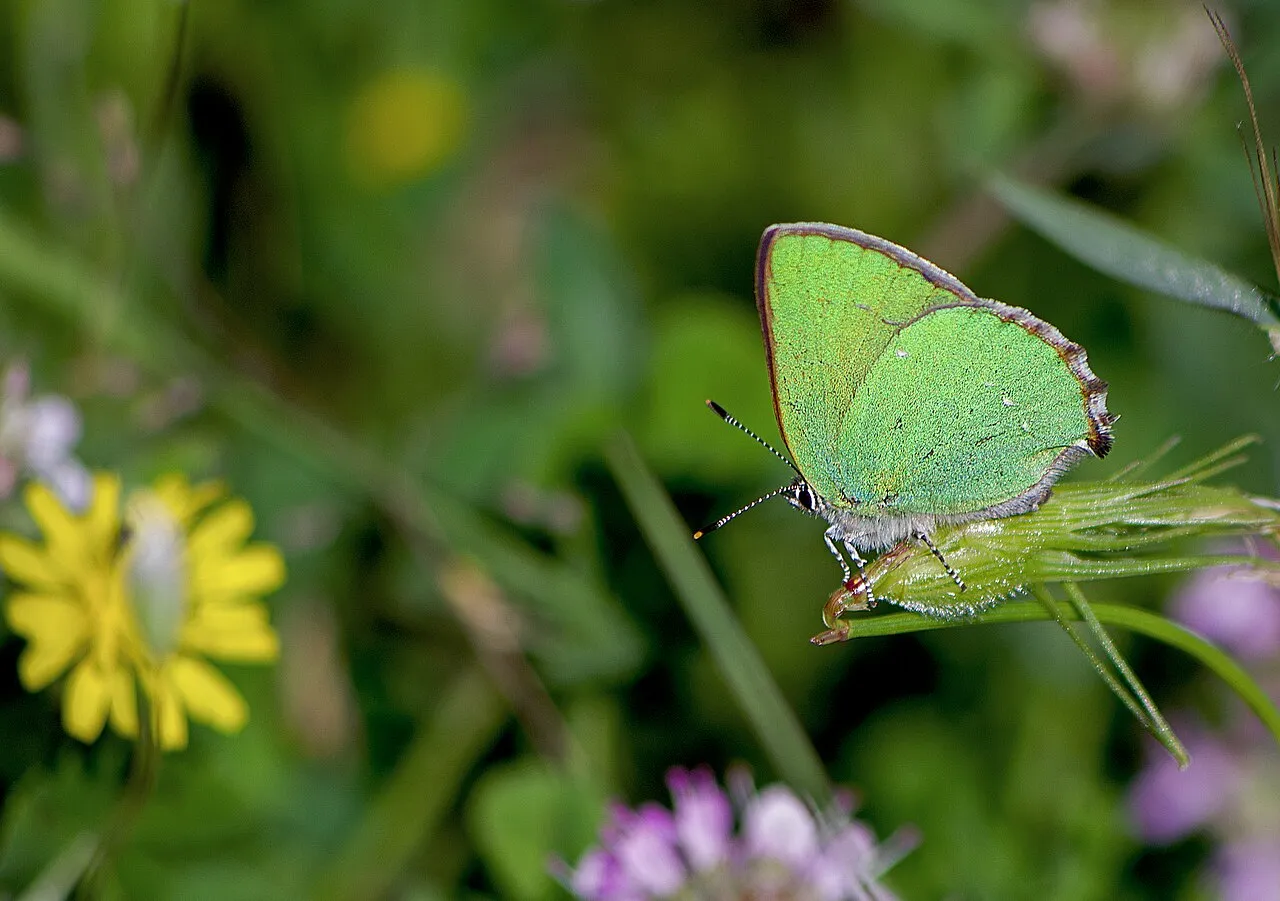
The Green Hairstreak, Callophrys rubi, is a small butterfly of the family Lycaenidae, named for the bright green underside it shows whenever it settles. It is found across most of Europe, North Africa, Russia, Asia Minor, Siberia, Amurland, Baluchistan and Chitral, and it is widespread across the UK, though localised near the coast around the Mediterranean.
Identification
This is a small butterfly, with a wingspan of about 27 to 34 mm. The upperside of both sexes is a uniform dull brown, and because the butterfly never rests with its wings open, that brown is only ever seen in flight. The underside is the species’ signature: a bright green produced by the diffraction and interference of light within a lattice-like structure in the wing scales, rather than by pigment, crossed by a thin white line that is often reduced to a faint row of dots or missing altogether. The sexes are close in appearance; the male carries two paler patches of scent scales on the upperside of the forewing that the female lacks, and the female sometimes shows a small reddish-yellow spot on the upperside of the forewing.
Range and habitat
Within this wide range the species turns up on hillsides, moorland, chalk downland, heathland, in woodland clearings, along railway embankments and in valley bottoms with scrubby plants and hedgerows, from sea level to about 2,300 m. That spread of habitats tracks its caterpillars’ food plants rather than any single type of ground, which is why the butterfly can be found on acid heath and chalk grassland alike.
Life cycle and host plants
Females lay their eggs singly on one of a long list of possible food plants. The caterpillars are highly polyphagous, feeding on gorse, broom, dyer’s greenweed, common bird’s-foot-trefoil, common rock-rose, bramble, bilberry, alder buckthorn, dogwood and cross-leaved heath, among other plants. Which of these a caterpillar eats depends on what grows locally, and this flexibility helps explain the butterfly’s wide distribution across such different habitats. The caterpillar itself is dark green with a black-edged yellow line down its back, pale spots along that line and a yellowish line along each side, a pattern that breaks up its outline against host-plant foliage.
Pupation brings an unusual partnership. The chrysalis is short and much rounded, like a small bean, and it emits squeaking sounds that attract ants, which then bury the pupa where they find it. Buried or not, the species overwinters as a chrysalis, motionless until spring, and completes a single generation a year.
Behaviour and flight period
Adults are on the wing from the end of March to the end of June, occasionally stretching into July or August, with UK sightings concentrated from mid-April to the end of June. Favourite perches are prominent sprigs such as hawthorn branches, where the closed, green-sided wings blend into the surrounding leaves; from there a Green Hairstreak will tilt its wings to catch the sun when it needs to warm up, without ever opening them to reveal the brown upperside beneath. Males are territorial, defending a chosen perch against rival males, and both sexes feed on nectar, with spring-emerging adults showing a particular fondness for the flowers of cinquefoils (Potentilla).
Across its huge range the species varies enough to have been split into five subspecies. The southern form fervida has an upperside that runs paler brown with a golden sheen, while the Asian form sibirica shows an underside green that is less bright than in the nominate European race.
Similar species
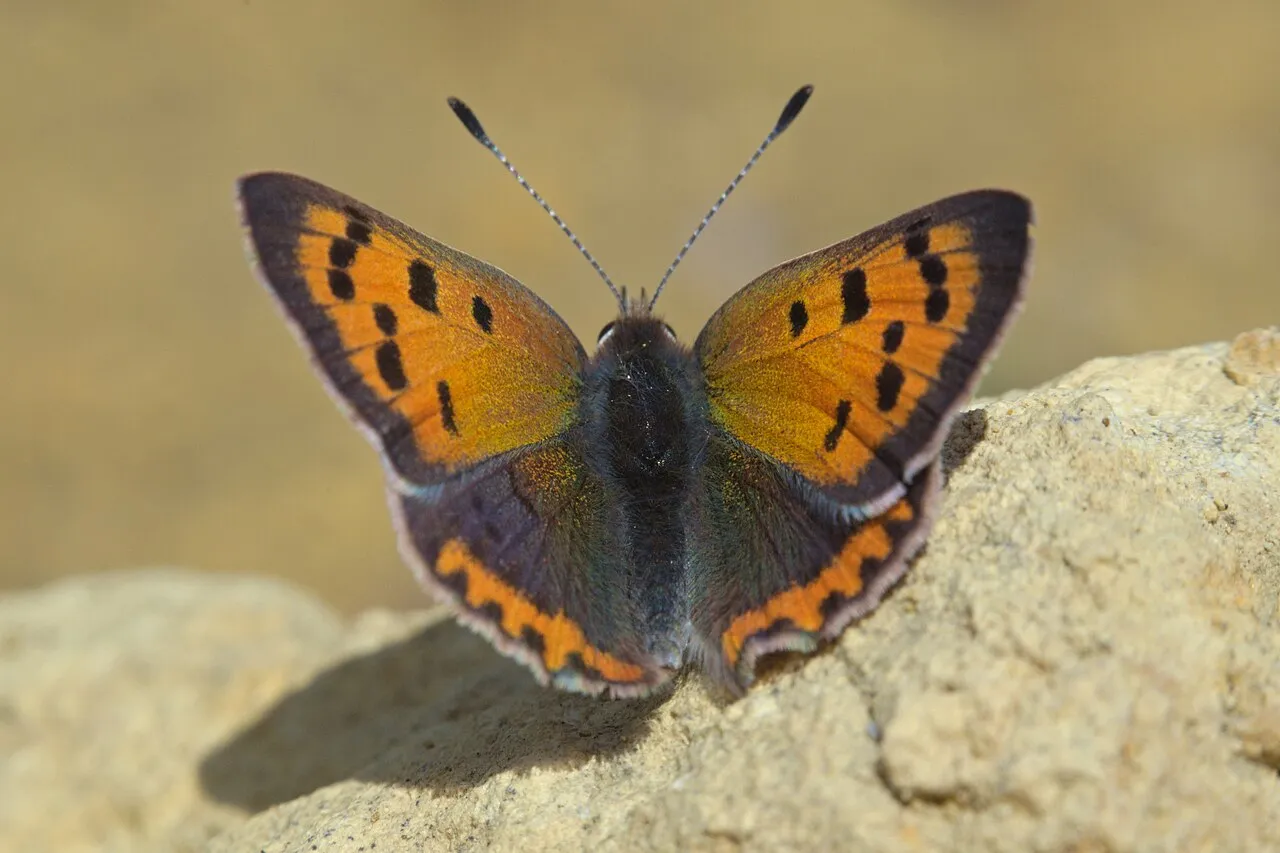
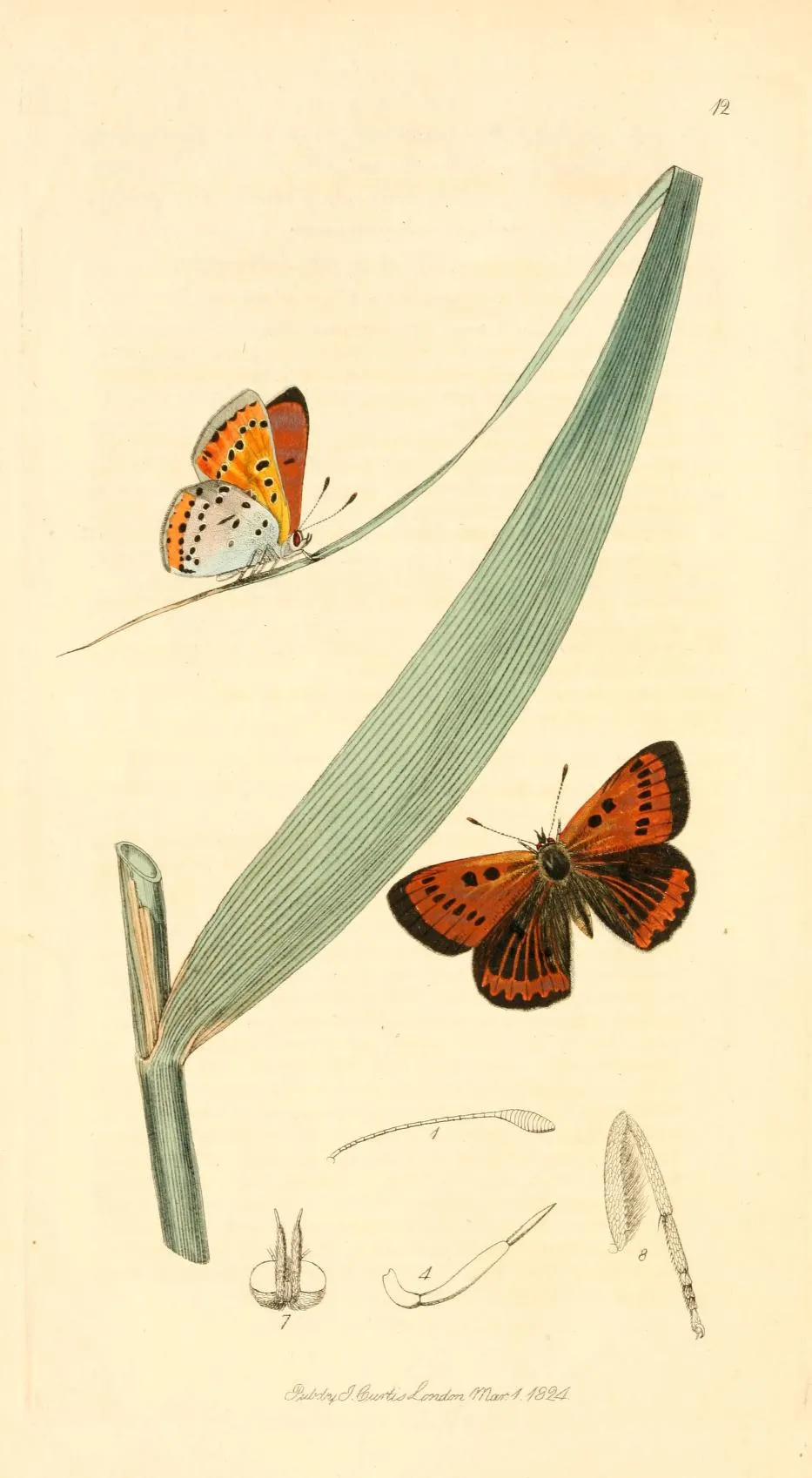
- Small Copper (Lycaena phlaeas): another small Lycaenidae that shares some of the Green Hairstreak’s open, scrubby habitats, though its orange, black-spotted wings make it easy to tell apart once seen from any angle.
- Brown Hairstreak (Thecla betulae): a later-flying relative with a similar resting posture, but it lacks the Green Hairstreak’s green underside and instead shows orange-brown markings on a darker ground colour.
- White-letter Hairstreak (Satyrium w-album): also brown above and marked with fine white lines below, but its underside is brown rather than green, with a bolder “W”-shaped white streak.
_male_Turna_Ewa2f.webp)
_07-05-2006_1_ZJyP4Y.webp)
_Lycaena_virgaureae_-_Radawa_Poland_-_male_Z25L2d2.webp)