Contents
The Ilex hairstreak, Satyrium ilicis, is a butterfly of the family Lycaenidae, described by Esper in 17791 under the name Papilio ilicis. It lives in southern and central Europe, Asia Minor, the Caucasus, Transcaucasia and Lebanon, as well as south-western Siberia and the southern Urals. Guy Padfield calls it widespread and sometimes very common2, though generally local. In the Naturalis guide to the butterflies of Europe it occurs locally at woodland edges3 and in coppices with warm, dry oak scrub.
Identification
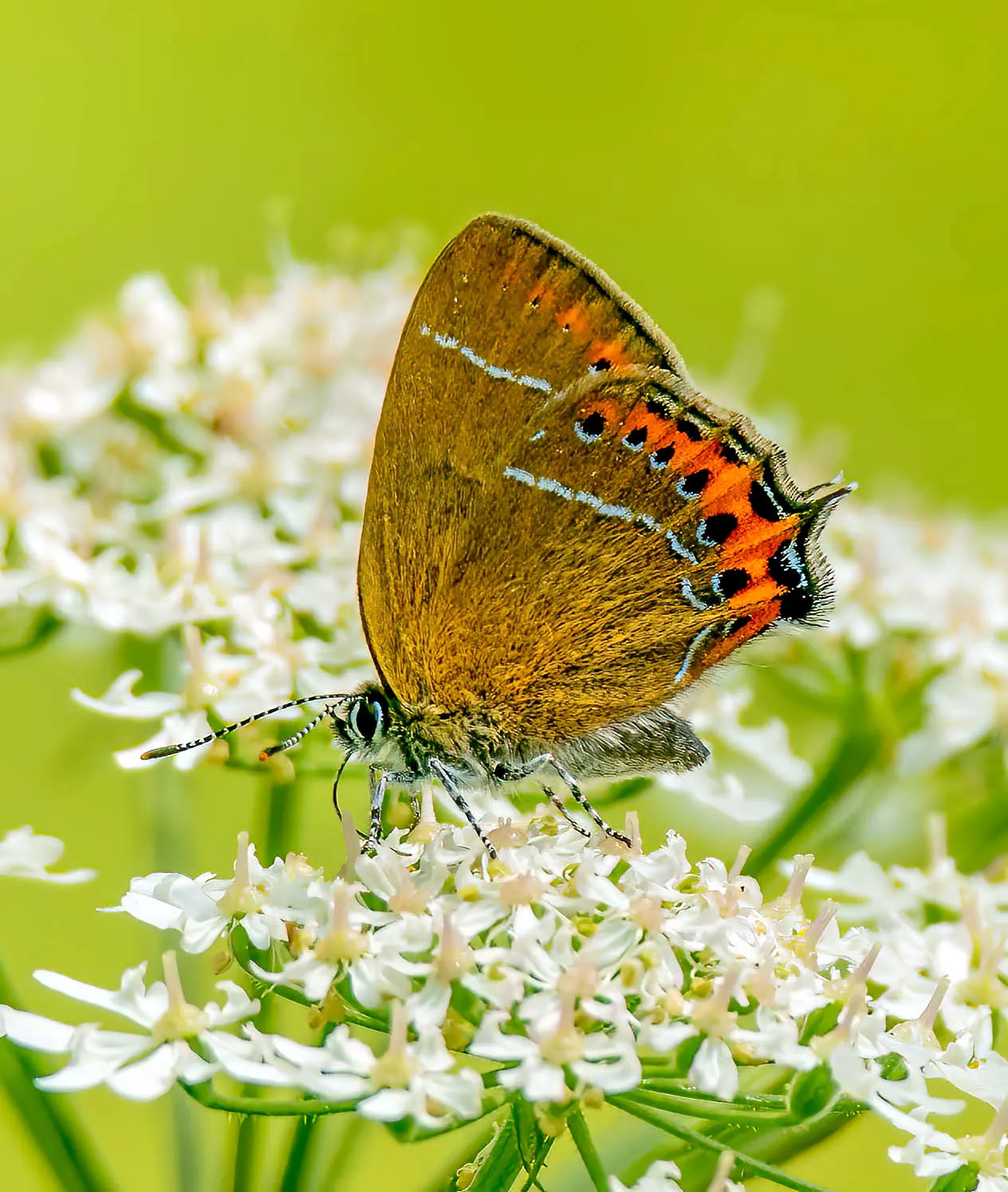
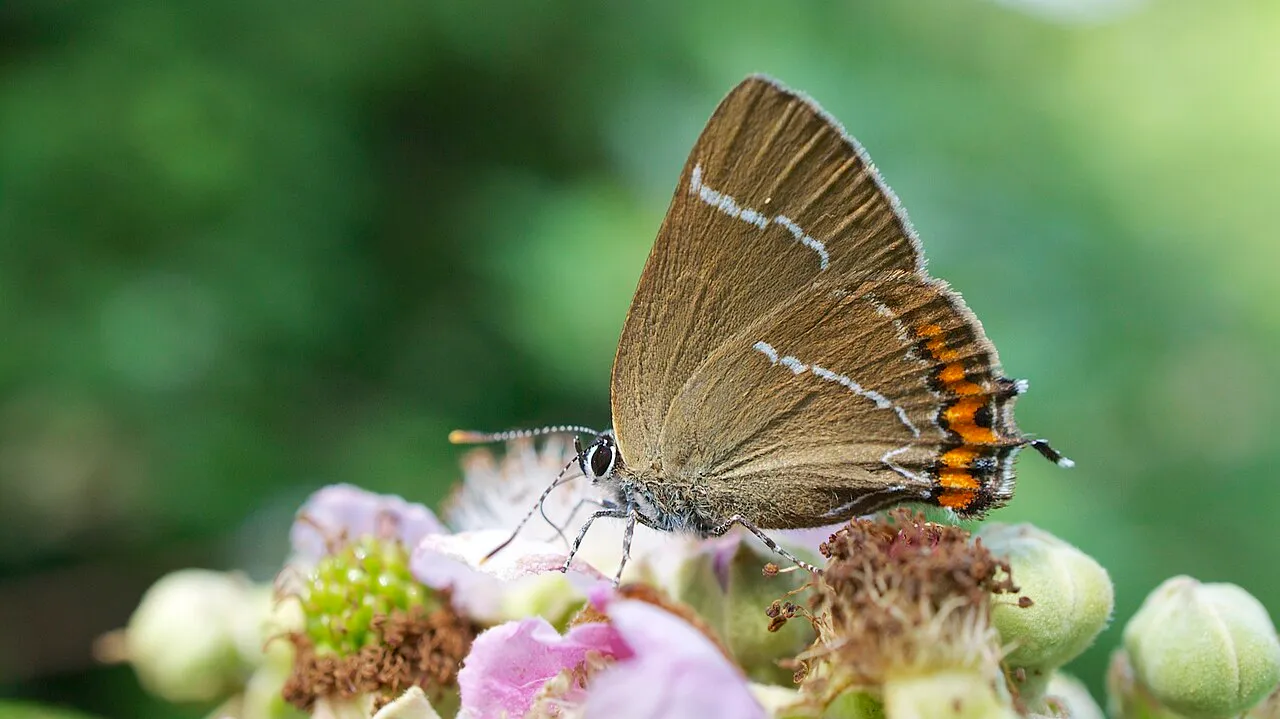
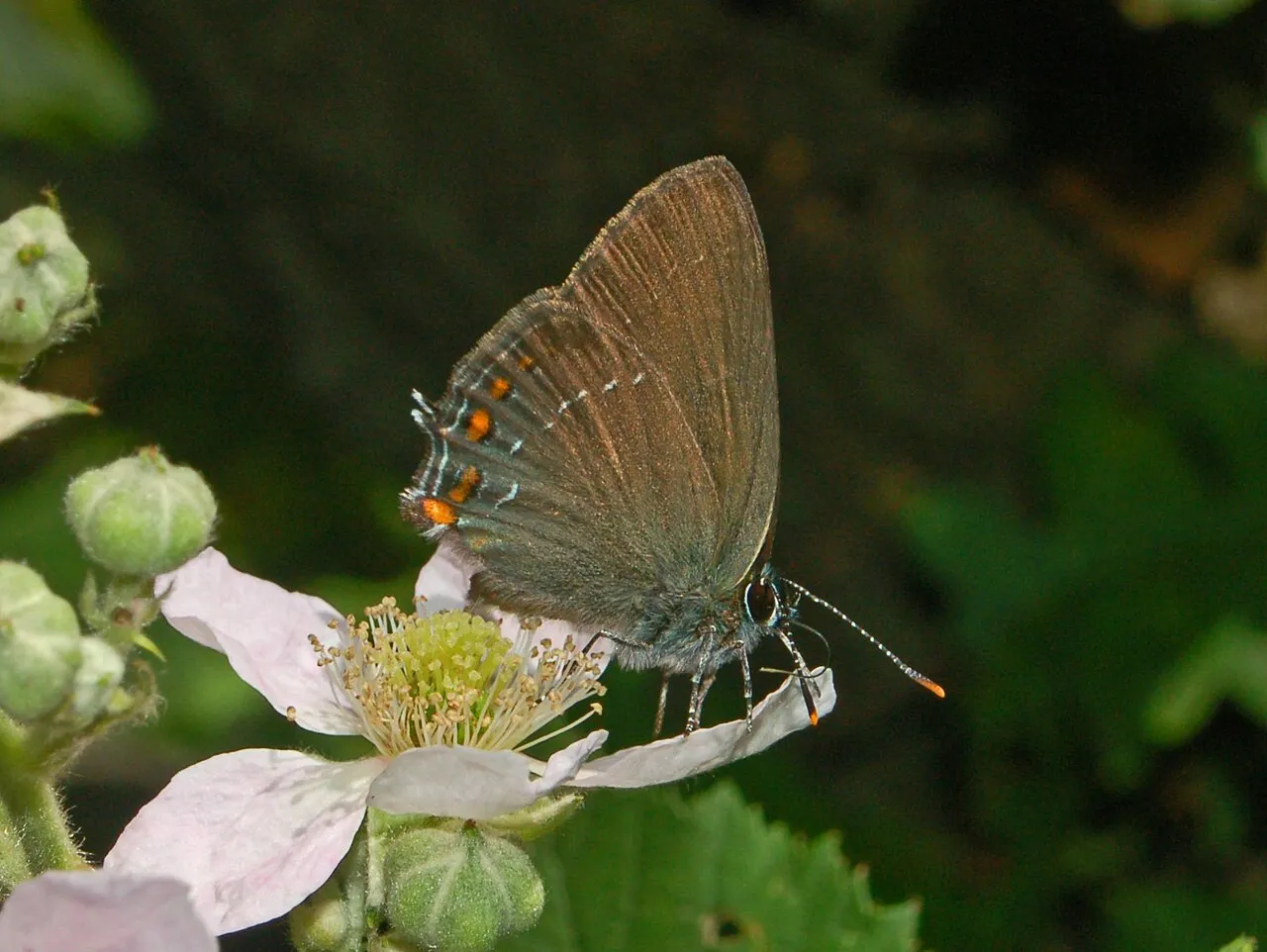
S. ilicis has a wingspan of 32–36 mm1. The basic colour of the wings is brownish. In the females the upperside of the forewings usually shows large patches of orange, while the underside of the hindwings carries orange lunules bordered with black. A series of irregular, broken white markings runs across the underside of both the forewings and the hindwings, and each hindwing has two short tails.
Padfield’s overall impression of the species is of a darker, sleeker butterfly than the false ilex hairstreak, with a strong but broken hairstreak. On the hindwing that line is bordered internally with black, and its sections usually fold into deep “v” shapes near the anal angle, or at least follow a strong curve there. The orange spots on the hindwing have no real hint of red and decrease in size away from the anal angle2.
Of the young stages, the larvae are pale green, about 2 cm long1.
Range and habitat
The species is present in southern and central Europe, Asia Minor and the Caucasus, and also in Transcaucasia, Lebanon, south-western Siberia and the southern Urals. It inhabits woods up to 1600 m1 in elevation.
The Naturalis guide lists its habitats as mixed woodland, heath and shrub3, and deciduous forests. In Switzerland, Padfield finds it in rather hot places in valleys where there are plenty of nectar plants and scattered small oaks. Further south it flies higher in the mountains: it is common along tracks in the Pyrenees up to at least 1600m2, and doubtless higher in places.
Life cycle and host plants
Caterpillars feed on oaks, especially Quercus robur, Q. coccifera and Q. ilex1, as well as Q. petraea and Q. pubescens. Elms (Ulmus species), Rhamnus cathartica and Prunus are also eaten. The larvae are attended by the ants Camponotus aethiops and Crematogaster species.
The female lays her eggs on rather stunted oak trees3, and certainly not on large oaks. Padfield writes that eggs are laid usually on the trunks or low branches of small bushes, some 50 cm or so off the ground, from where the emerging caterpillars can crawl to the leaf buds in spring. He adds that he is not at all sure where the common name comes from2, and that the only eggs he has found have been parasitised.
The tiny caterpillar hibernates in the egg, or in the first larval instar3. It feeds on the young oak leaves and eventually pupates in the litter layer under the food plant. The species is single-brooded.
Behaviour and flight period
It is a univoltine species, and adults fly from late May to early August1. According to Padfield, the butterflies emerge in late May or early June, or perhaps later where they fly at altitude, and he has found abundant fresh adults in the Pyrenees in late July. In the Swiss valleys they may often be seen in good numbers in June and July2.
The adults need nectar. They feed on flowering Common Privet3 (Ligustrum vulgare) and on bramble blossom (Rubus species).
Similar species
- False ilex hairstreak (Satyrium esculi): near the anal angle of its hindwing the sections of the hairstreak are flat or slightly curved, and its orange spots often show a distinct red tinge2 and are more or less the same size. Padfield adds that after a few of each have been seen there is little chance of confusion, except with very worn individuals.
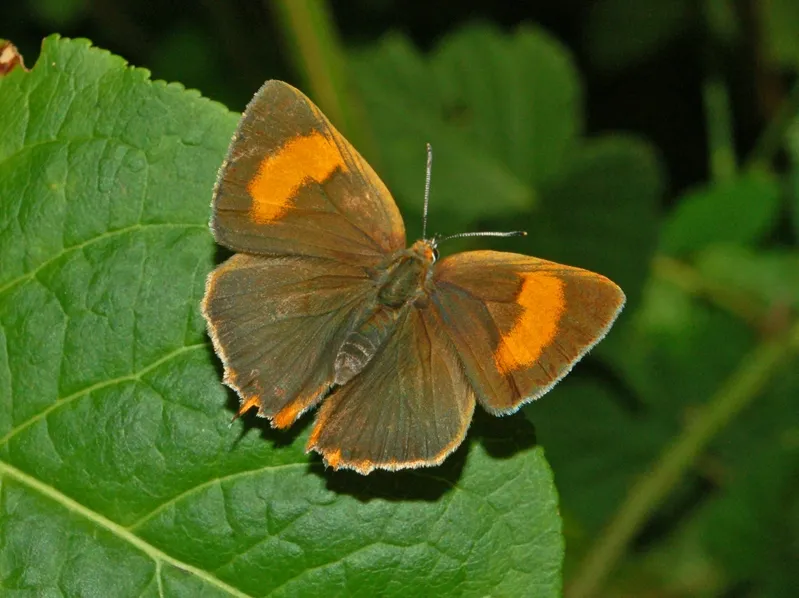
- Brown hairstreak (Thecla betulae): its wingspan is 36–41 mm in males and 39–45 mm in females, its primary larval foodplant is Blackthorn, and in the British Isles the adults are first seen on the wing in late July or early August4.
- White-letter hairstreak (Satyrium w-album): named for the letter “W” formed by a series of white lines on the underside of the hindwings; its wingspan is 25–35 mm5.
- Black hairstreak (Satyrium pruni): its colonies are typically in small woods or nearby hedgerows where Blackthorn, the larval foodplant, grows, and its extremely short flight period peaks in the last 3 weeks of June6.