Contents
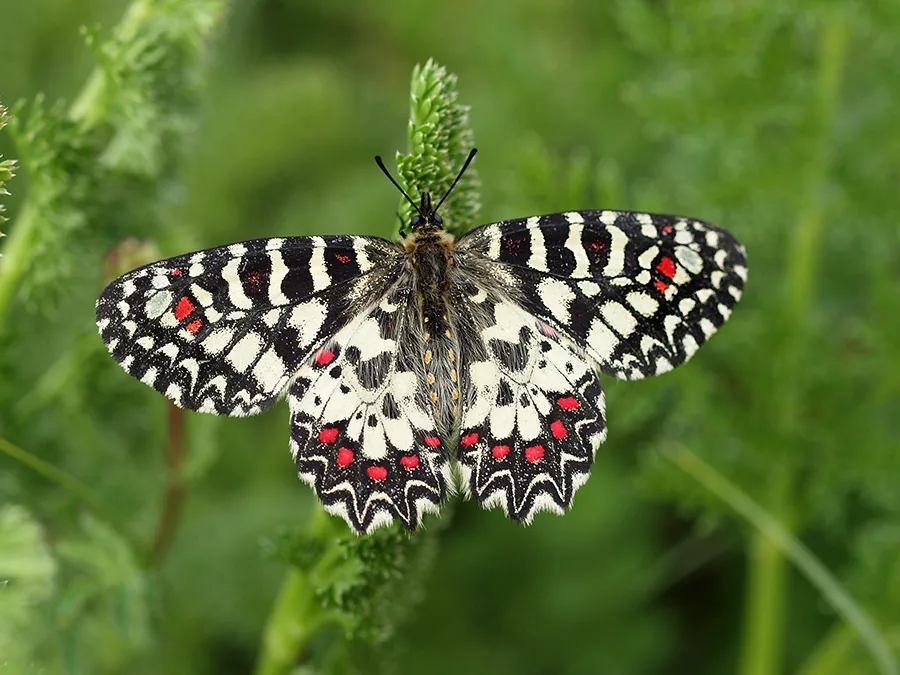
The Spanish festoon, Zerynthia rumina, is a butterfly of the family Papilionidae, first described by Linnaeus in 17581, with extensive red on the forewings that marks it out at a glance. It ranges across North Africa, the Iberian Peninsula and southern France and is widespread in Iberia2.
Identification
The forewings show extensive red, with black parallel cell-bars that are enlarged and separated by thin yellow bands; the underside of the hindwing carries whitish-yellow spots at its base. The amount of red on the forewing varies between individuals, from limited in some to very bright in others, and females tend to have slightly stronger body markings than males3. The species is told apart from the southern festoon (Zerynthia polyxena) by the lack of blue on the hindwing2, which that species carries.
Range and habitat
The Spanish festoon frequents most habitats, including dry siliceous and calcareous grasslands, sclerophyllous scrub, and rocky areas4, and sunny slopes and vineyards2, where it settles especially often on Asphodelus. In France the two species overlap in and around the département of Var, where the Spanish festoon’s range from the Iberian side meets the southern festoon’s range extending west from the east3.
Life cycle and host plants
Caterpillars feed on birthworts (Aristolochia), including A. longa, A. rotunda and A. pistolochia; in southern France it has been recorded on Aristolochia pistolochia, a low-growing plant reaching about 25 cm at most, and the species never wanders far from the hostplant3. The caterpillar is yellow, red or blackish, with short pale stripes, and the pupa is grey-brown, variegated with black. The species overwinters as a chrysalis, and development can occasionally take two to three years before the adult emerges from the chrysalis4. It flies in one generation a year, with a possible small partial second brood in September2.
Behaviour and flight period
Adults fly generally in April and May, emerging as early as February in the south and late March in northern Spain2; in southern France it emerges slightly later than the southern festoon and stays on the wing until the third week of May3. Adults are sun-basking butterflies, often seen with wings spread flat on stones to warm themselves, and females lay their eggs singly or in small groups4 on the host plants.
Similar species
- Southern festoon (Zerynthia polyxena): has an easterly distribution3, found across southern and southeastern Europe. The two overlap in southeastern France, where the Southern festoon is told apart by blue spots on its hindwings5, which the Spanish festoon lacks.
_13MRxF.webp)
_(Apollo)_-_(imago)__Triglavski_narodni_park_NP__Slovenia_Z1ilv4V.webp)