Contents
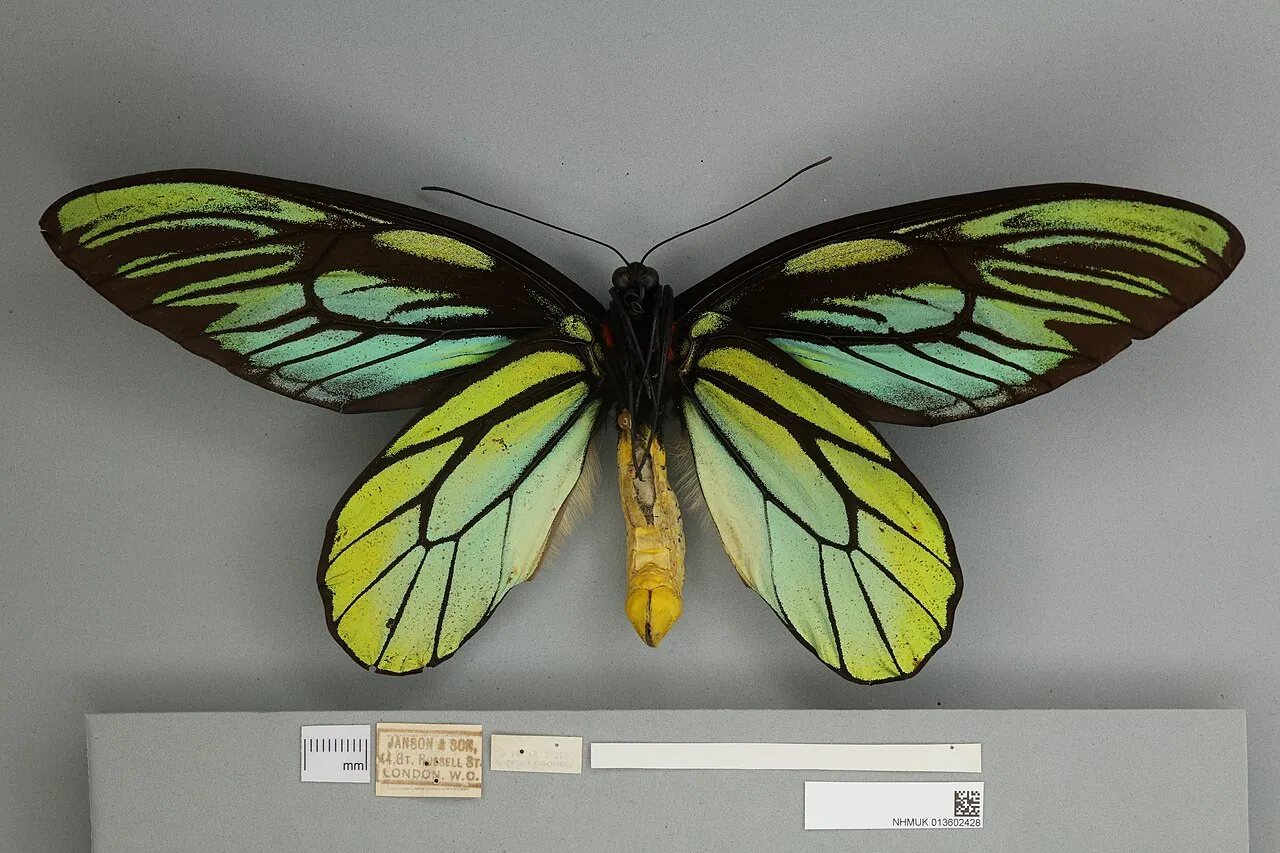
Queen Alexandra’s birdwing, Ornithoptera alexandrae, is the largest species of butterfly in the world, a member of the swallowtail family Papilionidae. It is restricted to the forests of Oro Province in eastern Papua New Guinea, where it depends on old-growth rainforest and a single group of caterpillar food plants found nowhere else. The species was discovered in 1906 by Albert Stewart Meek, a collector employed by Walter Rothschild, who named it the following year in honour of Alexandra of Denmark.
Identification
The female is the larger sex by far, with wingspans slightly in excess of 25 to 28 cm (10 to 11 in), a body length of 8 cm (3.1 in) and a body mass of up to 12 g (0.42 oz). Males are much smaller, with a wingspan of approximately 20 cm (8 in), but more usually about 16 cm (6.3 in).
The sexes also look very different. The female has brown wings with white markings arranged as two rows of chevrons, and hindwings that are brown with a submarginal line of centred yellow triangles; her body is cream coloured, with a small section of red fur on the brown thorax. The male is far more colourful, iridescent bluish green with a black central band above and green or blue-green with black veins beneath, with a bright yellow abdomen and a pronounced sex brand used to disperse pheromone. A rare form, atavus, has gold spots on the hindwings.
Range and habitat
The species is restricted to approximately 100 km2 (40 mi2) of coastal rainforest near Popondetta, Oro Province, in eastern Papua New Guinea, and requires old-growth rainforest for its long-term survival.
Life cycle and host plants
Caterpillars feed only on pipevines of the genus Pararistolochia, specifically P. dielsiana and P. schlechteri. A female can lay over 240 eggs throughout her life; the eggs are large, light yellow and flattened at the base, fixed to the surface on which they are laid by a bright-orange substance. Newly hatched larvae eat their own eggshells before feeding on fresh foliage; they are black with red tubercles and a cream-coloured band or saddle in the middle, and can ringbark the host vine before pupating. Development from egg to pupa takes approximately six weeks. The pupa is golden yellow or tan with black markings, with males distinguished by a faint charcoal patch on the wing cases, and the pupal stage lasts a month or more, with adults emerging from the pupae early in the morning while humidity is still high. An adult may live for three months or more.
Behaviour and flight period
Adults are most active in the early morning and again at dusk. Flight is usually high in the rainforest canopy, but both sexes descend to within a few metres of the ground to feed or find mates. Adults feed at flowers that provide a broad platform for landing, including Hibiscus. Males patrol the host plants for newly emerged females early in the morning, while females spend most of the day searching for host plants on which to lay. Courtship is brief but spectacular: a male hovers above a potential mate, dousing her with a pheromone to induce mating. Males are strongly territorial and will chase off rival males, small birds and other birdwing species. Known predators include large orb-weaving spiders of the genus Nephila and some small birds.
Conservation
The species is shown in the facts box as endangered, a status confirmed by its Wikidata record. Its tiny range makes it exceptionally vulnerable: an eruption of nearby Mount Lamington in the 1950s destroyed a very large area of the species’ former habitat, and today habitat destruction for oil palm plantations is the main threat. The butterfly is also highly prized by collectors, and is one of only four insects listed on Appendix I of CITES, which makes international commercial trade illegal. Prosecutions over the illegal trade have followed: in 2001 a collector was fined CA$50,000 for illegally importing six specimens, and in 2007 a butterfly smuggler pleaded guilty to 17 charges, including selling a pair of Queen Alexandra’s birdwings priced at US$8,500.
Similar species
- Common green birdwing (Ornithoptera priamus): a widespread relative found across New Guinea and nearby islands, far smaller and much less restricted in range.
- Queen Victoria’s birdwing (Ornithoptera victoriae): another large Papua New Guinea birdwing, confined to the Solomon Islands rather than the mainland.
_(6-25-2016)_denali_highway__mile_p13_pass__near_paxson__alaska_(7)_(28788418100)_9KfLF.webp)
_(Apollo)_-_(imago)__Triglavski_narodni_park_NP__Slovenia_Z1ilv4V.webp)
_13MRxF.webp)