Contents
The black swallowtail, Papilio polyxenes, is a butterfly of the swallowtail family, Papilionidae, found throughout much of North America. Its caterpillar is often called the “parsleyworm” because it feeds on parsley. Other names for the species are American swallowtail and parsnip swallowtail1.
Identification
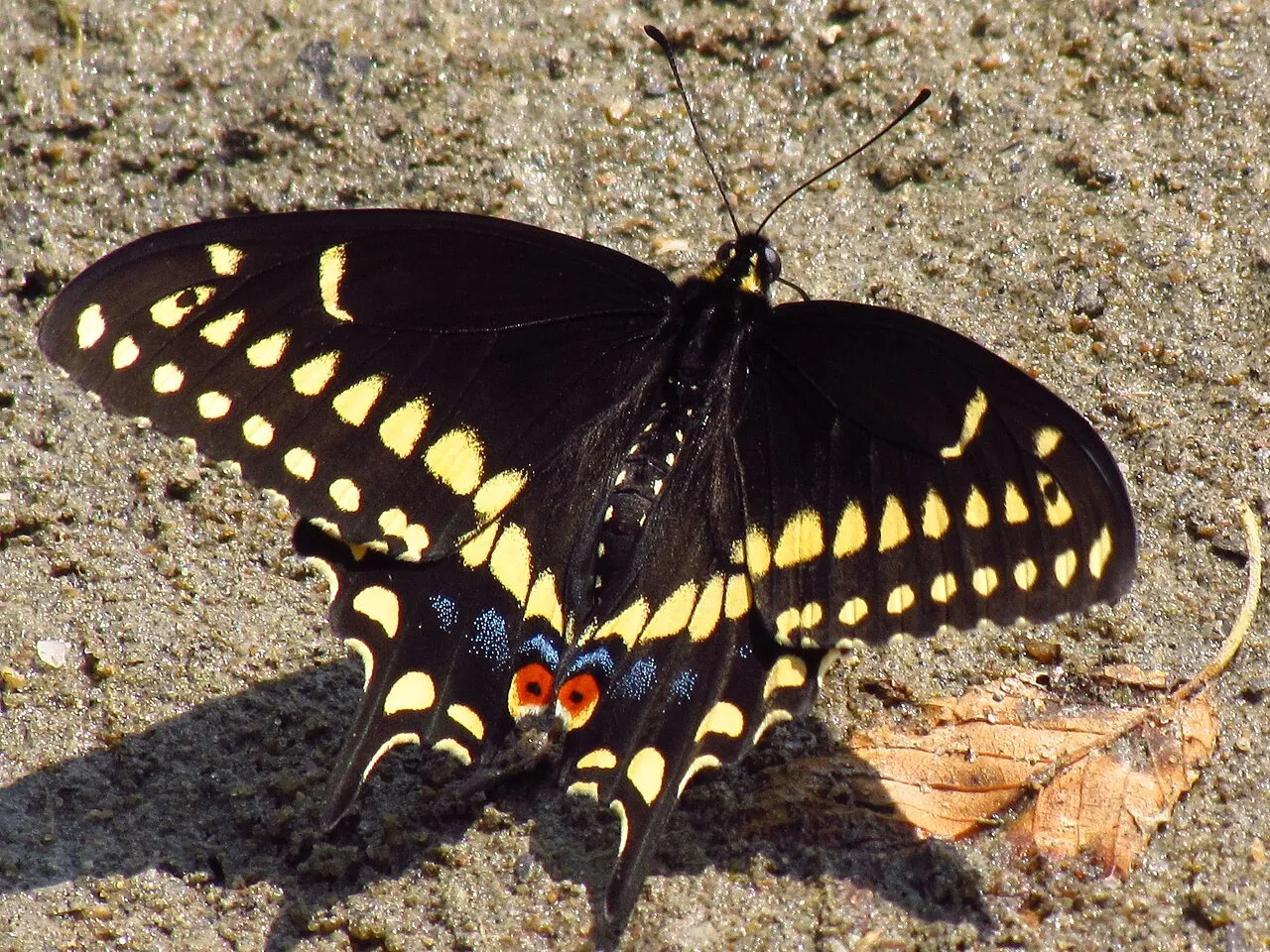
Butterflies and Moths of North America gives a wingspan of 8–11 cm; Animal Diversity Web gives a wingspan of up to 11.5 cm3. The upper surface of the wings is mostly black, and on the inner edge of the hindwing is a black spot centered in a larger orange spot2.
The sexes differ on the upperside. The male has a yellow band near the edge of the wings, while the female has a row of yellow spots and a hindwing with an iridescent blue band. On the hindwing, males carry iridescent blue spots3 rather than a band. In the Southwest, yellow forms predominate in the subspecies P. p. coloro2.
Under the forewing there are yellow spots, and the underside of the hindwing has a row of orange-red spots in front of blue caps3, followed by black-centred red spots towards the tail.
The young stages vary in colour. Older caterpillars vary from green to yellow, and most often each segment is crossed by a black band. Pupae can be green and yellow, brown and white, or a black form3.
Range and habitat
The range runs through most of the eastern U.S.2, north into Quebec, west into southern Saskatchewan, Colorado and south-eastern California, and south to northern South America, per Butterflies and Moths of North America. Animal Diversity Web places the species from southern Canada down to South America, including the West Indies, and notes that in North America it is not commonly found west of the Rocky Mountains3. The subspecies P. p. polyxenes, once found in Cuba, is considered likely extinct according to a 2020 field guide to Cuban butterflies1.
It lives in a variety of open areas, including fields, suburbs, marshes, deserts and roadsides2. Animal Diversity Web adds meadows, parks, gardens and lowlands3.
Life cycle and host plants
Caterpillars eat the leaves of plants in the parsley family (Apiaceae), including Queen Anne’s lace, carrot, celery and dill; sometimes plants in the citrus family (Rutaceae)2 are preferred. Parsley-family plants produce chemicals known as psoralens that repel insects, but the larvae are resistant to these psoralens3, which make the caterpillar bad-tasting to bird predators. When threatened, the caterpillar everts an orange forked gland, the osmeterium, which releases a foul smell1 to repel predators.
Females lay round, cream-colored eggs on the leaves of parsley-family plants, on average 200–440 eggs, 30–50 per day3. The egg stage lasts 4–9 days, the larval stage 10–30 days and the pupal stage 18 days1. The species hibernates as a chrysalis2.
Where the eggs are laid matters for survival. A 1985 study near Ithaca, New York, found that eggs laid on wild carrot or parsnip were more likely to survive to the fifth instar than eggs laid on a third host plant in the study. In all cases, the primary cause of mortality was predation1.
Adults take nectar from flowers including red clover, milkweed and thistles2, and Animal Diversity Web records adults feeding on flower nectar and mud3.
Behaviour and flight period
There are one or two flights from April to October in the northern part of the range, and three flights in southern regions2.
To find a female, males alternately perch on the tops of hills and patrol in flat areas, defending territories of about 70 square meters. About 67% of their day is spent perching, 25% patrolling, 6% feeding and 2% interacting with other butterflies. Courtship lasts about 45 seconds, and the coupling lasts from 30 to 45 minutes3.
Adult black swallowtails mimic pipevine swallowtails, a distasteful species. While black swallowtails are distasteful as a larva, they are palatable as adults, and by mimicking the pipevine swallowtail they gain some protection where their ranges overlap3.
Conservation
The black swallowtail is listed as Least Concern on the IUCN Red List 2022.24. Butterflies and Moths of North America describes it as not usually of concern, with the management need to maintain open fields in the East2.
Similar species
- Pipevine swallowtail (Battus philenor): similar black-blue upper wings, just lacking the yellow and blue markings3 of the black swallowtail.
- Ozark swallowtail (Papilio joanae): nearly identical to the black swallowtail; its face is yellow, and the black pupil in the hindwing eyespot is not centered and touches the inner edge5.
- Spicebush swallowtail (Papilio troilus): its forewing upperside is mostly black with ivory spots along the margin, and its hindwing has an orange spot on the costal margin6.