Contents
The eastern tiger swallowtail, Papilio glaucus, is a butterfly of the family Papilionidae1, native to eastern North America. It is the state butterfly of Alabama, Delaware, Georgia, North Carolina and South Carolina2, and the state insect of Virginia. It was also the first American insect pictured in Europe3, from a drawing sent to England from Sir Walter Raleigh’s third expedition to Virginia.
Identification
The wingspan runs from 6.2 to 11.4 cm1. Females are the larger sex2, and southern individuals are larger than northern ones.
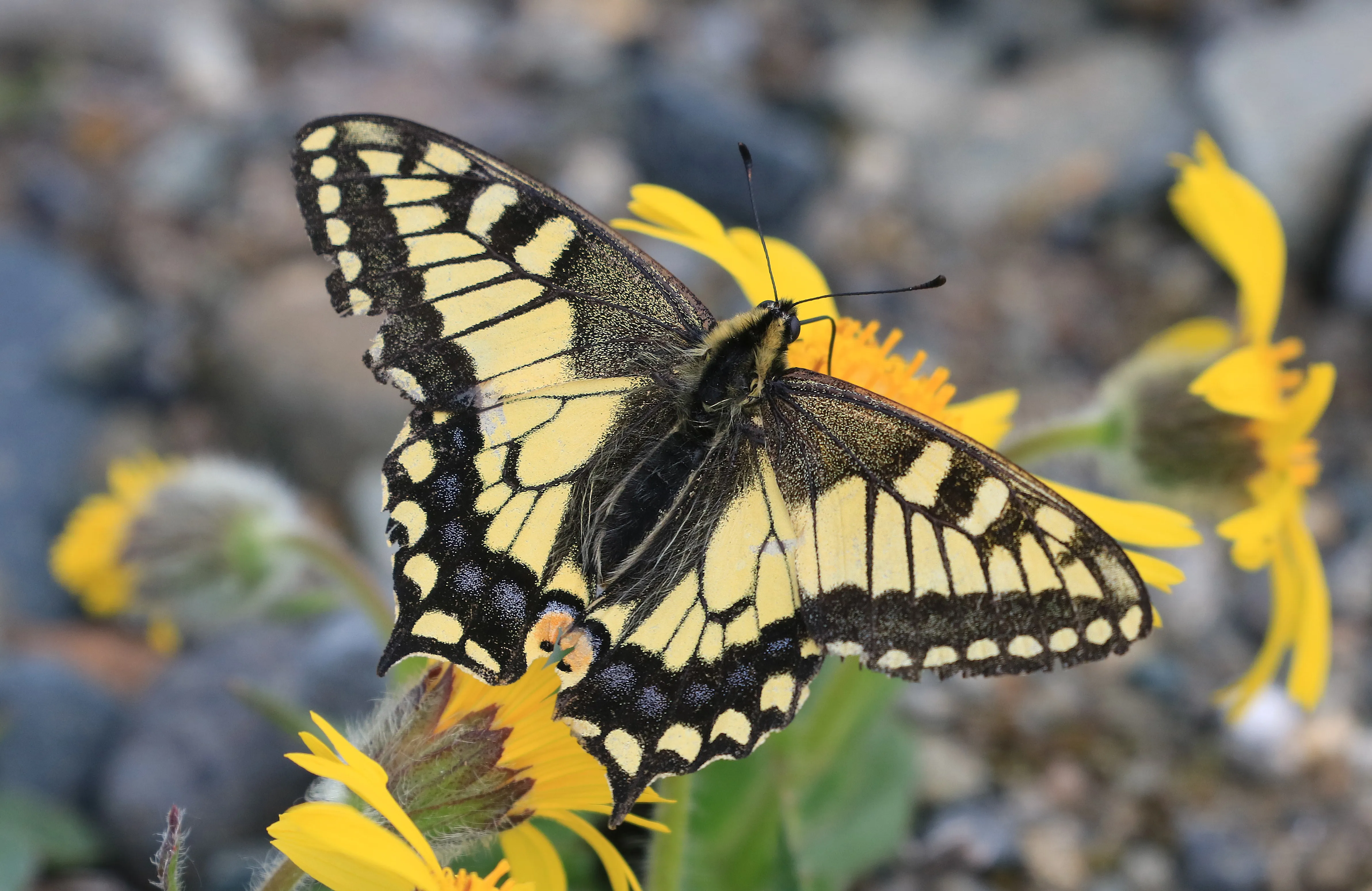
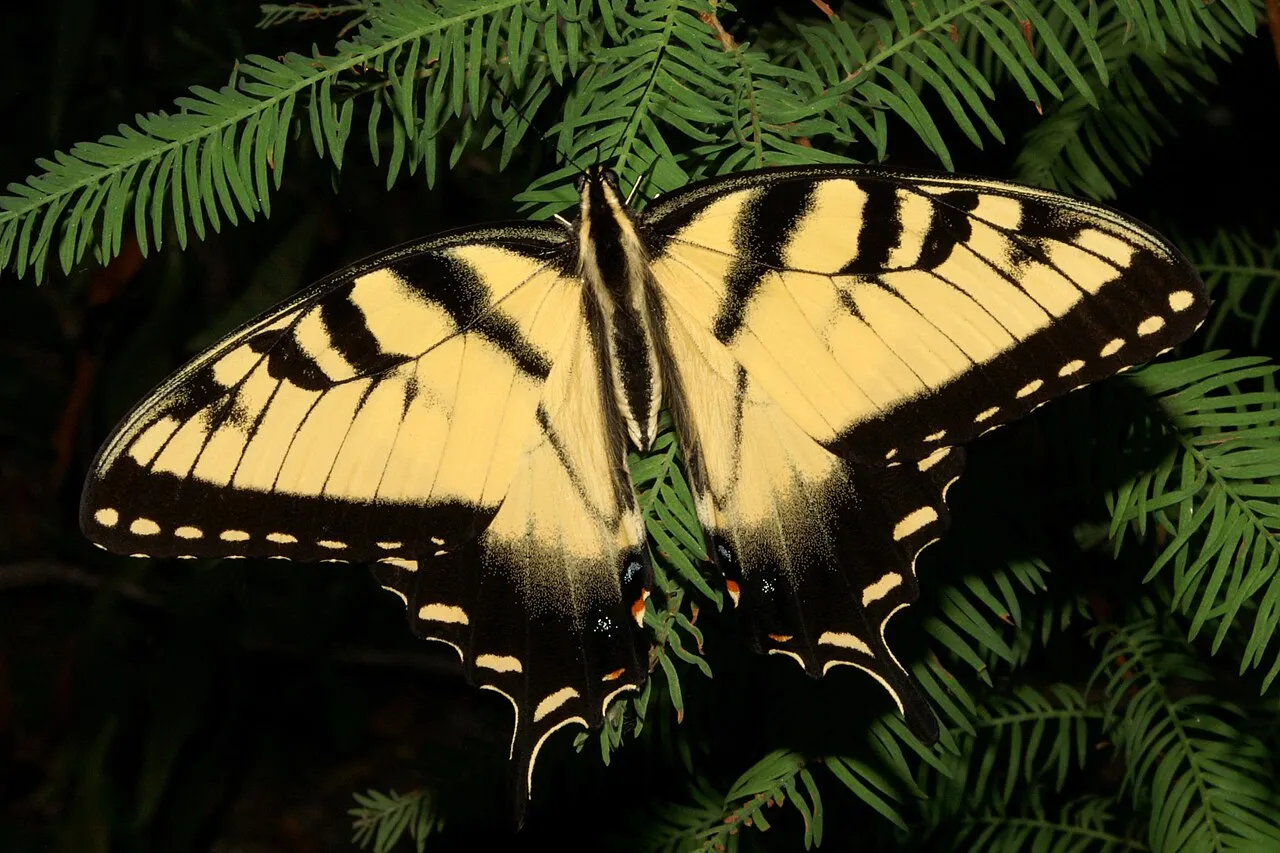
The male is yellow with dark tiger stripes1, and the outer edge of its forewing is black with a row of yellow spots2. In Georgia the colouring has more of an orange hint3, and the name australis has been applied to these southeastern tiger swallowtails.
The female has two forms, one yellow like the male and the other black with shadows of dark stripes. The hindwing of both female forms has a row of striking blue chevrons and an iridescent blue wash over parts of the interior hindwing. On the upperside hindwing, a prominent orange marginal spot1 is generally larger than the row of pale marginal spots.
On the underside, the forewing margin has a yellow bar that is broken into spots, present in both sexes and used to tell P. glaucus from its close relatives. In spring individuals, though, the row of marginal spots may be merged into a continuous band1, so that they look like the Canadian tiger swallowtail. In the dark female, the bluish area on the underside hindwing has one row of orange spots2.
The egg is round and green, later turning yellowish green with reddish dots. The first three caterpillar instars are brown, with a white saddle on the abdomen; from the fourth instar the caterpillar is green, with two black, yellow and blue eyespots on its swollen thorax. It reaches 5.5 cm and turns dark brown before it pupates. The chrysalis varies from off white to dark brown2.
Range and habitat
The range covers eastern North America from Ontario south to the Gulf coast1, west to the Colorado plains and central Texas. In 1991 the subspecies canadensis was raised to a species2, which reduced the range of P. glaucus, and in 2002 the closely related P. appalachiensis was described from the southern Appalachian Mountains.
It lives in deciduous broadleaf woods, forest edges, river valleys, parks and suburbs1. It occurs in nearly every area where deciduous woods are present, including towns and cities, and is most numerous along streams and rivers, and in wooded swamps3.
Life cycle and host plants
There are two broods in the north, three in the south. Females lay eggs singly on host leaves, preferring host plants near nectar sources, and the eggs take between 4 and 10 days to hatch2. The caterpillars eat leaves and rest on silken mats1 on the upper surface of leaves.
Recorded food plants include wild cherry, sweetbay, basswood, tulip tree1, birch, ash, cottonwood, mountain ash and willow (Prunus, Magnolia, Tilia, Liriodendron, Betula, Fraxinus, Populus, Sorbus, Salix). The larvae are polyphagous3, and their food plants also include apple, maple and occasionally sassafras. One account cautions that aspens, birches and willows2 have been recorded as host plants in older literature, but are used by P. canadensis.
The first three instars are bird dropping mimics; in later instars, the eyespots on the thorax serve to deter birds. Like all members of the family, the caterpillar has an osmeterium2, an orange, fleshy organ that emits foul-smelling terpenes and can be everted when the caterpillar feels threatened.
The chrysalis hangs from a surface by a silk girdle around the thorax and a silk pad at the base. Chrysalids overwinter1; otherwise the stage lasts nine to eleven days2.
Behaviour and flight period
The species has 3 flights from February to November in the Deep South and 2 flights from May to September in the north1.
Males patrol for receptive females1, and patrolling males can recognise areas of high moisture by their sodium ion concentration. Both sexes are known to be high fliers: groups of fifty butterflies have been seen in Maryland flying 50 metres high3, around the tops of tulip trees.
Adults take nectar from wild cherry and lilac, and milkweed and Joe-Pye weed are favourites in summer1.
Since adults are palatable, dark females use Batesian mimicry of the pipevine swallowtail to protect themselves from vertebrate predators. Dark females are more prevalent in the south2, where the pipevine swallowtail is more common.
Similar species
- Canadian tiger swallowtail (Papilio canadensis): smaller than the eastern tiger swallowtail, and the underside of its forewing has marginal yellow spots merged into a continuous band. It has one flight, from May to mid-July4.
- Appalachian tiger swallowtail (Papilio appalachiensis): larger, with narrower vertical black stripes, and both female forms have a markedly reduced iridescent blue wash on the upperside hindwing. Its orange marginal spot is generally smaller than the row of pale marginal spots5.
- Pipevine swallowtail (Battus philenor): the model the dark female mimics; it differs from the dark female by the row of light-colored spots on each wing margin2.
- Spicebush swallowtail (Papilio troilus): more greenish, with two rows of orange spots2 on the underside hindwing.