Contents
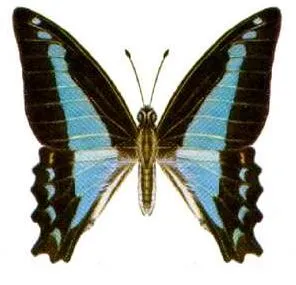
The Common Bluebottle, Graphium sarpedon, is a swallowtail butterfly of the family Papilionidae, named for the broad pale blue band that crosses its otherwise black wings. It ranges across East, South and Southeast Asia, including India, Sri Lanka, Japan, Taiwan, China, the Philippines, Malaysia, Indonesia and Vietnam, and eastern Australia, with about sixteen subspecies across this range. Despite the name, it carries no tails on its hindwings, unlike many of its swallowtail relatives.
Identification
The Common Bluebottle has a wingspan of 55 to 75 mm. The upperside is opaque black, crossed from above the tornal area of the hindwing to near the apex of the forewing by a broad, semi-hyaline pale blue medial band. That band is broadest in the middle and more or less greenish and macular toward the front, while the section crossing the hindwing turns white. The underside shows a dark brown ground colour, with the velvety black postdiscal areas of the hindwing crossed by pale veins and narrow crimson lines, and a crimson spot near the tornal angle.
The sexes are similar, but a male can be told by an abdominal fold that is grey within and carries a tuft of long, stiff white hairs. The species is also visually unusual among butterflies for its eyes, which carry fifteen types of colour-detecting opsins in their retinal cells.
Range and habitat
The Common Bluebottle lives in moist, low-level rain forest below about 1600 m, where it is usually seen flying just above the tree canopy. Its wide Asian and Australian range spans India, Sri Lanka, Japan, Taiwan, China, the Philippines, Malaysia, Indonesia, Vietnam and eastern Australia, with named subspecies including G. s. sarpedon in India and Sri Lanka, G. s. nipponus in Japan, G. s. connectens in Taiwan and China, and G. s. choredon in eastern Australia.
Life cycle and host plants
Caterpillars feed on trees in the laurel, myrtle, sapodilla and citrus families, including cinnamon, camphor and species of Cinnamomum and Litsea. The egg is yellowish and laid singly on a host leaf. The young caterpillar is black or dark green and covered in numerous spines; the mature caterpillar turns green, with short spines on each thoracic segment and the anal segment, a transverse yellow band on the fourth segment and a lateral band along the body. It usually rests on the centre of a leaf’s upper surface, is very sluggish, and pupates near its own feeding spot; the chrysalis is green, with a slender, pointed thoracic projection, yellowish wing cases and lateral bands.
Adults feed on nectar from a variety of flowering herbs, including lantana (Lantana camara).
Behaviour and flight period
This is a fast, alert flier, known for quick flight and rapid reactions that make it difficult to catch. Males have a habit of gathering at the edges of puddles, often at the roadside, with as many as eight sometimes seen at the same puddle; they are also drawn to animal droppings, carcasses and rotting insects. The species also moves in numbers: it has been recorded as a migrant in South India, where it made up as much as 5% of the migrating butterfly population counted over a 72-hour period in the Nilgiri hills.
Conservation
Its IUCN status, shown in the facts box, comes from the species’ Wikidata record. With sixteen subspecies spread across a wide swath of Asia and Australia, and with a wide-ranging migratory habit noted above, the Common Bluebottle is not a species confined to one fragile pocket of habitat.
Similar species
- Tailed Jay (Graphium agamemnon): another fast-flying Asian Graphium with pale green, not blue, spots banding its black wings, and short tails on the hindwings that the Common Bluebottle lacks.
- Common Jay (Graphium doson): closely related and similarly patterned, with a comparable blue-green band, but the band is narrower and broken into more separate spots.
_(6-25-2016)_denali_highway__mile_p13_pass__near_paxson__alaska_(7)_(28788418100)_9KfLF.webp)
_(Apollo)_-_(imago)__Triglavski_narodni_park_NP__Slovenia_Z1ilv4V.webp)
_13MRxF.webp)