Contents
The Asian swallowtail, Papilio xuthus, is a yellow, medium to large swallowtail1 found in northeast Asia, northern Myanmar, southern China, Taiwan, the Korean Peninsula, Japan, Siberia and the Hawaiian Islands. It belongs to the genus Papilio in the family Papilionidae, and its caterpillars feed on plants of the family Rutaceae. Other names for it are Chinese yellow swallowtail, Japanese swallowtail, Korean swallowtail and Xuthus swallowtail.
Identification
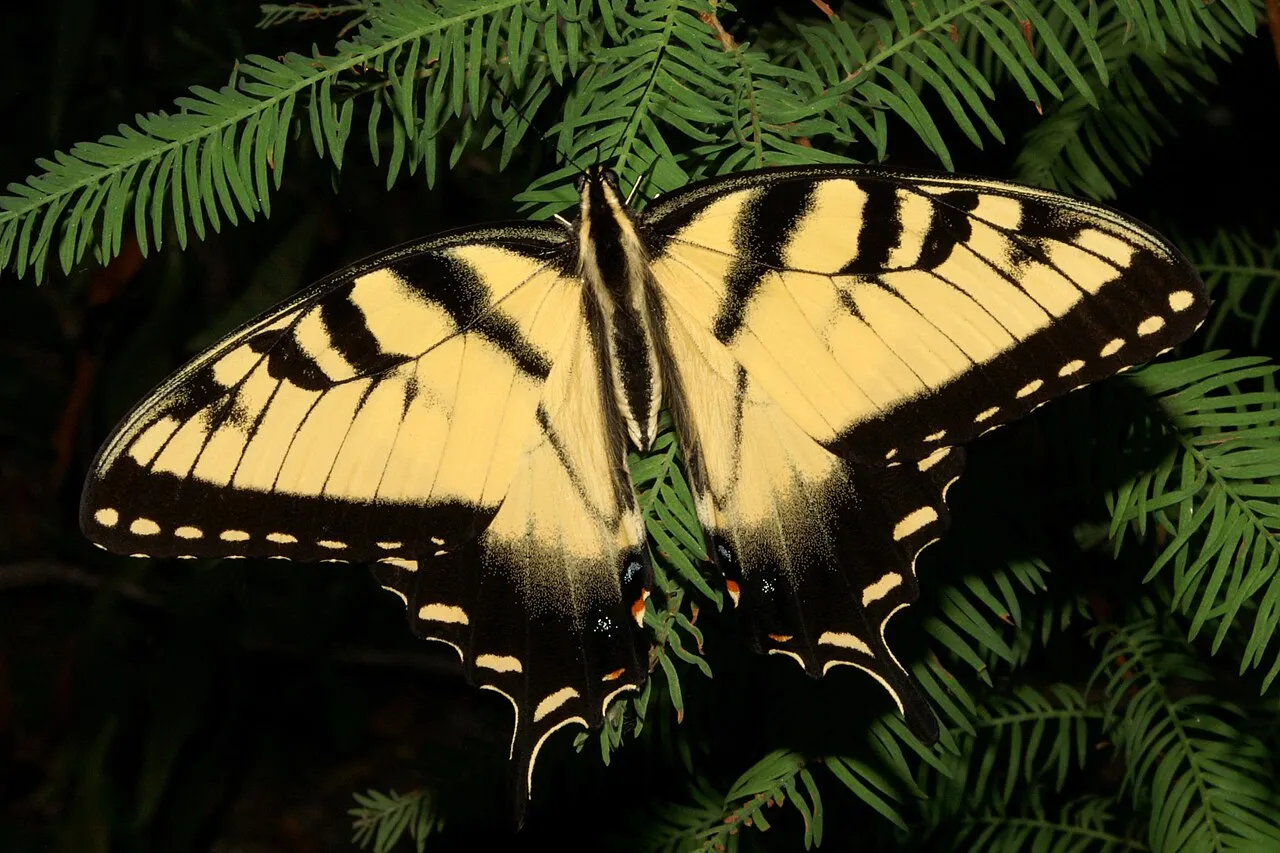
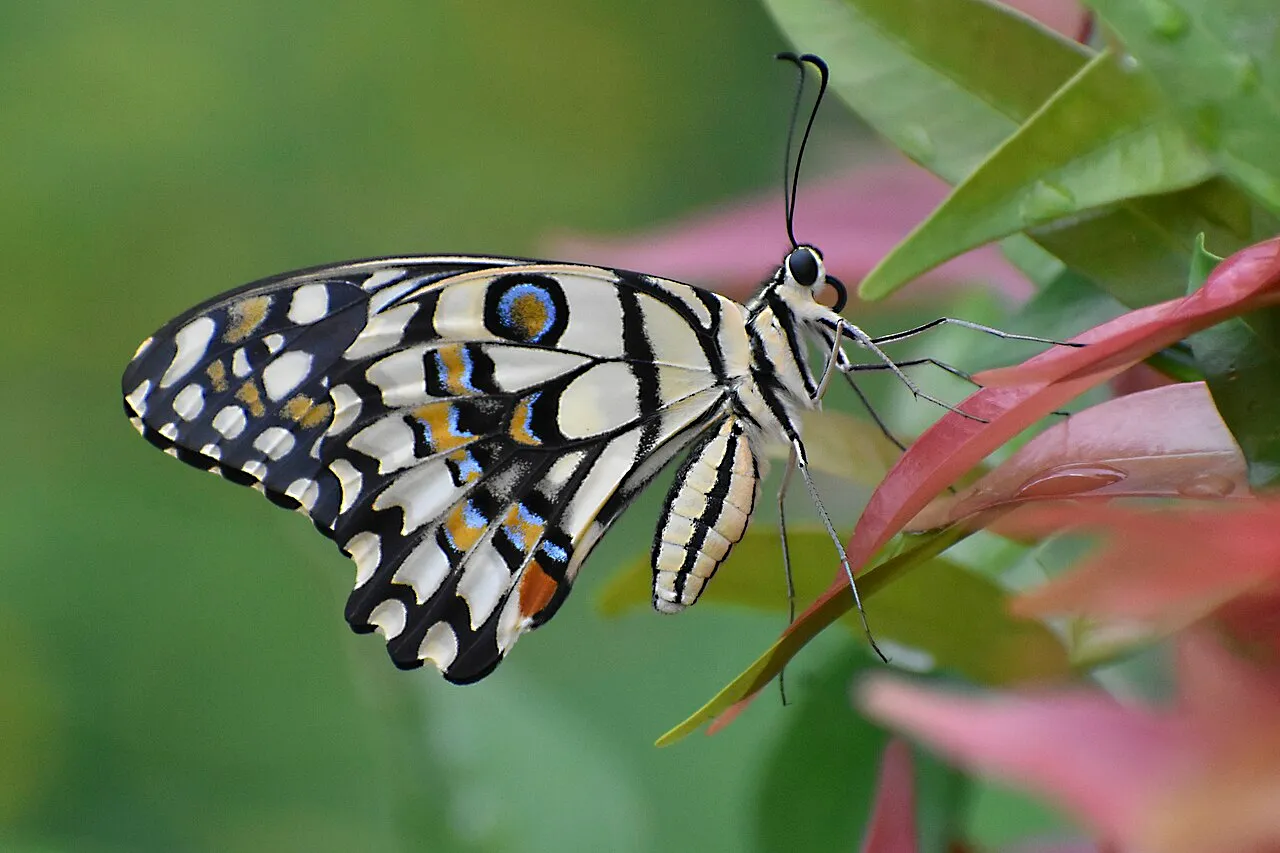
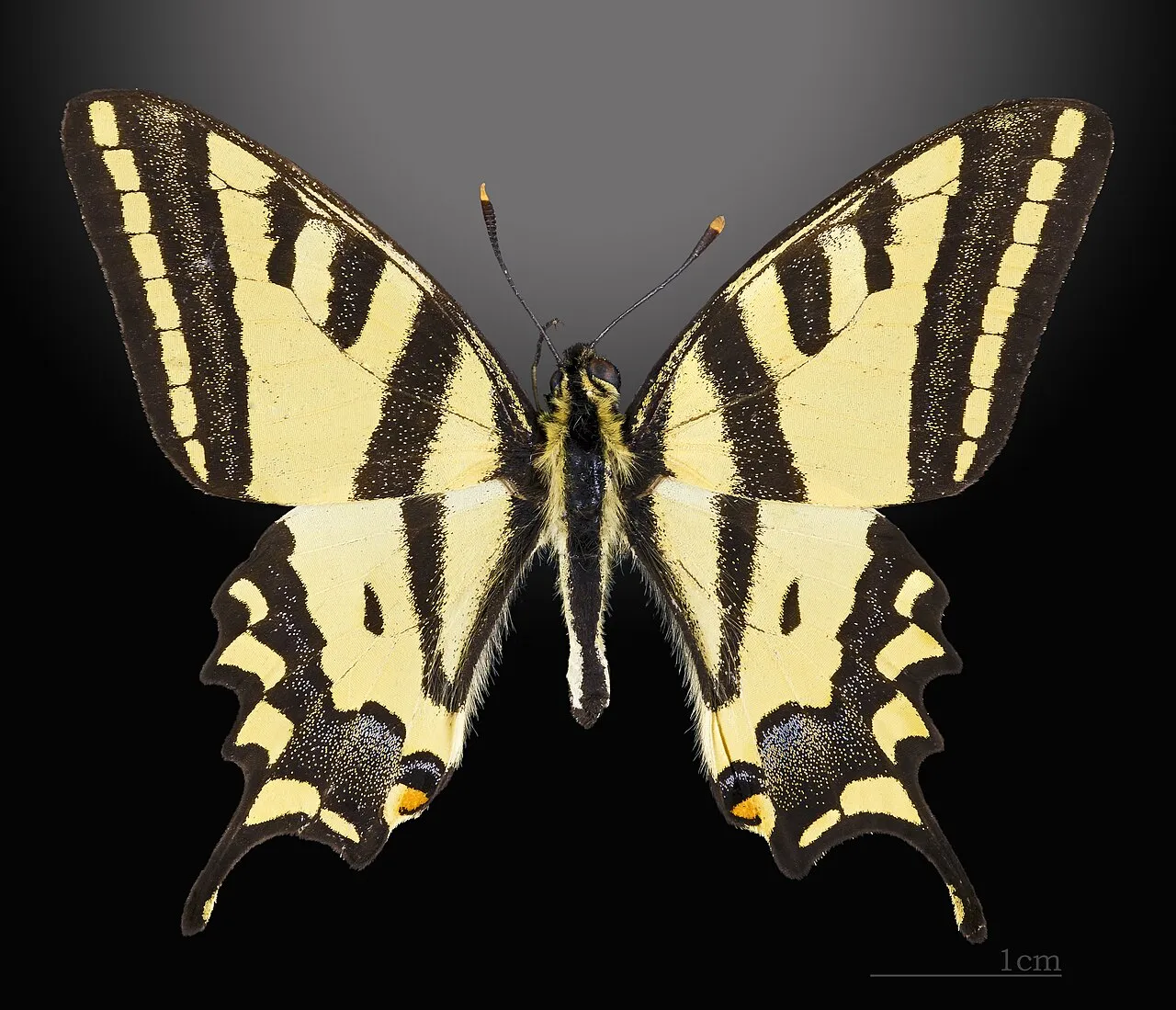
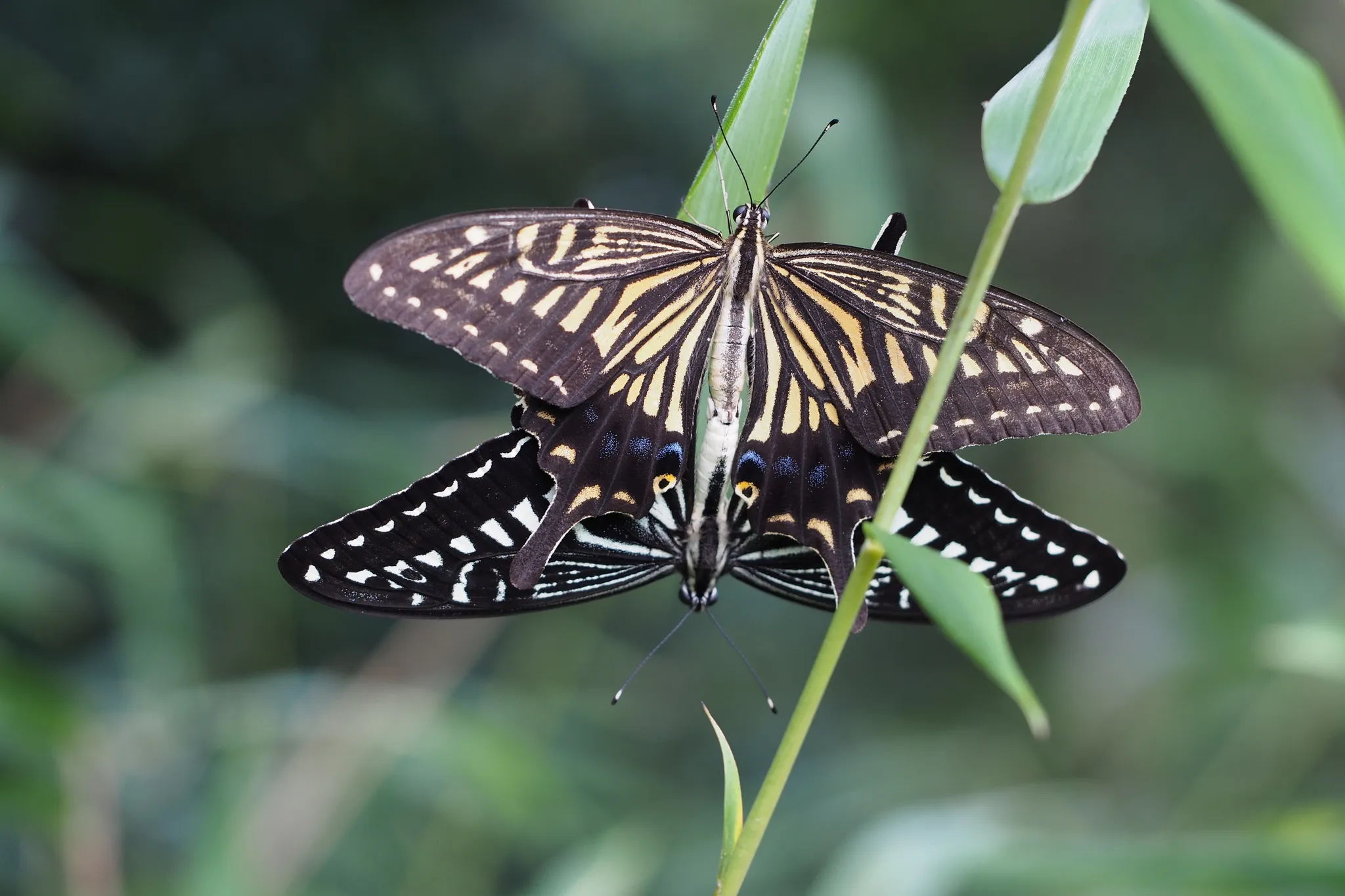
This mid-sized, yellow butterfly has prominent tails and a wingspan of 90 to 110 mm1. Its normal pattern is black on a yellow background, with black bands running in stripes of varying thickness along the forewing; on the hindwing, blue-iridescent and orange scales separate the black bands. Wing colour differs between the sexes: females show broader proximal marginal bands in the hindwing.
A study of the Japanese yellow swallowtail’s wing scales found that in the cream and orange scales, papiliochrome pigment is concentrated in the ridges and crossribs, while in the black scales the upper lamina contains melanin. The blue scales are unpigmented, and their colour is created by an optical multilayer in the lower lamina together with a fine-structured upper lamina. The most colourful patches sit on the lower region of the hindwings, on both wing sides2, upperside and underside alike.
Size also changes with the season. Adults emerging in spring from pupae that spent the winter in diapause have smaller bodies3 than adults emerging in summer from pupae that did not undergo diapause.
The young caterpillar mimics bird feces1 and has a white and brown spot on its head. As it matures, the caterpillar develops a light green body colour with brown spots.
Range and habitat
It was first introduced in Hawaii in 1971, from Japan or Guam, and Butterflies and Moths of North America4 gives its range in the region as introduced to Hawaii. It has been observed three times in New Zealand1: in Dunedin in 1996, emerging from a chrysalis in a car yard specialising in Japanese used cars, and later in Auckland in 2011 and 2016. It was also recorded in the Indian state of Arunachal Pradesh in 2014.
It is common in urban and suburban areas, woods and orange orchards, and it makes seasonal migrations of over 200 km1. Despite its wide distribution, its populations are described as stable at a relatively low level.
Life cycle and host plants
The larvae feed on plants of the family Rutaceae. Recorded food plants include Phellodendron amurense, Poncirus trifoliata and Zanthoxylum species1 such as the Japanese pepper tree (Z. piperitum), as well as cultivated Citrus species such as mandarin orange and yuzu, and rue (Ruta graveolens).
A Hiroshima University study compared four typical Rutaceae hosts of Papilio in Japan. Both females and larvae were successfully adapted to Citrus unshiu while Orixa japonica was completely rejected by ovipositing females and larvae. Females only marginally accepted Fagara ailanthoides. The authors attributed these choices to the females’ responses to stimulants and deterrents coexisting in the plants5.
Females lay single eggs on leaves of host plants. They decide how many eggs to lay in each subhabitat by the quality of the subhabitat, the adult population already in the area, the quantity of young leaves nearby, the degree of sun exposure and the height of the host plant, and they prefer sunnier areas. The larval stage lasts approximately three to five weeks and the pupal stage around two weeks1.
The winter is spent as a pupa in diapause, which is induced by short-day conditions typical of autumn. In rearing trials, larvae that went on to diapause had shorter development times and higher growth rates than those that did not. The authors suggest this plasticity may help the butterfly cope3 with the unpredictable length of the growing season before winter.
Some insects, such as Oecanthus longicauda, can remove the larvae from their eggs1 before they hatch, and in the first and second instars the main predators are ants (particularly Lasius niger), spiders and various other bugs. Wasps such as Trogus mactator and Pteromalus puparum may parasitise the caterpillars and kill them after pupation. Larval deaths from disease appear to correlate with the duration of the rainy season.
Behaviour and flight period
The flight period is from May to August. There are typically four to five generations per year1, with first-generation adults emerging from mid-April to early May and second-generation adults in mid-June.
During the mating season, males fly through the foliage of trees1 in search of a mate. A male that finds a female resting with open, horizontal wings examines her by touching the tips of her wings with his forelegs, and males are particularly attracted to closely spaced yellow patches on female wings. Most females mate more than once in their life.
The species is a well-studied subject of colour vision research: its retina holds photoreceptors of at least six different spectral classes, sensitive in the ultraviolet, violet, blue, green, red and broad-band ranges. When mating, males find females by the yellow and black areas2, which form a banding pattern with high colour and brightness contrast. While foraging on Rutaceae, it uses colour vision and colour constancy, recognising the colour of flowers whether they stand in shade or in sun.
Similar species
- Swallowtail (Papilio machaon): another Papilio, typically with yellow wings and black vein markings, whose range runs from Russia to China and Japan, including Taiwan. Its caterpillars mostly feed on Umbelliferae6, unlike other swallowtails which specialise on Rutaceae, the family the Asian swallowtail uses.
- Papilio protenor: a Rutaceae-feeding swallowtail of Japan studied alongside the Asian swallowtail. It readily accepted Fagara ailanthoides5 for egg-laying, which P. xuthus females only marginally accepted, and persistently avoided Phellodendron amurense.