Contents
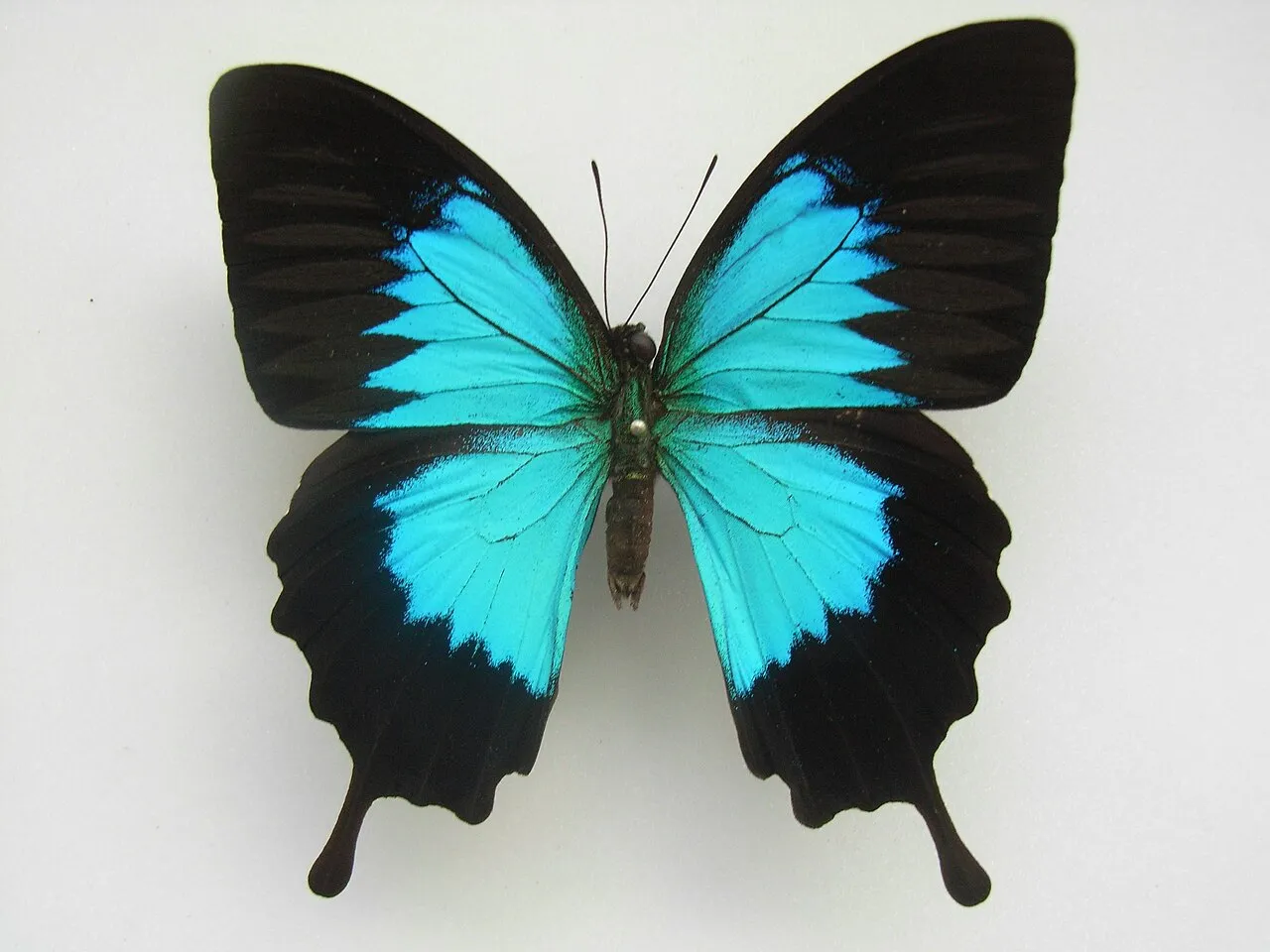
The Ulysses butterfly, Papilio ulysses, is a large swallowtail butterfly of Australia, Indonesia, Papua New Guinea and the Solomon Islands. Taiwan’s National Museum of Natural Science calls it the mountain blue swallowtail2, a member of the subgenus Achillides. In Queensland the butterfly is used as an emblem for tourism1.
Identification
The wingspan is 10–14 cm2. Size varies by subspecies, and in Queensland the wingspan is about 10.5 cm1.
In the male, the forewings and hindwings are lustrous royal blue near the centre of the body and black along the margins and on the hindwing tails, with light blue markings along the black hindwing margins2. Each hindwing has a tail near the tornus. The colours are produced by the microscopic structure of the scales1, a phenomenon called structural colouration, and the shade of blue varies with the angle of view and the lighting3.
Underneath, the wings have a cryptic brown pattern3. At rest the wings are closed, looking almost shadowy to avoid detection4.
Females are duller in colour2, and males have a little more blue than the females3. The female has little crescents of blue on the upper hindwing1, where the male has only black.
The eggs are white and spherical, laid singly on the upper surface of a leaf of the foodplant, and they darken as hatching approaches. Early caterpillars are yellowish-green with a pair of soft spikes on the back of each segment, black marks on the thorax and a pair of pale spikes on the tail. Later instars are green with a row of yellow marks along each side and a yellow and white bar across the thorax. Mature caterpillars lose the spikes and yellow markings but keep one or more pairs of white spots and the pair of white horns on the tail. The Coffs Harbour Butterfly House describes the fully grown caterpillar as shiny green with several creamy white blotches. The pupa has a length of about 4 cm3 and is normally suspended from the foodplant by cremaster and girdle; it is sometimes green or light brown with a tinge of orange4, with two prominent horns on its head.
Range and habitat
The species diverged into as many as 15 subspecies, spread across the Australasian realm: the Moluccas, New Guinea, the Bismarck Archipelago, the Solomon Islands and north-eastern Australia. That divergence began around 10 million years ago2, in the late Miocene, into three evolutionary branches.
In Australia it is represented by the subspecies joesa Butler, 1869, in northern Queensland3, listed from Cape York to Mackay. Other subspecies include P. u. ambiguus of the Bismarck Archipelago and P. u. orsippus of Choiseul, Isabel, Guadalcanal and Florida Island1 in the Solomon Islands.
The butterfly inhabits tropical rainforest areas and suburban gardens1. The Coffs Harbour Butterfly House gives its usual location as coastal north Queensland rainforests4, and the live butterflies in the rainforest along the tropical north-east coast of Australia3 are a popular tourist attraction.
Life cycle and host plants
The caterpillars feed on plants of the Citrus, Euodia and Melicope genera2 in the family Rutaceae. In the wild they eat the new growth foliage of various jungle trees, among them kerosine wood (Halfordia kendack), pink princess (Melicope elleryana), little evodia (Melicope rubra), silver ash (Flindersia bourjotiana) and, outside the Rutaceae, pink corkwood (Endiandra sieberi). They will also accept the foliage of oranges, lemons and other Citrus3. Females favour small trees up to 2 metres tall1 to lay their eggs.
By day the caterpillars rest on a pad of silk on a curled leaf, sometimes in pairs or small groups. Rearing the species in captivity is difficult, as the caterpillars are prone to a contagious, species-specific microsporidian. In a closed environment it can build up over two to three years to levels that cause 100% caterpillar mortality3.
Behaviour and flight period
In north Queensland the best months to see the butterfly are February to May. Adults fly high4, and in flight they show as sudden bright blue flashes that can be seen hundreds of metres away. They feed on nectar, especially from lantana flowers3 (Lantana camara), and in Australia from the blossoms of the pink flowered doughwood1.
Males are especially attracted to blue objects, even from 30 metres, and collectors often use a piece of blue paper or cloth to draw them in. Such blue objects are sometimes mistaken for females1. Caterpillars and adults are generally solitary, and only meet to mate3.
Similar species
- New Caledonian tailless Ulysses (Papilio montrouzieri): a member of the same species group, endemic to New Caledonia and smaller than all the forms of P. ulysses5, with both wings more strongly sinuous between the veins.
- Papilio syfanius: the third member of the Papilio ulysses species group1, found only in China6, where it may be a western subspecies of Papilio bianor told apart by white hindwing patches.