Contents
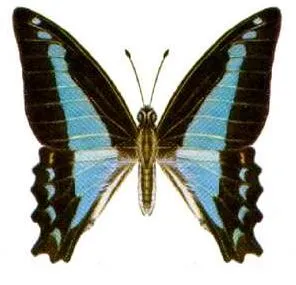
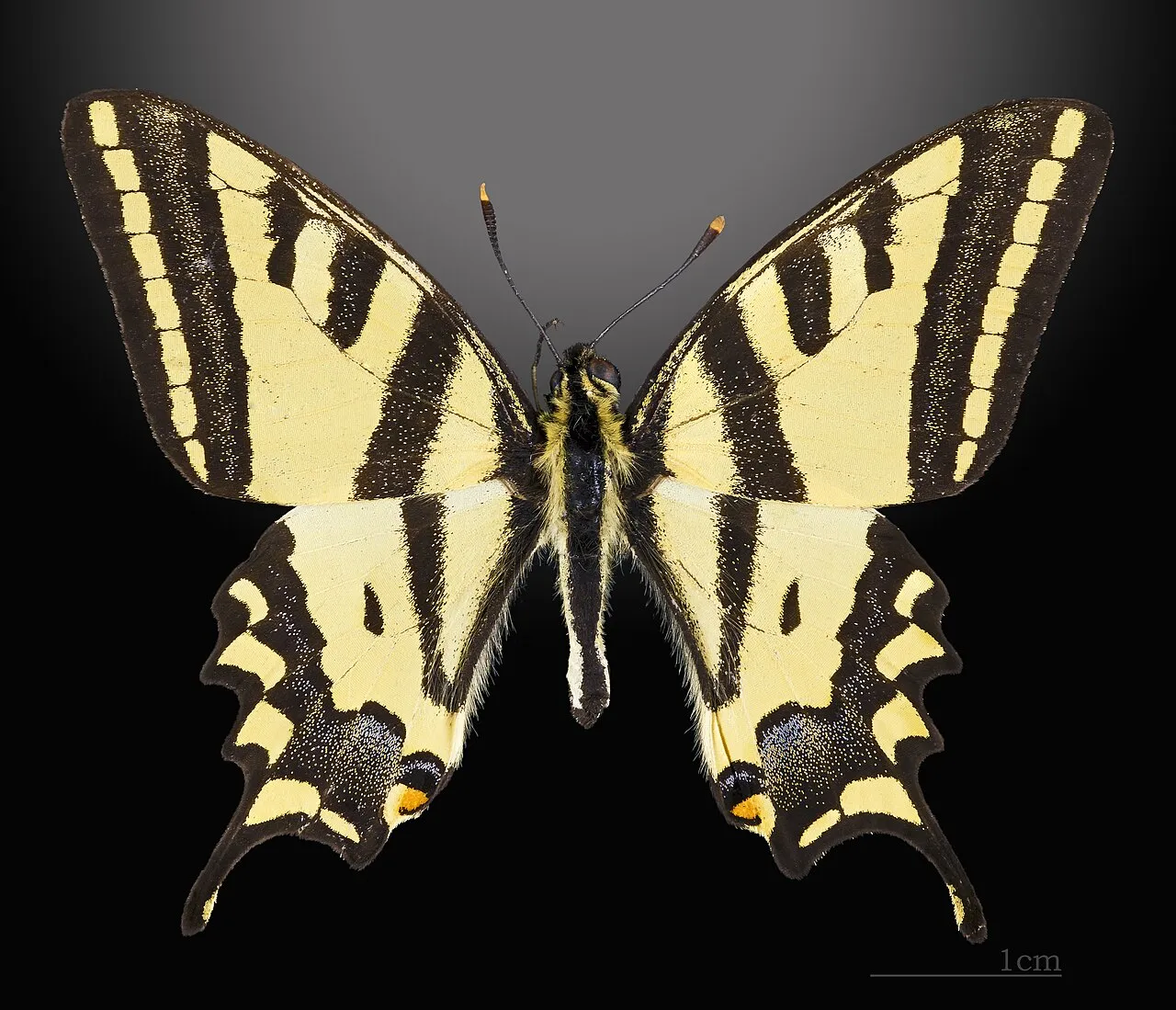
The Southern Swallowtail, Papilio alexanor, is a large swallowtail of mountain country, found from Southern Europe, Asia Minor and the Balkans, east through Anatolia, Iran, Afghanistan and Pakistan to the western Tian Shan. It belongs to the family Papilionidae, and its caterpillars feed on umbellifers. The species is closely related to the swallowtail, Papilio machaon, which it broadly resembles in pattern, though the two differ in the detail of the black markings.
Identification
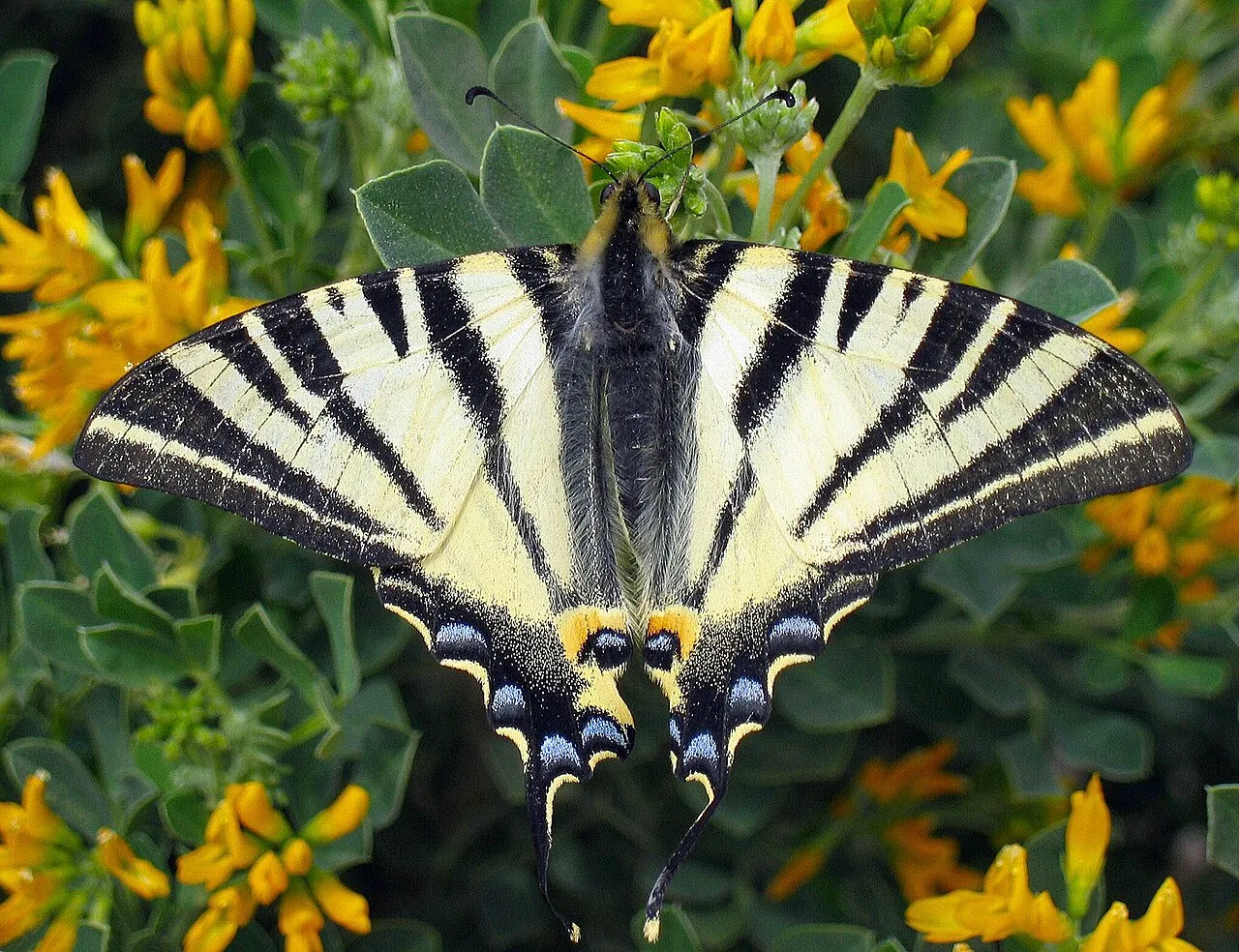
This is a sizeable butterfly, with a wingspan of 62 to 70 mm. Its wing pattern recalls Papilio machaon, but the black markings differ: on the Southern Swallowtail, a broad black band borders the basal third of the forewing on both the near and far side, leaving the area between pale rather than solid black, and the same bands continue across the hindwing, framing a yellow basal area. The pattern varies across its range: some populations have broader black bands in the basal area, while others show narrower black bands overall and a hindwing submarginal band that is broadly blue.
Several subspecies are described across this range, each tied to a particular region: destelensis in Southern France, judeus in Asia Minor, Judea and Transcaucasia, orientalis in Armenia, radighierii in Piedmont, Italy, hazarajatica in the Kopet-Dagh and south Ghissar, and voldemar in the western Tian Shan.
Range and habitat
The Southern Swallowtail is a butterfly of mountainous regions, generally at elevations up to about 1,700 m, across its wide stretch of Southern Europe, Asia Minor and the Balkans, east through Anatolia, Iran, Afghanistan and Pakistan to the western Tian Shan.
Life cycle and host plants
Caterpillars feed on umbellifers (Apiaceae), including Trinia vulgaris, Seseli montanum, Ptychotis saxifraga, Opopanax chironium and various Ferula species. The caterpillar gnaws the epidermis of its host plant, leaving pale, whitened stalks that make an infested plant easy to spot. Before pupation it forms a stone-grey, very flat chrysalis with carinate sides and an uneven surface, fastened to stones, which it resembles closely enough to pass for a small splinter of rock. The species passes the winter as a chrysalis, and completes a single generation a year across its range. That chrysalis can also sit out more than one winter: reared stock from Palestine has emerged only after at least three years in diapause, an arid-zone adaptation tied to the larval host plant.
Behaviour and flight period
Adults are on the wing from April to July, as a single generation, across its European and Asian range.
Similar species
- Swallowtail (Papilio machaon): the species the Southern Swallowtail most resembles, differing mainly in the extent and placement of the black wing bands.
- Scarce swallowtail (Iphiclides podalirius): another large black-and-pale swallowtail sharing much of the same mountainous Palearctic range.
_(6-25-2016)_denali_highway__mile_p13_pass__near_paxson__alaska_(7)_(28788418100)_9KfLF.webp)
_(Apollo)_-_(imago)__Triglavski_narodni_park_NP__Slovenia_Z1ilv4V.webp)
_13MRxF.webp)