Contents
The scarce swallowtail, Iphiclides podalirius, is a large pale swallowtail of orchards, scrub and open woodland across much of Europe and Asia. It belongs to the family Papilionidae, the swallowtails, and takes its common name from its rarity in Britain rather than anywhere within its true range, where it can be common. The species is widespread across the East Palearctic and most of Europe except the far north, extending through Asia Minor, Transcaucasia, the Arabian Peninsula, Pakistan, India and western China.
Identification
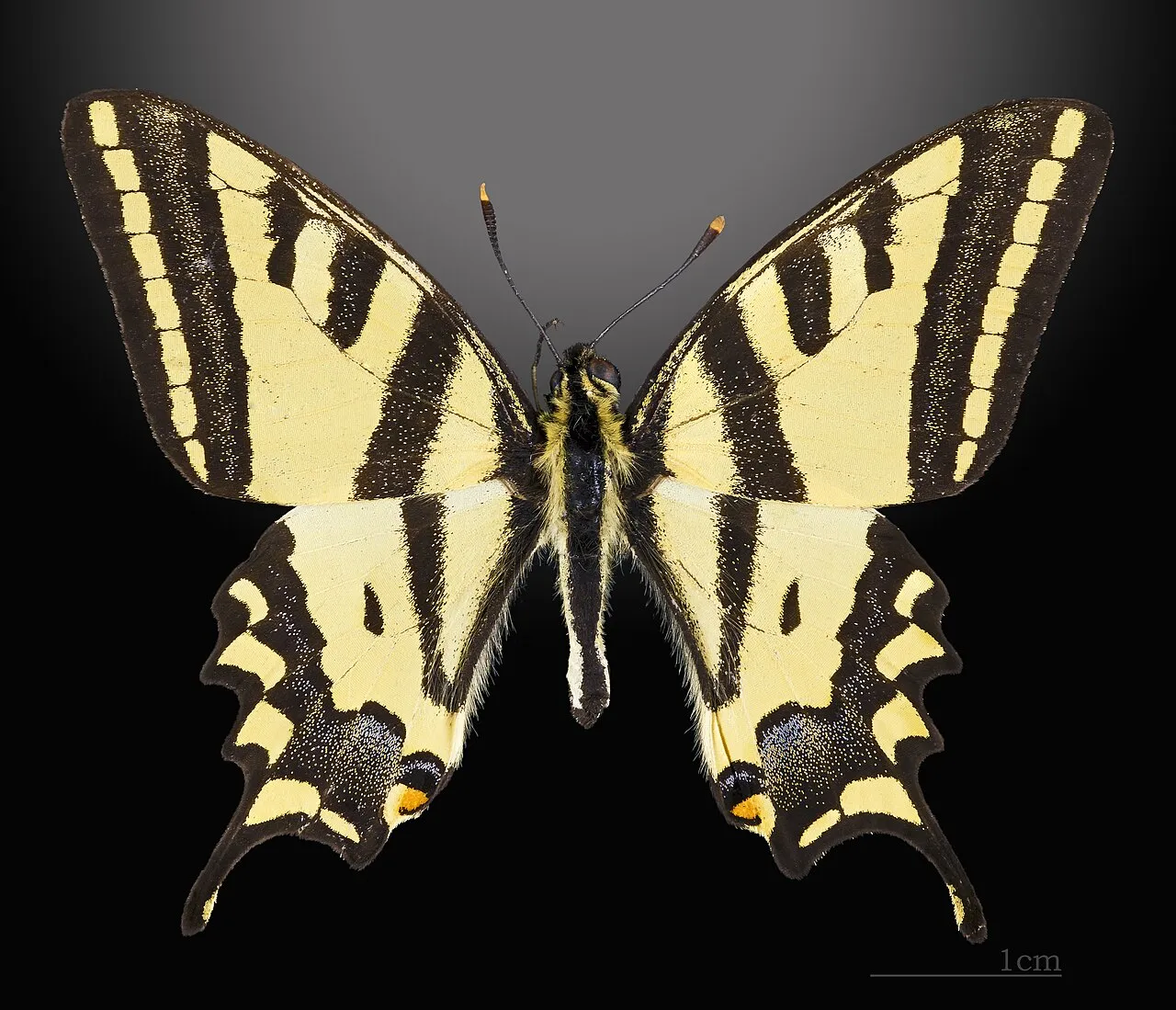
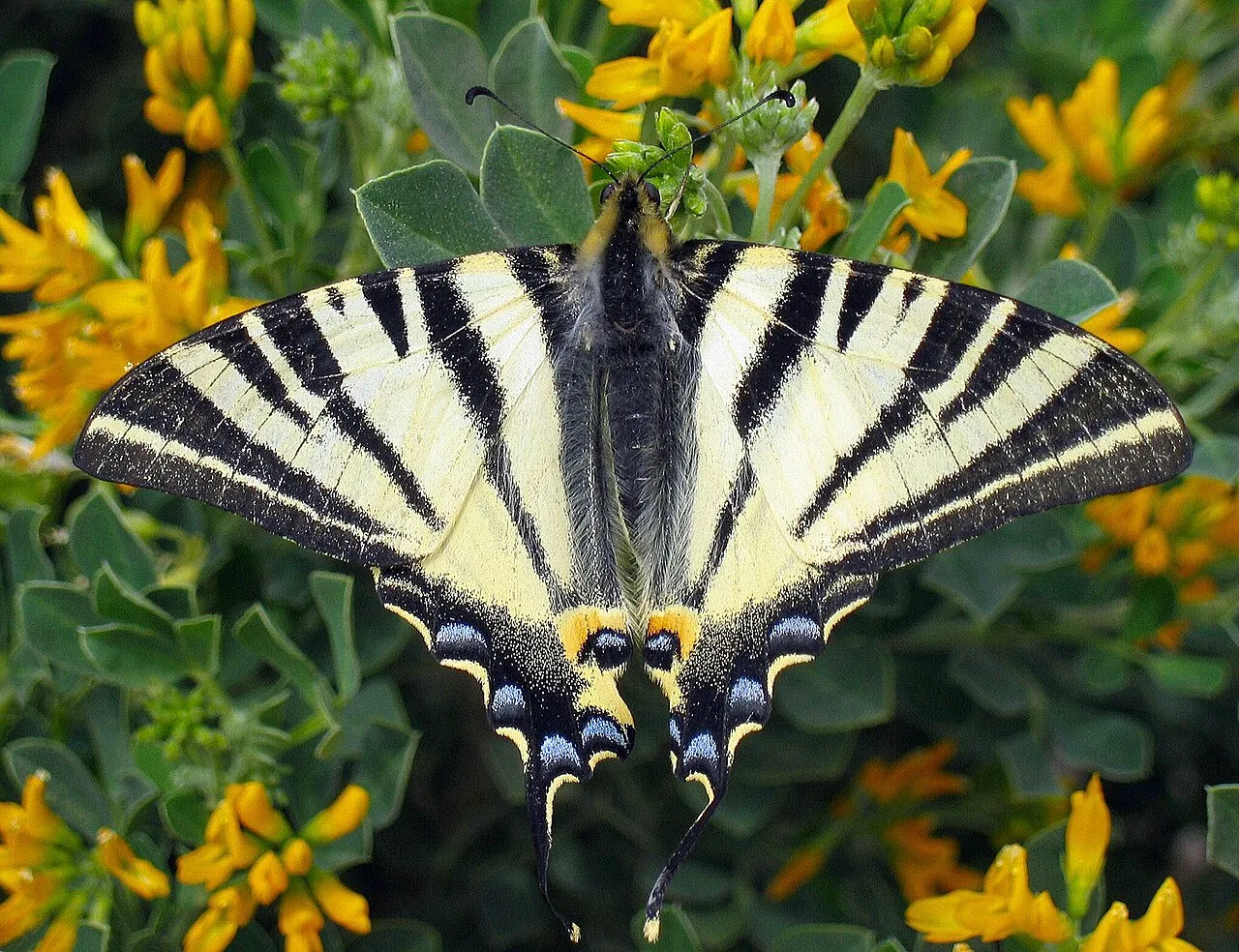
The scarce swallowtail is unmistakable once seen well. The background colour of the wings is creamy white or pale yellow, crossed by bold dark bands that give the species its tiger-striped look: the forewings carry six tiger stripes and wedge-shaped markings. The hindwings complete the pattern, showing blue crescent markings, an oblong orange spot at the back corner, and a relatively long tail on each wing, a feature shared with few other European butterflies. The wingspan runs from about 60 to 90 mm, with males at the narrower end (60–80 mm) and females slightly larger (62–90 mm). The sexes otherwise look alike; Wikipedia records only that females run slightly larger than males, with no other difference in pattern between them.
Range and habitat
Within its broad Palearctic range the butterfly turns up wherever its host trees grow. It favours gardens, towns and open countryside, fields and open woodland, and shows a particular liking for places with sloe thickets, and orchards above all. In the mountains it climbs well beyond the lowlands: Alpine populations are found up to altitudes of about 2000 m, though most individuals prefer the foothills and lower levels. The species is only an occasional stray far outside this range; the handful of British records are treated as likely escapes or accidental imports rather than natural colonists.
Life cycle and host plants
The caterpillars are polyphagous feeders on Rosaceae, taking in particular hawthorn (Crataegus), apple (Malus), cherry, plum and apricot (Prunus), pear (Pyrus) and rowan (Sorbus aucuparia) — the same orchard and hedgerow trees that shape the adult’s choice of habitat. Young caterpillars are dark in colour with two smaller and two larger greenish patches; as they grow they change markedly, becoming greenish overall with yellowish dorsal and side stripes that camouflage them among the leaves of the host plant.
The chrysalis stage shows a seasonal switch in colour that tracks how it will spend the coming months. Summer chrysalids are usually green, while the ones that will overwinter are brown, the brown form better matched to the leaf litter where the species passes winter as a chrysalis. Adults are on the wing from March to October, in one, two or three generations a year depending on the region, with the far south and east of the range typically fitting in the extra brood that cooler areas cannot.
Behaviour and flight period
The flight period itself, spanning March to October across one to three generations depending on region, means this species can be seen far longer in the season than most single-brooded butterflies of similar size. Documented behavioural detail beyond the flight calendar — courtship, roosting or predator defence — is thin in the open sources available for this profile; what is well recorded is the life stage that bridges one generation to the next, the brown overwintering chrysalis described above, which carries the species through the cold months to emerge as one of the first large swallowtails of spring.
Conservation
The species is listed by the IUCN under the category shown in the facts box, taken from its Wikidata record. It is not under global threat, but several European countries protect it domestically: it is protected by law in the Czech Republic, Slovakia, Germany, Hungary, Luxembourg, Russia, Ukraine, Poland and Macedonia, reflecting local declines tied to the loss of traditional orchards and sloe scrub even where the species as a whole remains secure.
Similar species
- Swallowtail (Papilio machaon): the other large tailed swallowtail across much of the same range, but yellow rather than creamy white, with black markings arranged differently and no tiger-stripe pattern on the forewing.
- Southern swallowtail (Iphiclides feisthamelii): a close relative found across Iberia, north-west Africa and parts of southern Europe (Italy, Slovenia, southern France and Serbia), sometimes treated as a subspecies of the scarce swallowtail rather than a separate species; the two overlap little in range, which is the most reliable way to tell them apart in the field.
_(6-25-2016)_denali_highway__mile_p13_pass__near_paxson__alaska_(7)_(28788418100)_9KfLF.webp)
_(Apollo)_-_(imago)__Triglavski_narodni_park_NP__Slovenia_Z1ilv4V.webp)
_13MRxF.webp)