Contents
The clouded apollo, Parnassius mnemosyne, is a swallowtail butterfly (Papilionidae) of the Palearctic realm1, named in the classical tradition for Mnemosyne, mother of the nine Muses. Its range runs from the Pyrenees across the Central Massif, the Alps and the Carpathians to central Asia. It lives in all European countries, including Norway, where it appears rarely and only in certain places, and a subspecies that lived in Denmark is extinct. Its type locality is Åland.
The northernmost populations, summarised in a paper by Bolotov and colleagues, lie in karst landscapes of the White Sea–Kuloi Plateau (65°35’–66°03’ N) and in the north of the Timan Highland (66°10’ N1), on the shore of Kosminskoe Lake in the Pechora basin.
Identification
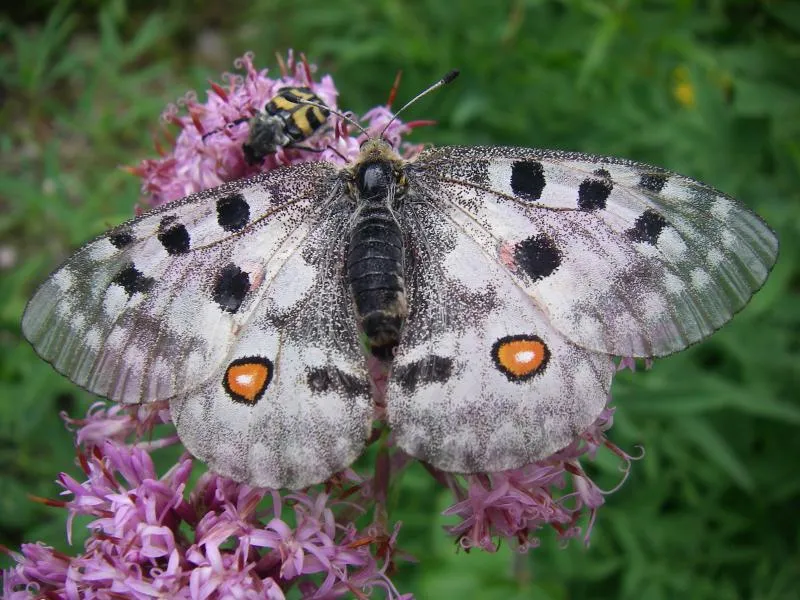
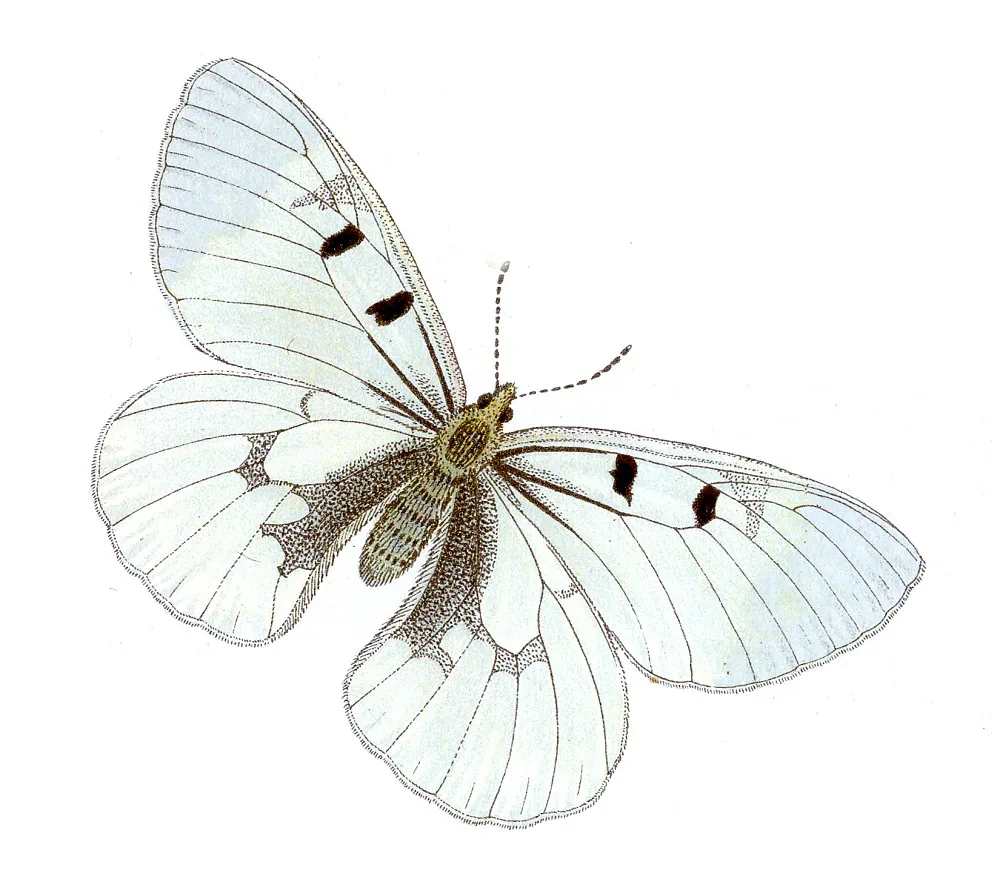
The clouded apollo has a wingspan of 50–68 mm2; it is a large butterfly1. The wings are white, with thin black veins and blackish fringes; the forewing carries two black cell-spots, and its outer margin is transparent grey, from the apex to about the middle in the male and further down and more broadly in the female. The hindwing is dusted with black from the abdominal margin to the cell, more densely in the female than in the male.
A Croatian field guide adds that the wings are white in young individuals and a bit brownish in older ones, and that the edge of the forewing is transparent3.
The sexes also differ in the abdomen. In the male it is covered with whitish hairs1; in the female it is nearly naked and glossy, bearing a whitish bladder-like pouch that occupies nearly two-thirds of the underside. The antennae and legs are black in both.
The species varies generally little, yet many forms have been named. Around Friesach in Carinthia, at 630 to 750 m, lives the conspicuously small local form minor, with reduced forewing spots and an expanse of only 52 mm. In Bavaria and the Salzkammergut, at about 1,000 m1, the species has become a constant melanotic form, hartmanni; its females resemble the aberration melaina, which is darkened by dense black dusting and found everywhere among the ordinary form, but are usually less dark in tint. An enlarged Central Asian race, with heavier black markings and a wider transparent border, is known as gigantea.
Range and habitat
The clouded apollo inhabits meadows and deciduous woodland clearings with plenty of flowering plants, but cannot survive in denser forest. It is found both in the lowlands and in the mountains, though not usually above 1,500 m1. The Naturalis guide to European butterflies places it in mountainous regions on damp to moderately dry grassland, usually with woodland or scrub in the neighbourhood, and Lepidoptera Mundi lists sunny woodland fringes and woodland meadows2 as its habitat; the Naturalis habitat list also includes alpine, humid and mesophile grasslands4.
In Croatia it is more common in the mountains and continental lowlands, and the same guide gives its habitat as meadows and woodland clearances at 0–1600 m3.
The butterflies inhabit small patches1: individuals move from patch to patch, and conservation of a network of patches is required to maintain the gene pool.
Life cycle and host plants
The egg is conical and whitish1, with a granular surface. At egg-laying time the food plant is not yet above ground4; the eggs go on its dried stems, on grass blades, or on other plants not too far from the food plants.
The caterpillar is cylindrical, tapering at both ends, black and short-haired, with orange spots along the body. It feeds in April and May1, only on sunny days, and otherwise hides under leaves or stones. Caterpillars feed exclusively on Corydalis species3, among them C. halleri, C. cava and C. solida; Lepidoptera Mundi also lists Corydalis intermedia and Pseudofumaria lutea, the yellow corydalis2. The northern limits of the range appear to be strongly determined by the distribution of the host plants, primarily Corydalis solida, with climate and relief of minor importance.
Accounts of pupation differ. One describes pupation in the ground in a loose cocoon1, the pupa thick and blunt; the Naturalis guide has the fully grown caterpillar pupate in a closely spun cocoon above the ground4, in the leaves of the food plant.
The overwintering stage is also given two ways. Butterflies of Croatia says the species overwinters as caterpillar3, while the Naturalis guide says the egg hibernates4 and the small caterpillar leaves it in spring to search for a food plant.
Behaviour and flight period
There is one brood per year, and the Naturalis guide likewise gives one generation a year. The adult feeds on the nectar of various flowers3, and the butterflies can often be seen visiting red or purple flowers4. The dark hartmanni form of Bavaria and the Salzkammergut is on the wing in June and July1.
Conservation
The clouded apollo is Least Concern in the IUCN Red List 2022.25. It is locally common in some places in central Europe1, yet to prevent its continuing disappearance from many places there, it is protected in some regions. Many Russian populations live in state nature reserves, among them Kizgi Skerries in Karelia, Pinega and Soyansky in Arkhangelsk Oblast, and Pechoro-Ilychsky and Belaja Kedva in the Komi Republic.
Similar species
- Apollo (Parnassius apollo): listed by Lepidoptera Mundi among similar species2; it measures 62–86 mm in males and 65–95 mm in females, and its hindwing carries two bright red or sometimes orange eyespots6.
- Black-veined white (Aporia crataegi): listed as a similar species4, but a member of the Pieridae whose upperside is translucent white boldly veined with black7.
- Small Apollo (Parnassius phoebus): listed by Lepidoptera Mundi among similar species2; it has strongly marked black and white antennae6 and two red spots near the forewing apex, while the clouded apollo’s antennae are black1.