Contents
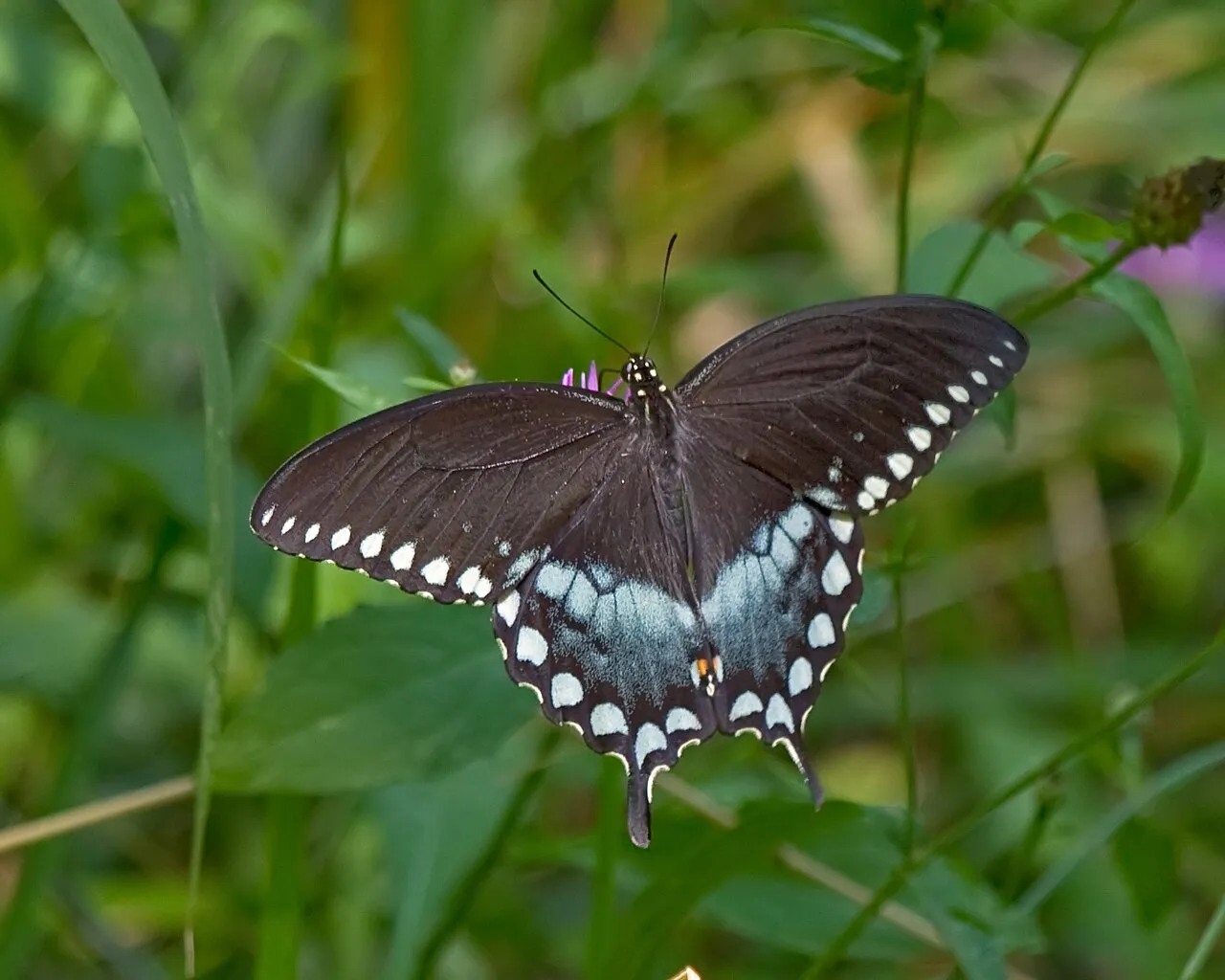
The spicebush swallowtail, Papilio troilus, is a common black swallowtail butterfly found in North America, with two subspecies: P. troilus troilus and P. troilus ilioneus, the latter found mainly in the Florida peninsula. It takes its name from its most common host plant, the spicebush1.
Identification
The wingspan ranges from 80 to 115 mm, and the female is the larger sex. On the upperside, the forewing is mostly black with ivory spots along the margin. The upper hindwing has an orange spot on the costal margin, which Animal Diversity Web calls unique to spicebush swallowtails. The sexes differ in the scales on the upper hindwing: a sheen of bluish scales in the female and bluish-green in the male3. The hindwing carries a tail 9 to 12 mm long2 at the bottom of the wing.
The underside of the hindwing has pale green marginal spots3. It also has a dual row of orange spots1, with more blue or green colouring between the rows.
The two subspecies differ in colour: the hindwing spots that are blue in P. t. troilus are more yellow in P. t. ilioneus1.
The caterpillar initially resembles bird droppings. In later instars it is green with a pale yellow lateral line along its length, and each abdominal segment is ringed by six blue spots outlined in black. It has two pairs of false eyespots; together with the swollen thorax, they are believed to mimic either green snakes or tree frogs. The pupa can be brown or green depending on the season2, with a pair of horns at the top.
Range and habitat
The species lives in eastern states from southern Canada to Florida, west to Oklahoma and central Texas. It occasionally strays to North Dakota, central Colorado and Cuba3. Animal Diversity Web notes that it is less common on the western edge of its range2, along the southern Mississippi River, and in New England.
The larval form is found in deciduous woodlands, wooded swamps, and pine barrens. Adults can be seen in woodlands, parks, yards, fields and roadsides, but prefer the borders of shady woods. Males are often found near moist, sandy areas along roads or streams2.
Life cycle and host plants
The caterpillars eat spicebush (Lindera benzoin) and sassafras (Sassafras albidum). Butterflies and Moths of North America adds that prickly ash, tulip tree, sweetbay, camphor and redbay3 are perhaps also hosts. The larvae feed on the leaves of aromatic trees and shrubs in the family Lauraceae, and the choice of host depends primarily on host availability in a particular part of the range2. Redbay and swampbay are the primary host plants1 of P. t. ilioneus.
A female finds a host by visual and chemical cues, then drums the leaf with her forelegs to “taste” it. She lays single eggs on the underside of host plant leaves. The caterpillars live in shelters of folded-over leaves3 and come out to feed at night. When disturbed, a caterpillar releases a disagreeable odour from an orange scent gland behind its head2.
The pupae are green (summer) or brown (fall). Some chrysalids from each generation hibernate3, and the overwintering pupae are usually brown to mimic dead leaves. Shorter days trigger that brown colour regardless of whether the leaf is green or brown. Adults live roughly from 2 days to 2 weeks2.
Behaviour and flight period
There are 2 generations per year from April to October3; in Florida, three are possible between March and December2.
Males patrol in woods, roads and woodland edges3 to find receptive females. When a female appears, a male performs a brief courtship ritual, lasting less than a minute, and copulation often lasts over an hour. Both sexes often copulate with multiple partners. Adult males may congregate at moist, sandy areas along roads or streams2 to sip moisture and minerals from the soil, a habit called puddling.
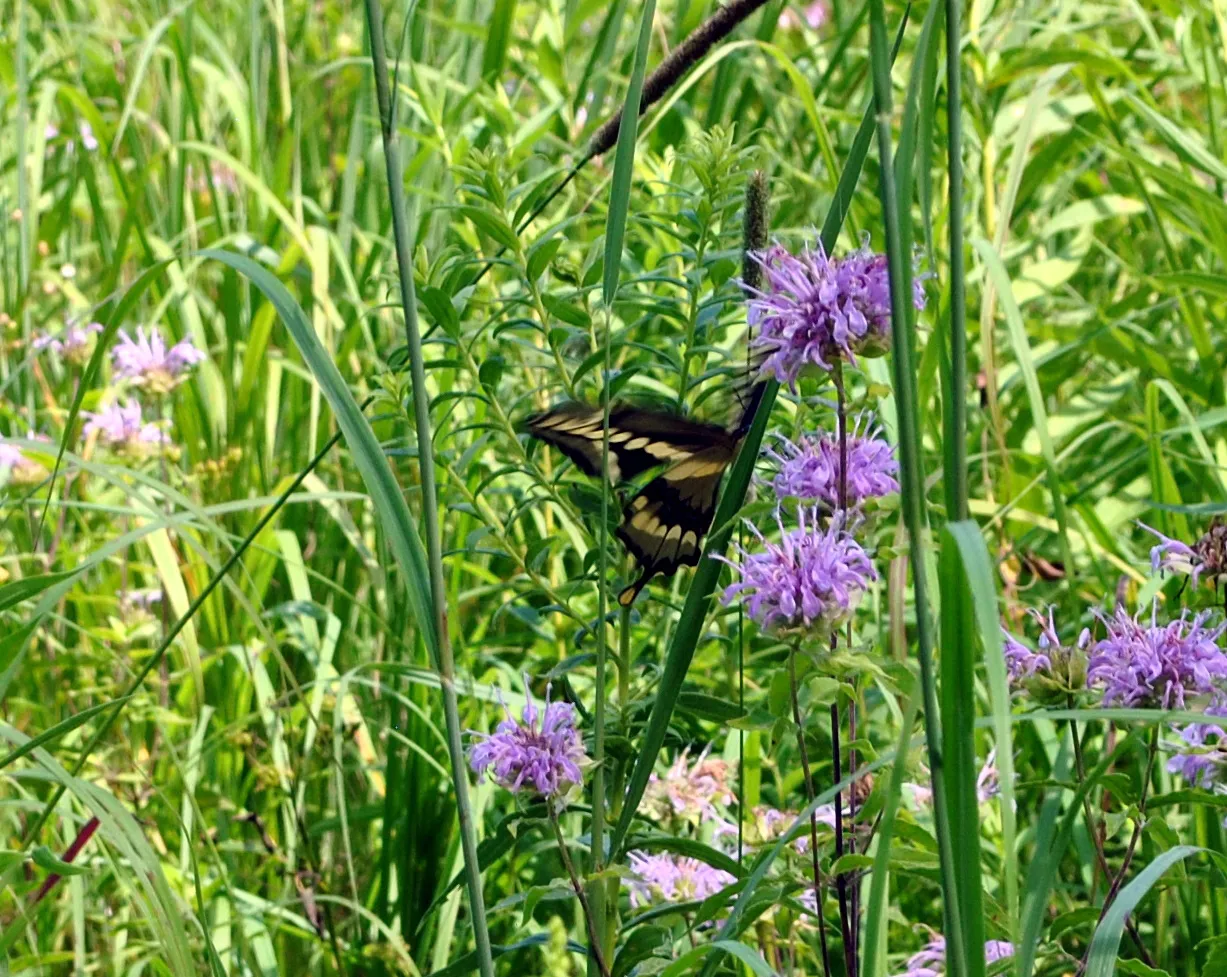
Adults take nectar from Japanese honeysuckle, jewelweed, thistles, milkweed, azalea, dogbane, lantana, mimosa and sweet pepperbush3. Their unusually long proboscis2 reaches nectar in deep flowers such as bee balm.
As adults they mimic the poisonous pipevine swallowtail (Battus philenor). Because the spicebush swallowtail is not unpalatable itself, this is an example of Batesian mimicry1. Despite this mimicry, the species suffers extensive predation2 from spiders, dragonflies, robber flies and especially birds.
Similar species
- Pipevine swallowtail (Battus philenor): its hindwing underside has only a single row of spots1, where the spicebush swallowtail has a dual row of orange spots.
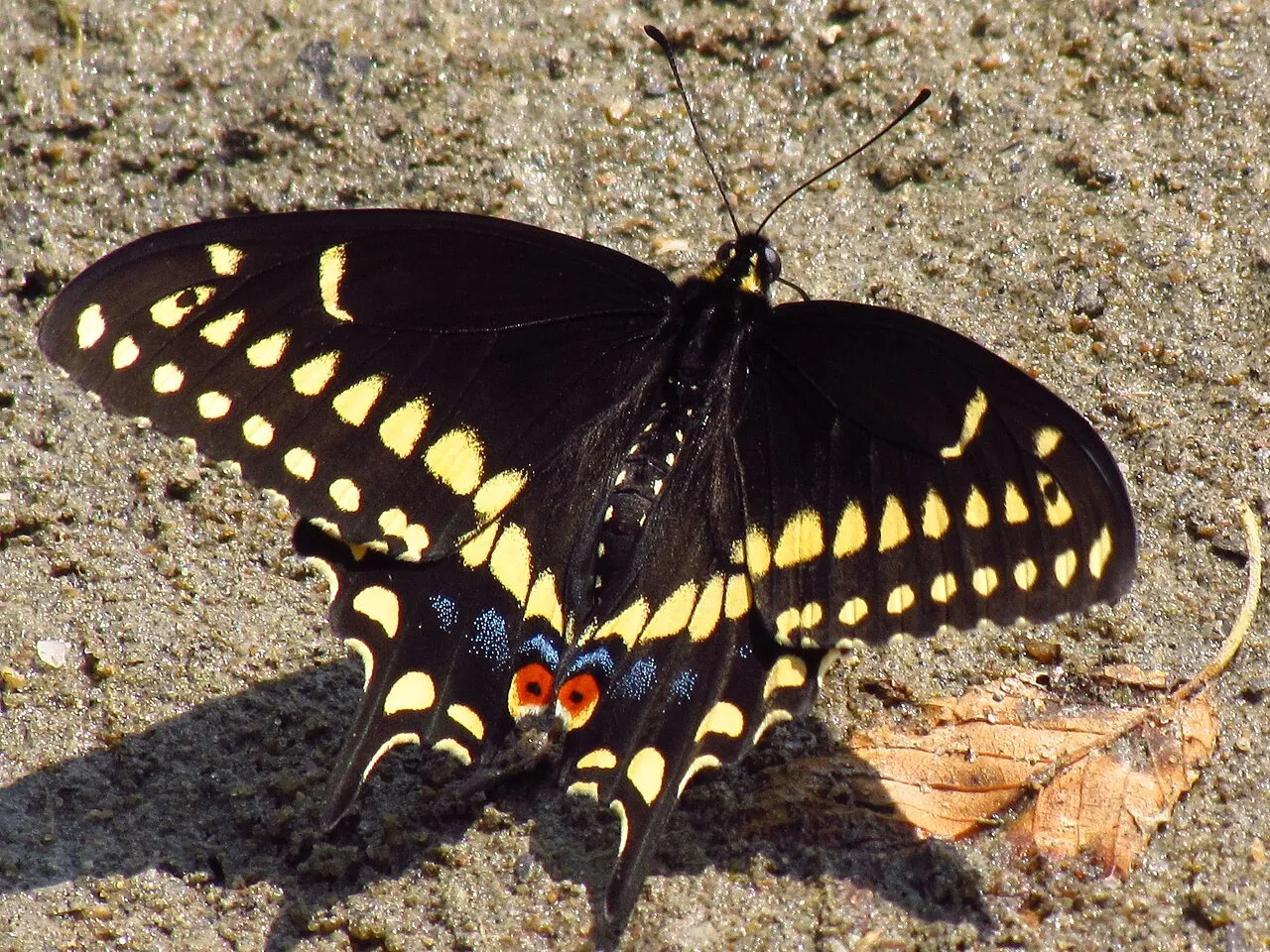
- Black swallowtail (Papilio polyxenes): its hindwing has a black spot centered in a larger orange spot4 on the inner edge, and the male has a yellow band near the edge of the wings.