Contents
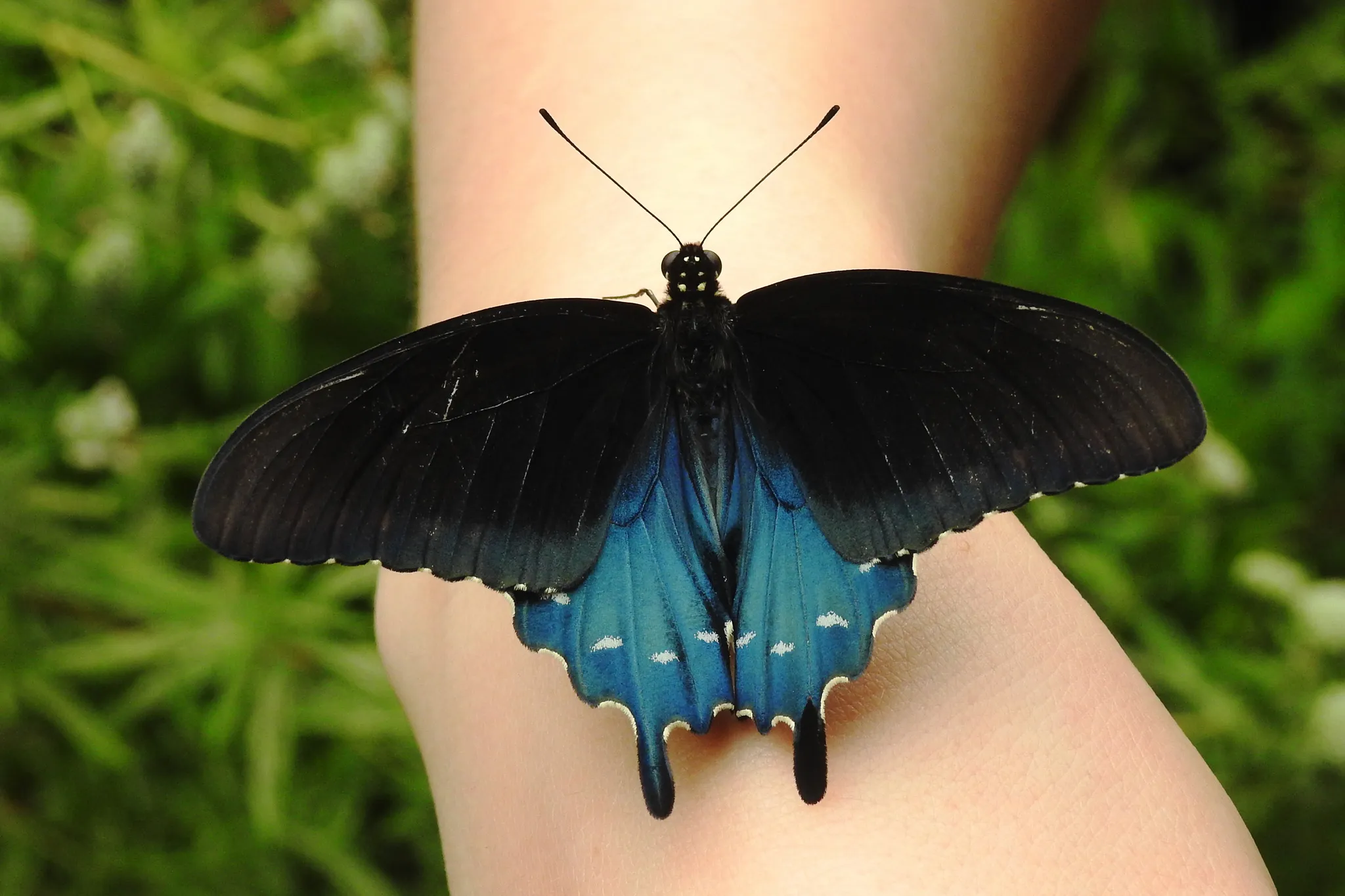
The pipevine swallowtail, Battus philenor, is a swallowtail butterfly of North America and Central America1, black with iridescent blue hindwings. It lives in the southern half of the United States2, occasionally further north, and ranges south to southern Mexico.
Linnaeus first described it in 1771, in the genus Papilio, and Scopoli moved it to Battus in 1777. It belongs to the tribe Troidini, a group of butterflies whose larvae all feed on Aristolochia1.
Identification
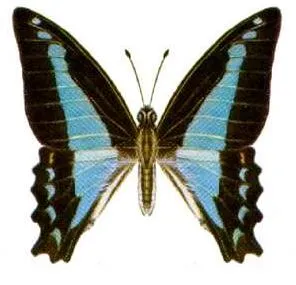
The wingspan is 7–13 cm. The forewing is coal-black above and gray below2, and the upper surface of the hindwing is iridescent blue or blue-green3.
The sexes differ most on the upperside of the hindwing. Males have smaller cream or pale spots than females2, running along the fringe of the wings, and males are also a brighter metallic blue there than females. The iridescence of the female is duller in appearance. Adults from Californian populations have smaller and hairier bodies1 and are thought to be a subspecies, Battus philenor hirsuta.
On the underside, the hindwing carries a submarginal row of 7 round orange spots3 in an iridescent blue field. The bottom half of the underside hindwing is metallic blue in both sexes2, with small pale cream dots at the edge of the wing as well as the orange spots.
The eggs are red-orange and circular. The caterpillar is black, with red projections and spots running down its back, and the colour of both caterpillar and chrysalis is affected by temperature: animals experiencing warmer temperatures shade from black to red. The chrysalis has its own shape2: a segmented, inward-curving rear end, a raised thorax underneath and a pair of horns on the head.
Range and habitat
In the United States the butterfly is found from New England down to Florida, west to Nebraska, Texas, New Mexico, Arizona, California and Oregon. It is a rare stray to southern Manitoba3 in Canada, and occurs in the tropical lowlands south to southern Mexico. A population in central California is geographically disjunct1 from the rest of the range.
It uses a wide variety of open habitats3, open woodland and woodland edges. The species favours open woodlands, meadows2 and anywhere else that pipevine grows in abundance, including backyard gardens and nurseries.
Life cycle and host plants
The caterpillars feed on pipevines (Aristolochia species)3, including Aristolochia californica and A. serpentaria. As larvae, pipevine swallowtails feed only on plants in the genus Aristolochia. The caterpillars and later stages retain the toxins from the plant2 and use them to discourage predators.
Females lay batches of eggs on the underside of host plant leaves. Young caterpillars feed in small groups but become solitary when older3. The larvae feed and wander for several weeks1 before finding an isolated spot to pupate.
The species spends the winter as a chrysalis2, or in warm regions spends just a few weeks in that stage, and emerges as an adult in the spring.
Behaviour and flight period
In the East and California, adults fly mainly in late spring and summer3, though as early as late February or March. In the South and Southwest the butterfly is commoner in late summer and fall.
Adult males patrol likely habitat in search of receptive females. Males have also been observed to take moisture and nutrients from mud1, a behaviour motivated by the presence of other males. Adults feed solely on nectar3, from flowers including thistles, bergamot, lilac, phlox, lantana and verbenas. Pipevine swallowtails can quickly learn to associate certain flower colors2 with nectar supplies.
Many other butterflies mimic B. philenor as a form of defense2, because it has a bad taste.
Conservation
In version 2022.2 of the IUCN Red List, the pipevine swallowtail is assessed as Least Concern4. It is demonstrably secure globally3, though it may be quite rare in parts of its range, especially at the periphery.
Similar species
- Eastern tiger swallowtail (Papilio glaucus), black female: one of the two female forms is black5, and it shows shadows of dark stripes and a row of striking blue chevrons on the hindwing. See the eastern tiger swallowtail.
- Spicebush swallowtail (Papilio troilus): the upper hindwing has an orange spot on the costal margin6, and the underside of the hindwing has pale green marginal spots.
- Red-spotted purple (Limenitis arthemis): a mimic of the pipevine swallowtail, whose forewing underside has 2 red-orange bars near the base7 of the leading edge and whose hindwing underside has 3 red-orange spots near the base.