Contents
The monarch, Danaus plexippus, is an orange and black butterfly of the family Nymphalidae, found from southern Canada to South America and parts of the Pacific, whose caterpillars feed only on milkweed1.
Identification
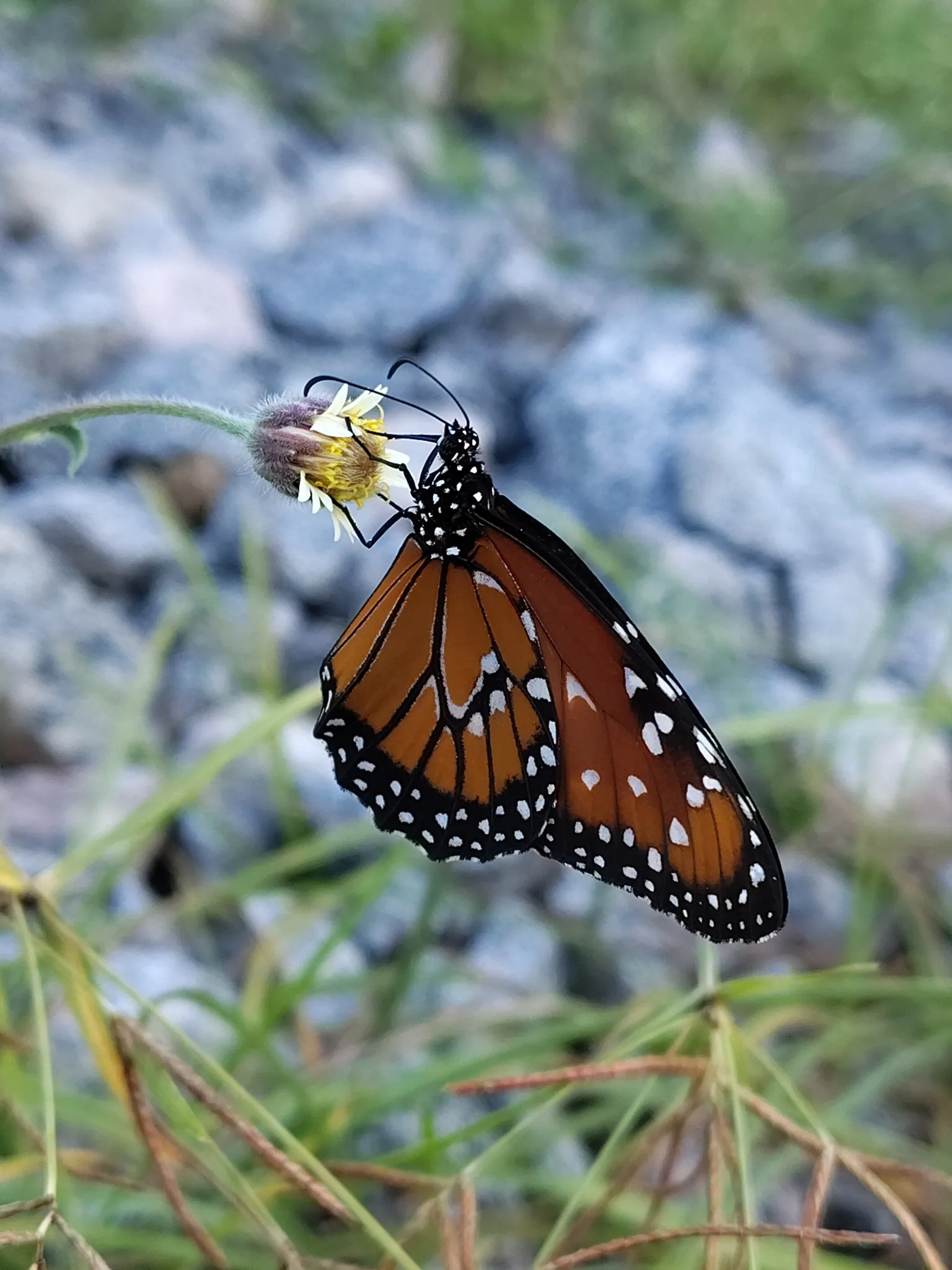
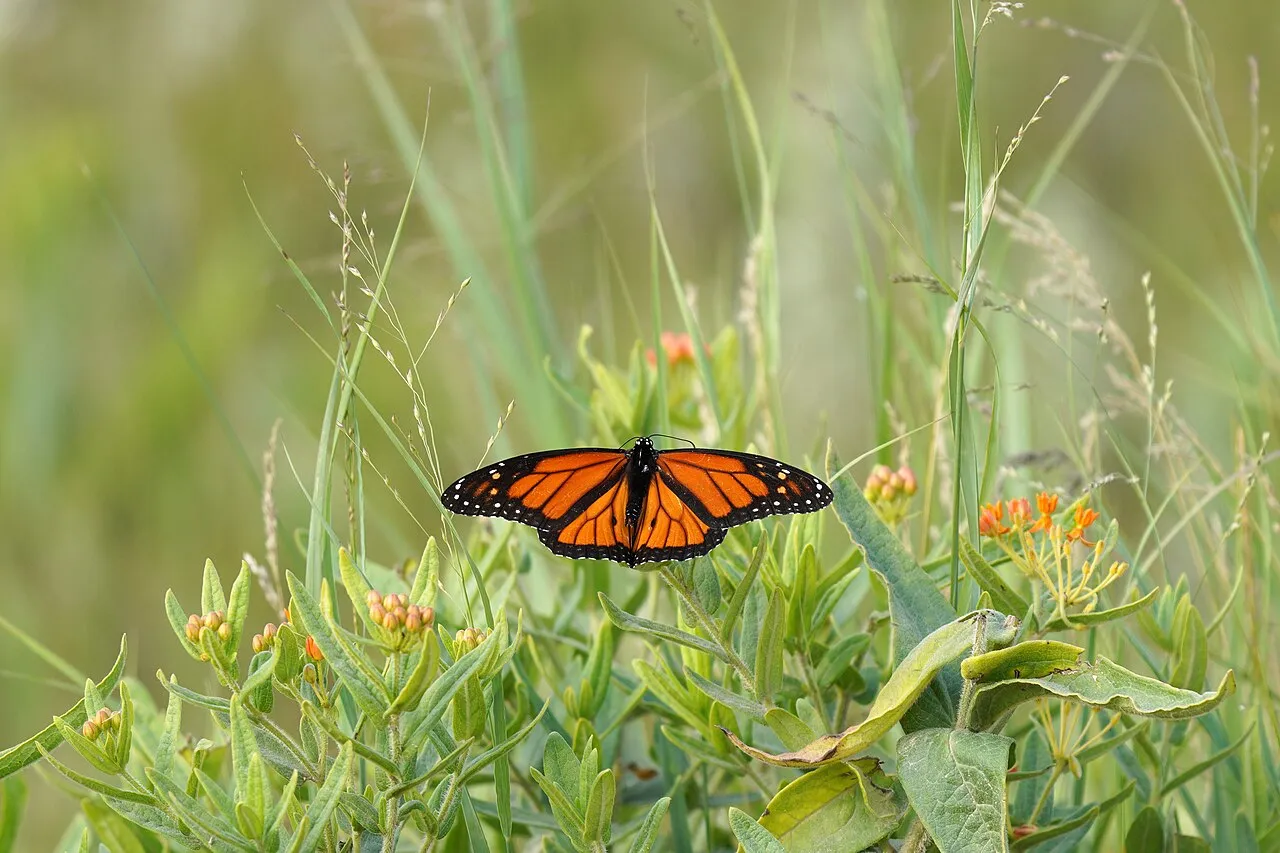
With a wingspan of 86–124 mm, the upperside of the male is bright orange with wide black borders and black veins, and the hindwing carries a patch of scent scales; the female’s upperside is orange-brown with wide black borders and blurred black veins. Both sexes show white spots on the borders and wingtips2. Separately, male monarchs also have a swollen pouch on both of their hind wings3. The underside looks much like the upperside, except the wingtips are yellow-brown instead of orange, and the white spots are larger1.
As a second instar, the caterpillar develops transverse bands of white, yellow and black, with a yellow triangle on the head; by the fifth and final instar this has grown into a more complex banding pattern, with white dots on the prolegs and small front legs close to the head. Before the adult emerges, it forms a chrysalis that is pale green with small gold dots and a gold-and-black rim1.
Range and habitat
Butterflies and Moths of North America2 gives the monarch’s range as southern Canada south through the United States, Central America and most of South America, also present in Australia, Hawaii and other Pacific islands. Ecologist Anurag Agrawal’s account of the species draws a narrower line, with the monarch itself reaching only southern Canada through northern South America1; the butterflies of Brazil, Uruguay, Paraguay, Argentina, Bolivia, Chile and southern Peru further south belong to the related southern monarch, Danaus erippus (see Similar species).
It uses many open habitats, including fields, meadows, weedy areas, marshes and roadsides2. It is frost intolerant, and where it breeds depends on the presence of milkweeds. Winter is a different matter: the overwintering butterflies need dense tree cover3, and most of the present California overwintering sites are found in groves of blue gum (Eucalyptus globulus), a tree originally introduced to the state from Australia.
Flight period
Adults migrate south from August to October, flying thousands of miles to overwinter mainly along the California coast and in central Mexico, with a few along the Gulf coast or the south Atlantic coast. In North America during spring and summer there may be one to three broods in the north and four to six broods in the south; it may breed all year in Florida, South Texas and southeastern California2.
Life cycle and host plants
Caterpillars eat milkweeds, including common, swamp and showy milkweed (Asclepias syriaca, A. incarnata, A. speciosa), with milkweed vine used in the tropics. Most milkweeds contain cardiac glycosides, stored in the bodies of both the caterpillar and the adult, making them distasteful and emetic to birds and other vertebrate predators; after tasting a monarch, a predator might associate the bright warning colours of the adult or caterpillar with an unpleasant meal, and avoid monarchs in the future2.
Females lay their eggs singly under host leaves, and the caterpillars eat leaves and flowers. The egg and larval period is temperature dependent and lasts about two weeks; working from eggs taking three to eight days to hatch and five larval instars of about three to five days each1, the longer estimate runs to roughly 18 to 33 days. After a further 9 to 15 days of pupation3 the adult emerges from the chrysalis to begin the cycle again. Early in the season, before milkweeds bloom, adults visit dogbane, lilac, red clover, lantana and thistles for nectar; in autumn they turn to goldenrods, blazing stars, ironweed and tickseed sunflower2.
Behaviour
Adults warm up by basking with their wings open toward the sun. Along the migration route they stop to feed on flower nectar and roost together at night, and at the Mexican wintering sites they roost in trees in huge aggregations that may hold millions of individuals. During winter, on warm days, the butterflies may take moisture and flower nectar. Mating takes place in spring, just before the butterflies leave the overwintering sites3, and most monarchs have mated before heading north, with females laying eggs along the way. Residents of tropical areas do not migrate, but appear to make altitude changes during the dry season2.
Conservation
The species as a whole is listed Least Concern, on the IUCN Red List’s 2022 assessment4. The migratory population, rather than the species as a whole, carries its own status: as of December 2023 the IUCN classifies the migratory monarch butterfly as Vulnerable5, a decision specific to the migratory populations. Wintering sites, migration corridors and the principal breeding areas all need conservation and management plans2.
Similar species
- Viceroy (Limenitis archippus): similar coloration, and also distasteful, a Mullerian mimic2 of the monarch. Ritland and Brower’s 1991 study is the source behind both the description of the viceroy as more unpalatable than the monarch and, in the study’s own words, the finding that viceroys are “as unpalatable as monarchs”1. It is told apart by a black line crossing the hindwing, absent on the monarch6.
- Southern monarch (Danaus erippus): found in tropical and subtropical South America, mainly Brazil, Uruguay, Paraguay, Argentina, Bolivia, Chile and southern Peru. The two may once have been a single species; Hay-Roe, Lamas and Nation’s 2007 study established them as separate species from reproductive isolation in reciprocal crosses1 between the two, supported by differences in cuticular hydrocarbons. A field mark is reported, though only by this one source: the southern monarch usually has an orange trailing edge to the forewings7, where the monarch’s is black.