Contents
The Arran brown, Erebia ligea, is a member of the subfamily Satyrinae of the family Nymphalidae, and it is widespread in south-eastern and northern Europe. Carl Linnaeus first described it in 17581, in the 10th edition of his Systema Naturae, with Sweden as the type locality. He named it Papilio ligea; later names now listed as its synonyms include Erebia livonica Teich, 18662 and Erebia dovrensis Strand, 1902. UK Butterflies places it in the tribe Erebiini of the subfamily Satyrinae, and in the genus Erebia Dalman, 1816 of the family Nymphalidae Rafinesque, 1815. The English name comes from the Isle of Arran in Scotland, where the original record was made in 18033.
Identification
The Arran brown is a medium-sized butterfly, and Lepidoptera Mundi gives its wingspan as 36–50 mm2. Females tend to be a little larger than males1.
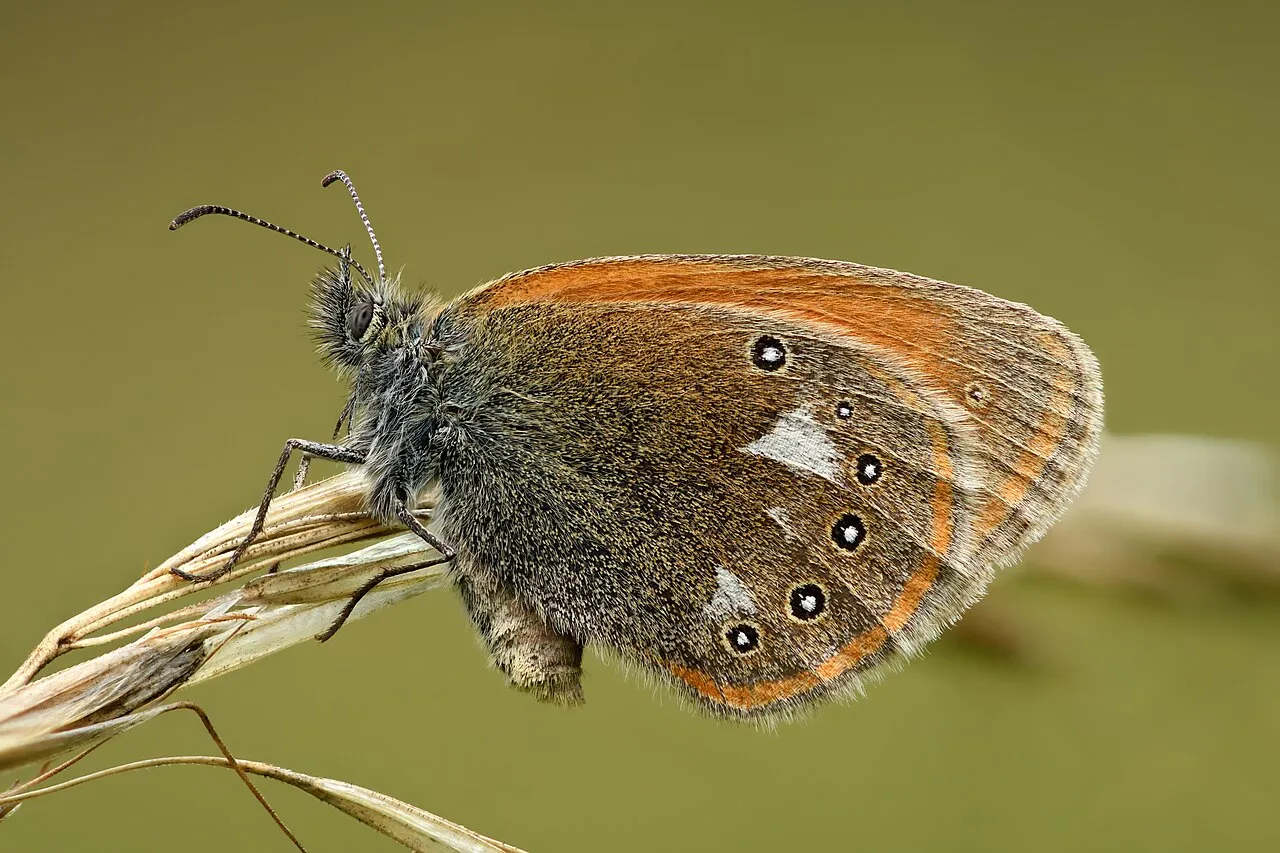
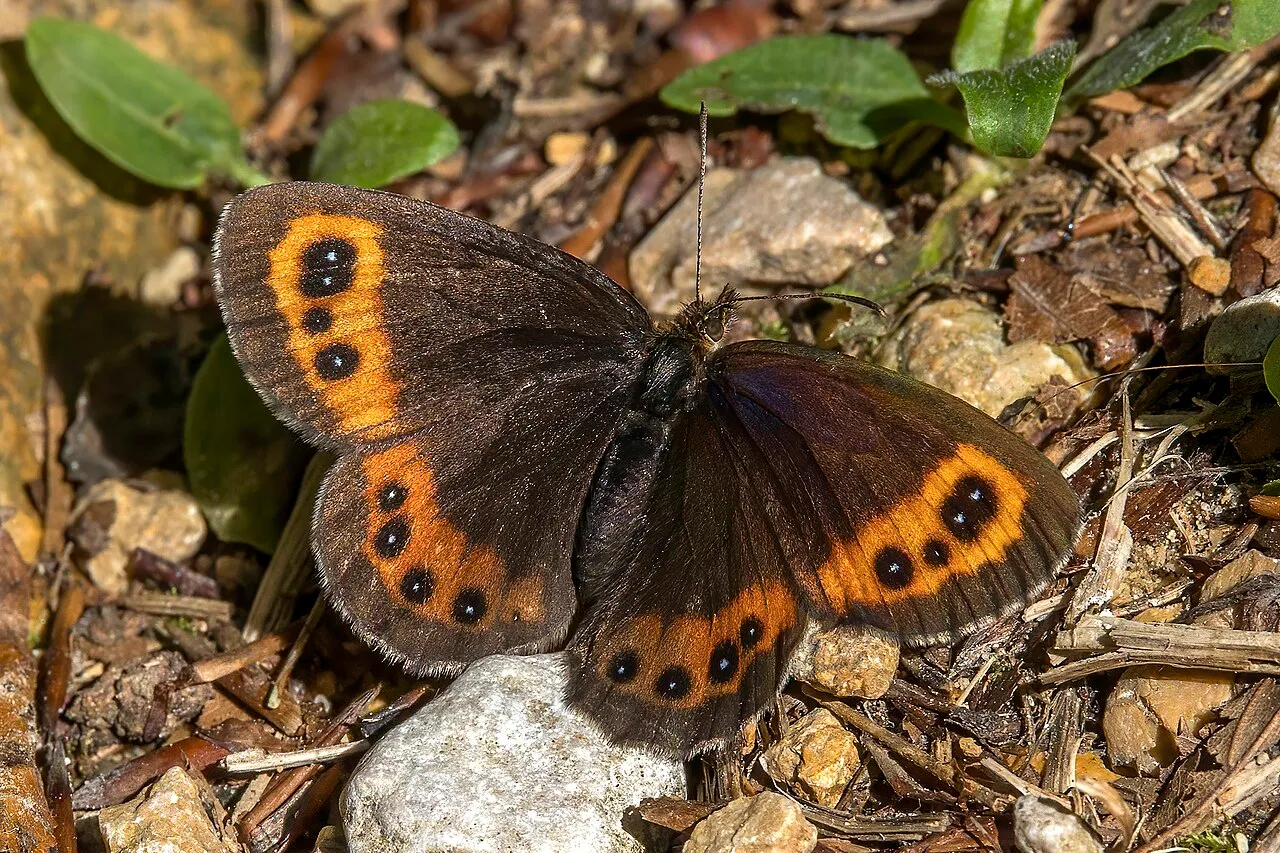
On the upperside, both wings are dark greyish brown with a reddish-orange strip near the margin, along which runs a series of black spots. Many of the spots are small but some have white centres1.
The forewing underside is dark brown with a reddish strip carrying black, white-centred eyespots near the outer edge. The hindwing underside is brown, edged with a row of more or less distinct dark eyespots, and it has one or two patches of white. In the female, the basal part of the hindwing is a darker brown1 than the rest of the wing.
Range and habitat
Wolfgang Wagner’s pyrgus.de gives the range as Central France across Central and Northern Europe to Kamchatka and Japan. To the south, the species occurs to Northern Greece, where Wagner saw it near Mount Vitsi in July 20114. Lepidoptera Mundi gives an altitude range of 350–2000 m2.
The Arran brown colonizes open woods such as floodplain forests, forest gap systems, clearcuts, wooded bog edges and grove-rich grasslands. Lepidoptera Mundi lists its habitat as forest paths, glades and spruce forests2. Pyrgus.de calls it a montane species4 of the low mountains and the Alps, including the northern foreland, which avoids hot, dry and low-lying habitats.
Pyrgus.de rates it as regionally endangered or decreasing. In the Alps it is not so endangered, at least at higher elevations. In the valley bottoms, the low mountains and the foothills of the Alps it is threatened by darkening of the forests, eutrophication, the destruction of riparian forests and so-called natural forest management. Climate change affects especially the populations in lower elevations, and on the lower eastern Swabian Alb a strong decline4 has been observed over recent decades.
Its place in Britain has long been disputed, and some specimens of Arran brown have turned up within series of Scotch Argus in old collections. There are several historical records that would suggest it was once found in Scotland, but British specimens of this species are few and far between. UK Butterflies finds insufficient evidence3 to say whether it was ever resident, a migrant, or accidentally or deliberately introduced.
Life cycle and host plants
The caterpillars feed on grasses (Poaceae and Cyperaceae), and plants of the Cyperaceae, such as Carex alba and Luzula, seem to be more important4. Lepidoptera Mundi’s primary host plants include Carex sylvatica2, along with the grasses Calamagrostis, Deschampsia, Milium effusum and Poa. Females lay their eggs on grasses and sedges1.
According to pyrgus.de, a two-year development is obviously mandatory. The caterpillar overwinters in the egg shell for the first time, and the second time in the penultimate instar. Wagner found a last-instar larva in mid-May 2011 in a light forest dominated by Carex alba in the Iller valley in southern Germany. He found a penultimate-instar larva in late October 20104 on the Adelegg, probably already hibernating in moss on a patch of Luzula.
In Finland the larvae take two years to develop1 and overwinter twice as caterpillars.
Behaviour and flight period
The adults fly from June to August4. The butterfly prefers mixed woodlands1 and is rarely seen in open areas.
Similar species
- Lapland ringlet (Erebia embla): unlike it, the Arran brown has white blotches on the under surfaces of the hindwing1.
- Arctic ringlet (Erebia disa): it lacks the Arran brown’s white hindwing blotches, and its upperside is plain brown1, while the Arran brown always has eyespots on its hindwings.
- Dewy ringlet: it has a more rusty red forewing1, and the red strip along the underside of its wings is not continuous.