Contents
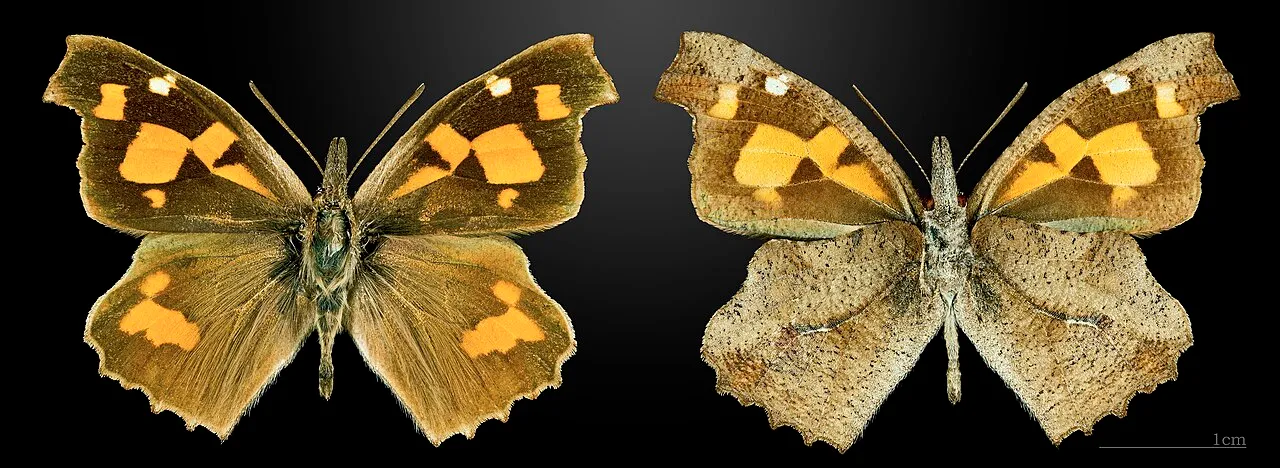
The European beak, Libythea celtis, is a brown-winged butterfly of the family Nymphalidae, named for its long palps that point forward and seem to form a snout, one of the “snout butterflies”. It is also called the nettle-tree butterfly, after the tree its caterpillars eat. The species ranges across southern Europe, Asia Minor, Central Asia and the Chitral range of Pakistan.
Identification
The upperside ground colour is a rich silky brown, broken up by orange-yellow markings that make the wings hard to mistake for anything else on the wing in its range. The forewing carries a broad orange-yellow streak in the cell, a small discal orange-yellow spot, and a much larger discal spot of the same colour between veins 2 and 4, together with a white preapical spot and a double spot near the tip. The hindwing shows an irregular, curved, transverse orange patch across the upper postdiscal area. Seen from below, the forewing apex is brown, sprinkled with fine dark transverse streaks and dots on a pale purplish ground, a mottled pattern that camouflages the butterfly at rest. The antennae, head, thorax and abdomen are dark brown. The long snout-like palps are themselves a field mark, present on no other butterfly family sharing its range, and within that range the species is considered unmistakable.
Range and habitat
Within its southern European, Asia Minor, Central Asian and Chitral range, the species occupies dry calcareous grasslands, mixed woodland, urban parks and gardens, and deciduous forests, wherever its host plant grows. It favours scrub or wooded ground near its food plant rather than open country, though the pale, mottled underside camouflages a resting adult on bark or dead leaves just as well in a shaded orchard or city park as in wilder woodland.
Life cycle and host plants
The caterpillar’s main food plant is the nettle tree, Celtis australis, and it has also been recorded on species of Prunus, Ulmus and other species of Celtis. Females lay their eggs singly on the leaf buds early in the season. The caterpillars are green and keep mostly to the underside of the leaves, where they also pupate. The species completes one generation a year.
Behaviour and flight period
Adults are strong fliers, and the genus as a whole is noted for wandering and even migratory individuals. This species is a good flyer that often roams some distance from its habitat, though it does not stray outside its overall distribution range. The single generation emerges in spring, flies into summer, and the adults hibernate, sometimes as early as August, reappearing the following March. The butterfly overwinters as an adult.
Similar species
- Common beak (Libythea lepita): the Asian counterpart, found from southern India to Japan. Its forewing cell streak is much narrower for two-thirds of its length before expanding abruptly at a right angle, its spots more orange-yellow and white, and its hindwing patch narrower and straighter, set obliquely rather than curved; its overall ground colour runs slightly darker brown than the European beak.
- African beak (Libythea labdaca): an African relative in the same widespread genus of “beaks” or “snouts”, sharing the long snout-like palps but replacing L. celtis south of its Palearctic range.
_kkJaX.webp)
_2r3CXC.webp)
_2_rmr34.webp)