Contents
The chestnut heath, Coenonympha glycerion, is a small orange-brown butterfly of woodland edges and grassy meadows, similar in size to the small heath. It belongs to the family Nymphalidae, in the same genus as the small heath and the pearly heath, and is a widespread though unobtrusive butterfly of the Palearctic. The species ranges throughout Central and much of Northern Europe, as well as North and Central Asia, extending east across the Palearctic to Siberia, the Caucasus and North Korea.
Identification
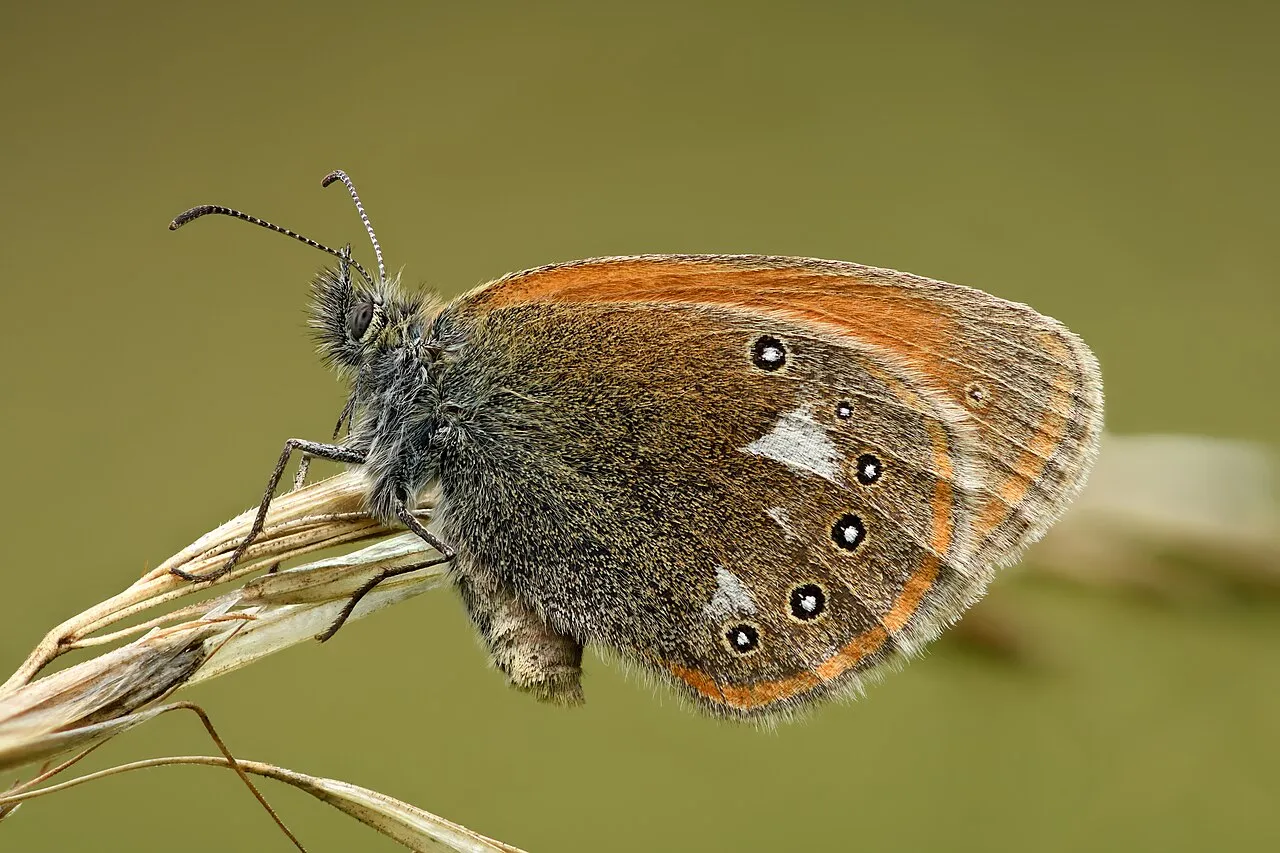
The hindwing underside carries several eyespots, often five or six, with two large irregular white sinuous patches beyond the middle that may be separate or thinly connected. The forewing underside, by contrast, is either entirely without eyespots or shows just a small, pale one near the wing tip. The sexes differ on the upperside of the forewing disc: males are copper-brown, while females run yellowish brown in varying shades; in both sexes the hindwing upperside is a uniform blackish brown. An exact wingspan figure is not yet available from a source this site can cite; it is being tracked for addition. The species is split into several subspecies across its range, which vary mainly in how prominent the hindwing eyespots are and in their geographic distribution through Europe and Central Asia, so the exact look of a chestnut heath depends somewhat on where it is found.
Range and habitat
Within its broad Palearctic range the chestnut heath keeps to warm woodland edges with irregularly used grassland, including grassy forest roads and damp meadows. It favours the dappled, unmanicured ground between trees and open country rather than either deep woodland or wide-open fields.
Life cycle and host plants
Caterpillars feed on various grasses, though the source does not name particular species. The larva is dull green, with a blue-green head, a dark stripe down its back, a paler stripe along its side, a red anal fork and yellowish-red spiracles; it carries the species through winter, remaining through spring until May before pupating. The pupa is green, with a white-spotted abdomen and dark-edged wing cases.
The species produces one generation a year, on the wing from June to August, with exact timing varying by region across its wide range.
Behaviour and flight period
Adults fly from June to August, with a single generation covering the whole season rather than overlapping broods. Females are notably sedentary fliers: they rarely rise more than one or two feet above the ground, and when disturbed usually fly only a few paces before settling again. This low, short-hop flight keeps them close to the grass stems where they rest and lay eggs, rather than drawing attention in open flight.
Similar species
- Pearly heath (Coenonympha arcania): a close relative in the same genus, distinguished by the broad, unbroken white band that crosses its hindwing underside, unlike the separate white patches of the chestnut heath.
- Small heath (Coenonympha pamphilus): smaller and paler, and a widespread grassland species across much of the same range; its hindwing underside lacks the chestnut heath’s prominent row of eyespots.
__Dahlem_ZP6IRJ.webp)
_kkJaX.webp)
_2r3CXC.webp)