Contents
The dark green fritillary, Speyeria aglaja, is a large, powerfully-flying butterfly of the family Nymphalidae, named for the green wash on the underside of its hindwings. It is now classified in the genus Speyeria, though older sources and much of the European literature still know it as Argynnis aglaja. It has a wide Palearctic range, found across Europe and into Morocco, Iran, Siberia, Central Asia, China, Korea and Japan, and it is the most widespread fritillary in the British Isles. Across that range taxonomists recognise eleven subspecies, from two found only in Morocco to others spread from the Caucasus and the Altai through Siberia to Kamchatka and Sakhalin.
Identification
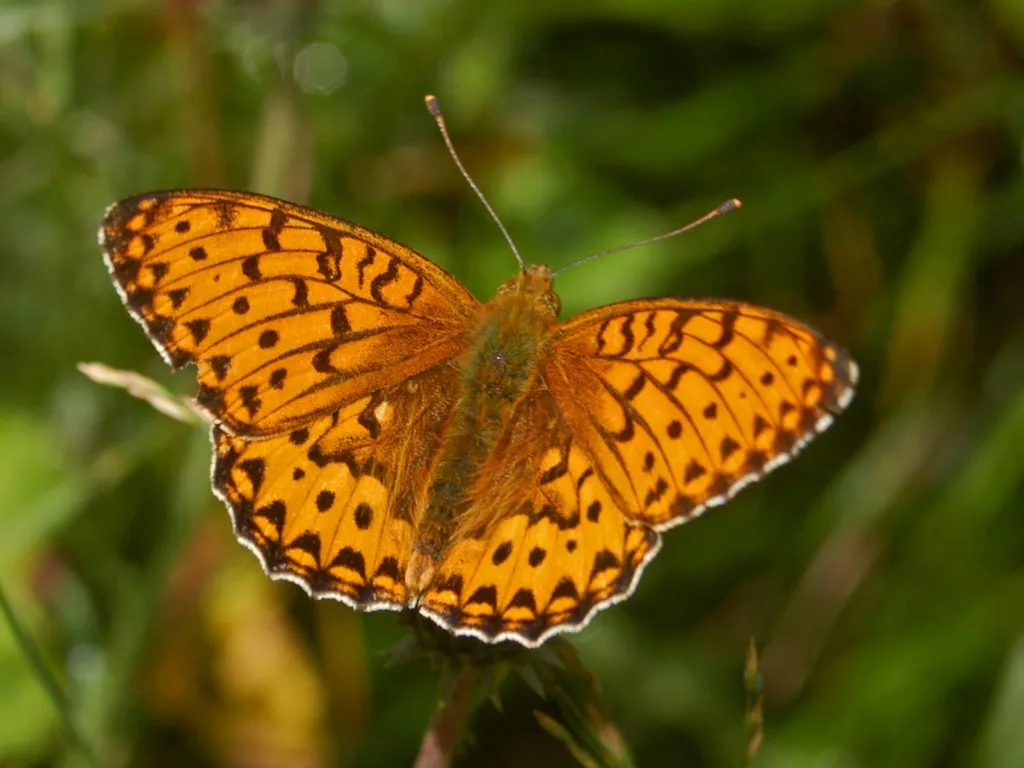
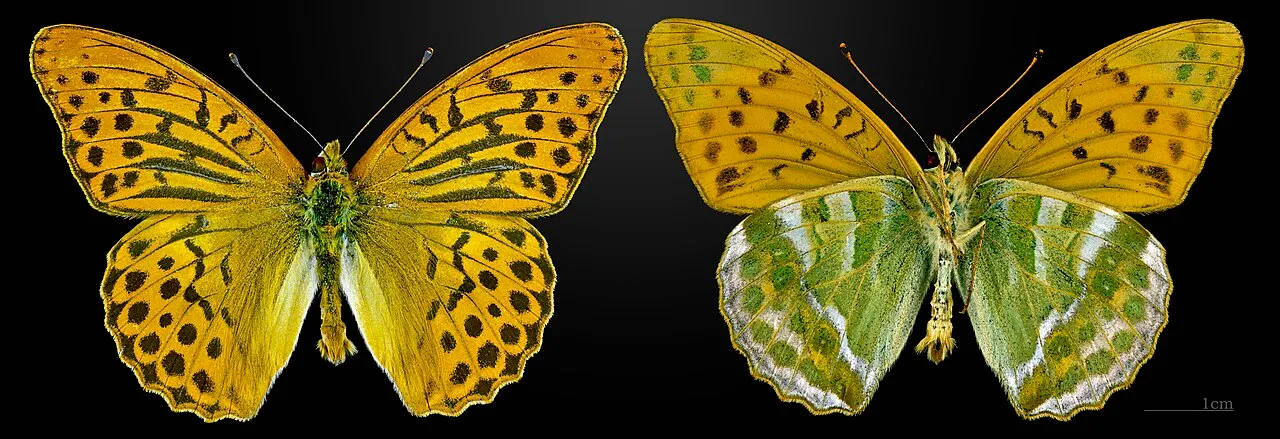
The upperside is fiery reddish yellow, with black margins, marginal arcs and a straight central row of dots crossed by six thin black transverse bands; males show a duller, darker basal area than females. The underside of the hindwing gives the species its name: it is washed with green and peppered with large silver spots, set on a ground that is partly verdigris and partly leather-yellow. Unlike the High brown and Niobe fritillaries, it lacks the row of eye-spots (ocelli) in the marginal area of the hindwing underside, which makes it one of the easier fritillaries to name with confidence. The wingspan runs 58–68 mm.
Range and habitat
Within Britain it is the only fritillary found in Orkney and the Outer Hebrides, though it is less common across central and eastern England. It favours open, windswept calcareous grassland, woodland clearings and coastal dunes. Despite being a strong flier, it is not especially mobile, tending to stay within its breeding grounds rather than colonise new ground.
Life cycle and host plants
Caterpillars feed on violets, chiefly common dog-violet (Viola riviniana), hairy violet (Viola hirta) and marsh violet (Viola palustris). The egg is pale primrose-yellow at first, deepening and banding with lilac-purple and pale greenish-yellow before turning dusky-brown and then pearl-grey just before hatching. It hatches in two to three weeks, and the caterpillar hibernates as soon as it hatches, staying dormant for about 228 days before resuming feeding in spring. The young caterpillar is grey-white with black spines and stripes, while the full-grown, sixth-instar larva turns velvety black with an orange blotch on each segment, a yellow band down the back and red spots along each side, reaching about 38 mm. It then passes through five moults before pupating, with the pupal stage lasting three to four weeks: the chrysalis is ochreous and orange-brown with dark blotches across the wing cases, giving it a scorched look, and hangs upside down in a loose tent of leaves spun together by the caterpillar. There is one generation a year.
Behaviour and flight period
Adults are on the wing from mid-June to early August in Britain, peaking in early July in the south and in late July or early August in northern Scotland. The butterfly flies powerfully over its grassland habitats, stopping frequently to nectar on thistles and knapweed, and more widely it is recorded taking nectar from common knapweed, marsh thistle, devil’s-bit scabious and field scabious. Males patrol extensively in search of virgin females resting low in the vegetation, and mating follows almost as soon as one is found; females are seen more often while egg-laying, when they alternate between nectaring, basking and crawling through the vegetation, and eggs are laid in high summer, on or near violet plants.
Similar species
- High brown fritillary (Argynnis adippe): the closest look-alike where their ranges overlap, but the dark green fritillary lacks the row of eye-spots on the hindwing underside that the High brown fritillary carries.
- Silver-washed fritillary (Argynnis paphia): larger, with a wingspan of 69–80 mm against the dark green fritillary’s 58–68 mm, and its underside carries streaks of silver rather than the dark green fritillary’s silver spots.
- Queen of Spain fritillary (Issoria lathonia): much smaller, at 34–56 mm across the wings, and recognised by the large silver spangles on its hindwing underside and a sharply angled hindwing edge not found in other British fritillaries; in Britain it is only a rare migrant, unable to survive the winter.
_kkJaX.webp)
_2r3CXC.webp)
_2_rmr34.webp)