_female_Macedonia_Z3684v.webp)
Contents
The dusky meadow brown, Hyponephele lycaon, is a butterfly of the family Nymphalidae found very locally1 on warm, dry ground from the Iberian Peninsula to Central Asia. One account instead describes the species as broadly distributed across the Palearctic, from Portugal to the Russian Far East2.
Identification
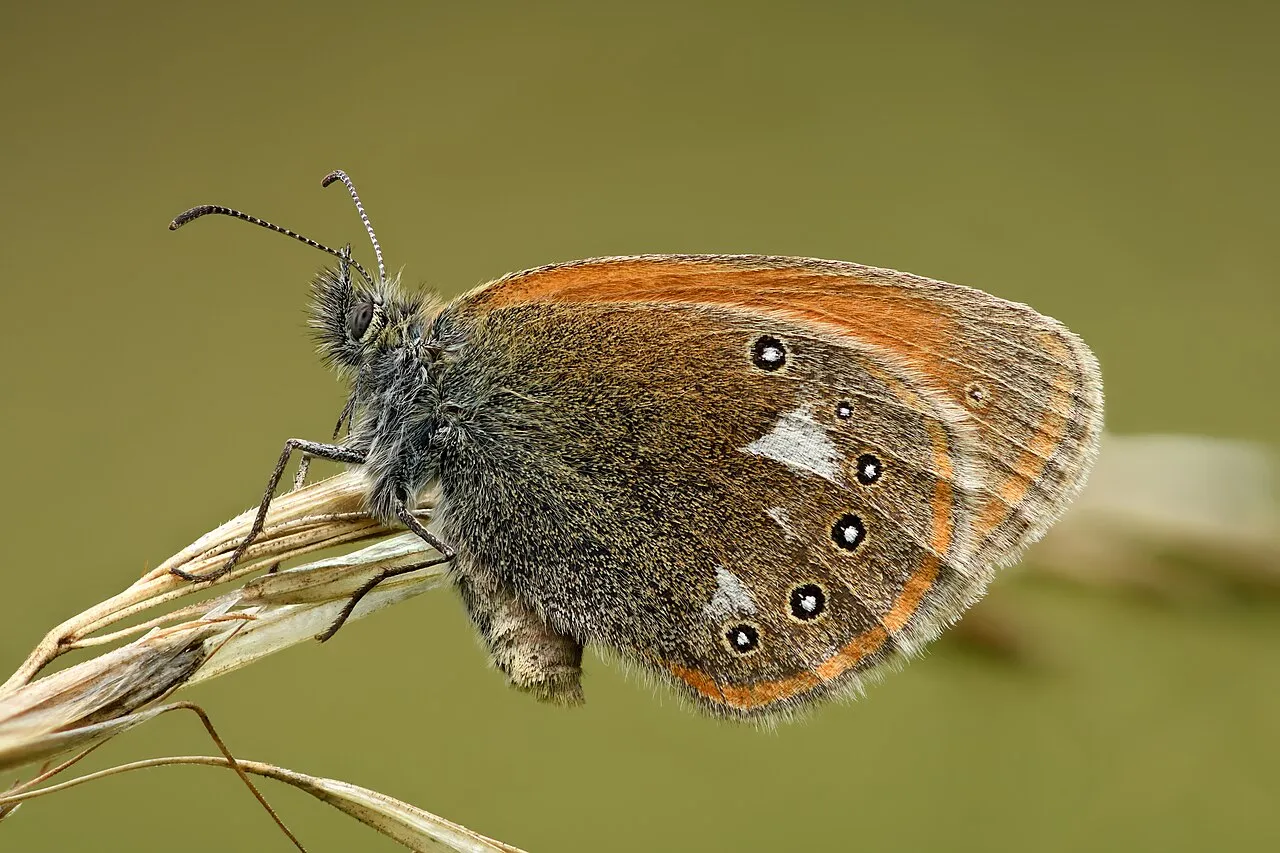
Adults have a wingspan of 36–40 mm3. The upperside is brown, with a dark spot near the forewing tip and another in space S2 of the forewing, smaller in males than in females4. The look-alike Hyponephele lupina is told apart from it most easily by size: lupina is a bit larger, approaching that of the meadow brown, Maniola jurtina, whereas the dusky meadow brown is smaller5.
On the underside, the hindwing is finely speckled, an “irrorated” texture, rougher than the smooth-looking hindwing underside of M. jurtina, and crossed by a discal line whose contrast varies between individuals; next to H. lupina, its hindwing underside shows a slightly brighter postdiscal band4. The sexes are also told apart on the forewing underside: females carry two eyespots, while males lack the lower one6.
The pattern of the hindwing underside is not fixed even within one population. In a DNA-barcode study of Mount Hermon in northern Israel, butterflies identified as H. lycaon fell into two groups: one with a more contrasting pattern and a clear medial band, collected mainly in the forest zone lower on the mountain, and another with a paler, lower-contrast pattern, collected mainly on the thorny-cushion steppe of the subalpine zone above it. The two groups also tended, though inconsistently, to differ in the male genitalia: longer brachia in the contrasting-pattern group, more often reduced brachia7 in the pale-pattern group.
Range and habitat
The species occupies sandy grassland, steppe and rocky slopes on bare, xerothermous ground, sometimes on sparsely wooded mountainsides with steppe-like clearings. South of the Alps it climbs well into the mountains, recorded up to 2000 m, and in southern Spain up to 2600 m1; in the French Alps, one observer has never recorded it below 1000 m6. In Israel, H. lycaon-type butterflies were found only on Mount Hermon in the north of the country, unlike the more widespread H. lupina, which also occurs further south in central Israel. On the mountain itself, the two hindwing-pattern groups kept largely to different belts: the contrasting-pattern group mostly in forest at 1450–1600 m, the pale-pattern group mostly on subalpine steppe at 1800–2050 m7, where thorny cushion plants such as Onobrychis cornuta and Astragalus species dominate.
Life cycle and host plants
Caterpillars feed on grasses with low production such as fescues (Festuca spp.), with erect brome and meadow-grasses3 (Bromus erectus, Poa spp.) also named as food plants. Eggs are usually attached to dead grasses near the ground, and the caterpillar hibernates right after hatching, overwintering as a young larva. One observer found penultimate- and final-instar caterpillars active by day in spring at 2000 m in the Valais in early June, at 2500 m in Spain’s Sierra Nevada in late June, and near Madrid in early May1.
Behaviour and flight period
Adults are on the wing mainly in July and August, sometimes into September, and already from June at lower elevation1; one account gives a shorter window, June to August2 depending on location. At rest it keeps its wings closed4; one observer in the French Alps never once saw it settle with the wings open, even briefly6, which also makes the upperside hard to photograph in the field.
Conservation
As of 20248, the species carries an IUCN Red List assessment of Least Concern. That global standing masks pressure in some regions: in Germany it is threatened with extinction as its sandy, xerothermous sites disappear, through abandoned military training grounds, bush encroachment and fragmentation, while south of the Alps it is endangered by intensive agriculture, such as new vineyards, spreading into land once only lightly used, though it remains better distributed at higher altitude1 there.
Similar species
- Hyponephele lupina: the species it is most often confused with, distinguished most easily by its larger size, approaching that of the meadow brown, and by a more serrated hindwing margin; males also differ in the shape of the forewing androconial scales, and the final-instar caterpillars are separated by the shape of the head capsule5, whose edges are prolonged in H. lupina. A molecular study of Israeli populations found the two far apart genetically, H. lupina closer to Hyponephele interposita than to H. lycaon. In Israel the two are told apart by range as well, since only H. lupina reaches central Israel7, while H. lycaon-type butterflies there are confined to Mount Hermon in the north.
- Meadow brown (Maniola jurtina): larger, close in size to H. lupina5 and so bigger than the smaller H. lycaon.
- Hyponephele lycaonoides: a taxon described from Iran’s Zagros Mountains (reports from Turkey have been questioned). Genus specialists treat it as a full species, separated from H. lycaon mainly by shorter male genitalic brachia, but one earlier study read that same difference as variation within one species rather than a species-level trait, and the name lycaonoides could turn out to be a synonym of an earlier-described form, libanotica. Where the two have been compared on genetic grounds, in Israel, the forms proposed to carry each name differed by 3.5% in their mitochondrial DNA barcode and in hindwing underside pattern7, but the study’s authors stop short of confirming that the two represent separate species.
_female_Dobruja_26TKKb.webp)