_2_rmr34.webp)
Contents
The meadow brown, Maniola jurtina, is a common grassland butterfly of the family Nymphalidae, found across much of the Old World. It is one of the most familiar brown butterflies of summer meadows, on the wing for weeks on end while most other species pass in a single short burst. The species ranges across Europe south of about 62°N, Russia east to the Urals, Asia Minor, Iraq, Iran, North Africa and the Canary Islands.
Identification
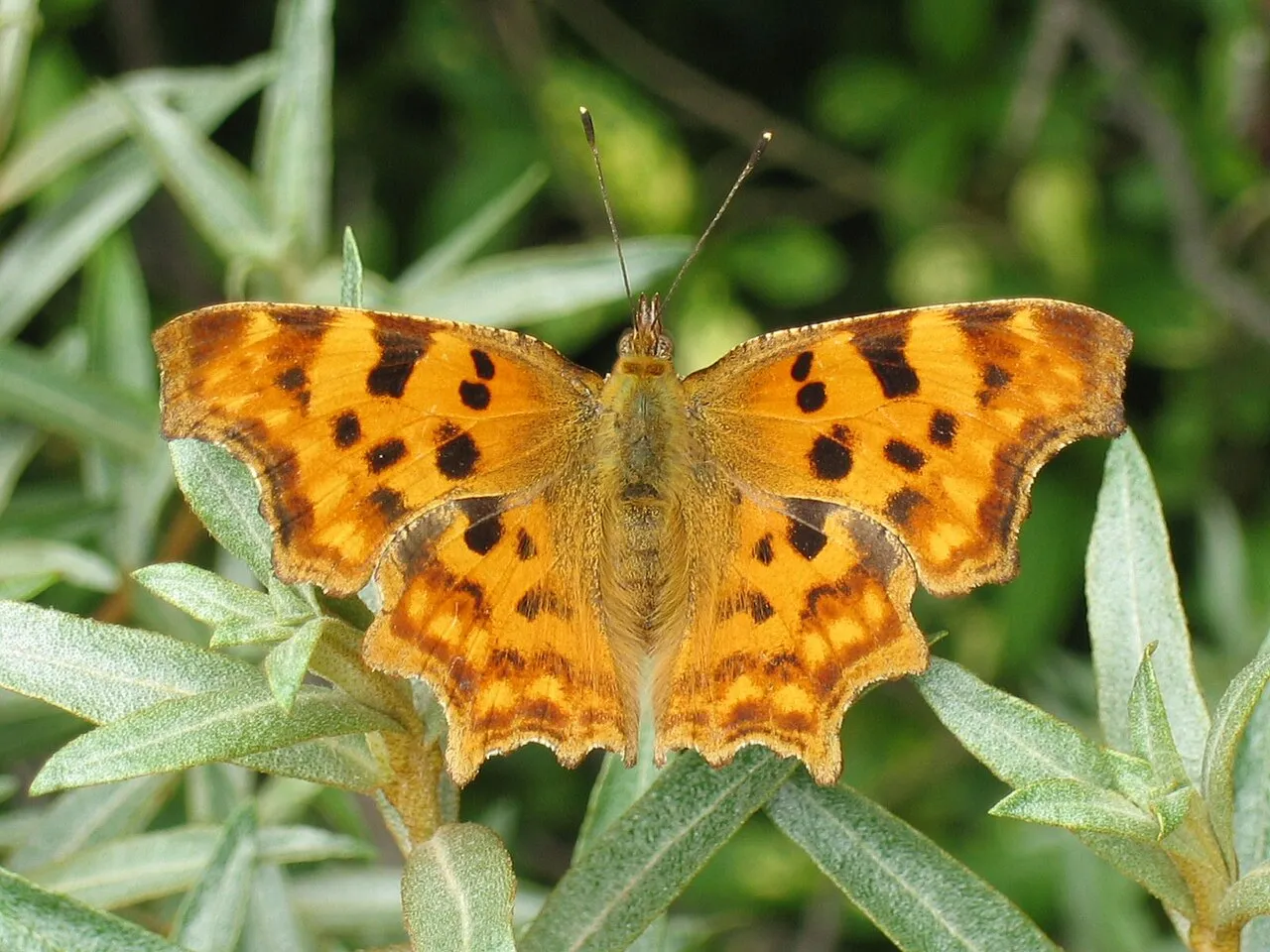
The meadow brown has a wingspan of 40 to 60 mm, with males running from 40 to 55 mm and the larger females from 42 to 60 mm. The sexes look quite different above. The male is uniformly light brown on the upperside with a black eyespot centred white at the forewing tip, and his ground colour is darker overall, with tawny-orange patches confined to the area around that eyespot. The female carries a tawny patch that spreads further around the eyespot and can extend onto the hindwing, giving her a noticeably brighter, more orange look than the male.
The underside tells a similar story. On the male the hindwing underside is ochre bordered with dark beige, with a matching eyespot at the apex, while the female’s hindwing underside is greyish to brown, crossed by a more or less orange band. Both sexes can show extra small eyespots scattered across the hindwing underside; these number up to twelve per butterfly, with as many as six to a wing, though some individuals show none at all.
Range and habitat
Across its range the meadow brown lives in forest edges, forest-steppe and meadow-steppe up to 2,000 m, as well as cultivated land such as meadows, forest plantations, parks and orchards. In Britain it is far less fussy than many relatives, turning up in almost any grassy habitat where the sward is of medium height, including woodland rides, field margins, hedgerows, road verges and overgrown gardens, and it tolerates even heavily grazed fields as long as some rank grass survives around the edges.
Life cycle and host plants
Caterpillars feed on a range of common grasses, including bents (Agrostis spp.), cock’s-foot (Dactylis glomerata), fescues (Festuca spp.) and meadow-grasses (Poa spp.). Eggs are laid singly on the foodplant and hatch after two to four weeks. The caterpillar passes through six instars before reaching its full size of around 25 mm, a stage that stretches out over roughly eight to nine months because it overwinters as a partly grown larva, hidden at the base of a grass clump and feeding again whenever winter weather turns mild. The chrysalis, slung by its cremaster, then lasts three to four weeks before the adult emerges.
The meadow brown is univoltine, with a single generation a year, but adults emerge over an unusually long stretch of spring, summer and autumn rather than all at once, because larvae that develop quickly give rise to a trickle of later adults alongside the main summer emergence.
Behaviour and flight period
In Britain, adults are on the wing from mid-June to the end of September in most years, and further south and east the flight period runs on even longer through summer into autumn. The sexes behave differently in the air as well as in colour: males are much more active and wander widely, while females fly less and often stay close to the area where they grew up. Adults are also unusually long-lived for a butterfly, a trait that lets a single generation keep fresh individuals flying across most of the warmer half of the year.
Similar species
- Gatekeeper (Pyronia tithonus): overlaps with the meadow brown through summer but prefers to rest with its wings open, unlike the meadow brown’s habit of keeping them closed.
- Small heath (Coenonympha pamphilus): a similar but distinctly smaller butterfly that shares grassy habitats with the meadow brown across much of its range.
_kkJaX.webp)
_2r3CXC.webp)
_Melanargia_galathea_-_Foret_de_Bouconne__France_-_male_ZVEkr8.webp)