Contents
The gatekeeper, Pyronia tithonus, is a small orange and brown butterfly of hedgerows and scrubby grassland, named for its habit of basking along the gaps and gateways between fields. It belongs to the family Nymphalidae, in the grass-feeding subfamily that also holds the meadow browns and ringlets. The species is found across Europe, including Britain, Ireland and the Channel Islands, where it is common in the south of Britain and sparser in the north, with its range expanding northward in recent decades.
Identification
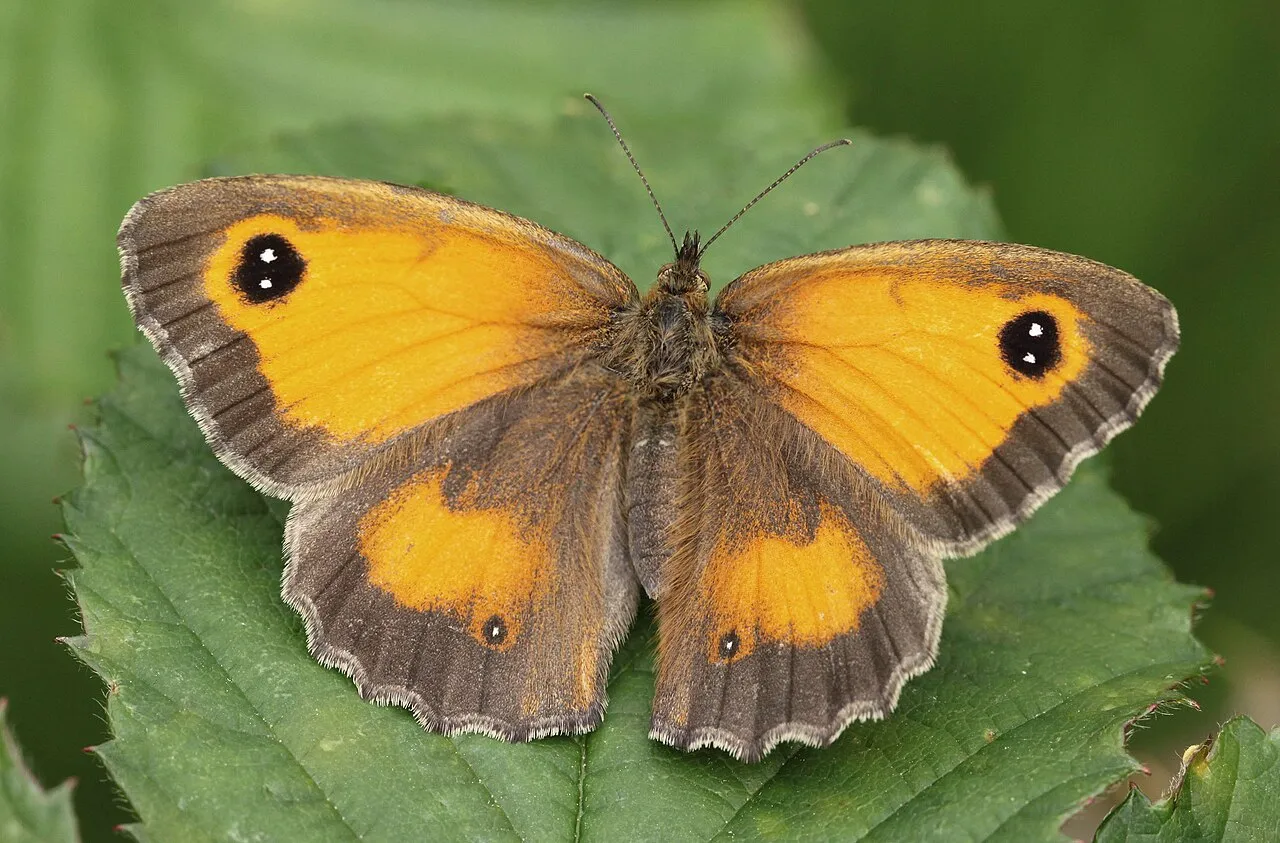
The gatekeeper has a wingspan of about 37 to 48 mm, with males running 37 to 43 mm and the larger females 42 to 48 mm. The upperside is orange with two large brown spots on the wings and a brown border around the wing edges. Each forewing carries an eyespot, and the eyespots most likely reduce or deflect bird attacks, which is why the butterfly often rests and basks with its wings held open. A reliable field mark separates it from the similar meadow brown: the gatekeeper has double pupils in its eyespots.
The sexes are easy to tell apart in the field. Only the male carries the dark sex brand, a patch of scent-producing scales, on the upperside of the forewing, formally known as the androconia. Spotting runs the other way: females typically show more spots than males, and their eyespots sit spread further along the wing margin, while a male’s eyespots sit closer to the leading edge of the wing.
Range and habitat
Within its European range the gatekeeper favours scrubby grassland, woodland rides, country lanes, hedgerows and field margins next to rough grassland. The hedgerow-edge habit gives the species both its common name and its tendency to turn up wherever a hedge or scrubby boundary meets open ground.
Life cycle and host plants
Caterpillars feed on fine grasses, among them bents (Agrostis), fescues (Festuca), meadow-grasses (Poa) and common couch (Elymus repens). A female is prolific: once mated, she typically lays between 100 and 200 eggs, laid singly, usually in shade beneath a shrub, either placed directly on a foodplant or simply ejected into the air over a suitable patch of grass. Inside the egg, the developing larva starts out yellow before developing brown patches and darkening further over roughly a fortnight before hatching. Once hatched, the caterpillar is already patterned in these colours, and by day it hides at the base of grass stems and feeds at night. The species overwinters as a caterpillar, which hibernates after its first moult at the base of a grass clump. Pupation produces a flimsy chrysalis that either hangs upside down or lies among grass stems, and the species completes a single generation a year. Across its range the gatekeeper raises only this one brood annually, timed so that the single flight period below coincides with the warmest weeks of summer, after which the next generation overwinters as caterpillars to begin the cycle again.
Behaviour and flight period
In Britain the gatekeeper is on the wing from late June to August, peaking in late July and early August, though flight periods run shorter nearer the edge of its European range. Adults spend much of the day basking with their wings open, a habit that also makes the sexes easy to tell apart in the field. Males are territorial, and they set up small territories, often centred on a particular shrub or bush, flying up from their perch to investigate any passing butterfly in the hope of finding a mate.
Conservation
The species is listed by the IUCN under the category shown in the facts box, taken from its Wikidata record. Its range has not contracted in the way many grassland butterflies have; if anything, the gatekeeper’s range has been expanding northward in Britain in recent decades, likely helped by its tolerance of the scrubby, unmanaged field margins that persist around farmland.
Similar species
- Meadow brown (Maniola jurtina): the classic look-alike, sharing orange-brown colouring and grassland habits, but its eyespots have a single pupil, unlike the gatekeeper’s double-pupilled spots. See Meadow brown.
- Speckled wood (Pararge aegeria): another grass-feeder of woodland edges and lanes, though its wings are dappled brown and cream rather than orange, and males hold territories in sunlit gaps rather than along hedgerows. See Speckled wood.
_kkJaX.webp)
_2r3CXC.webp)
_2_rmr34.webp)