Contents
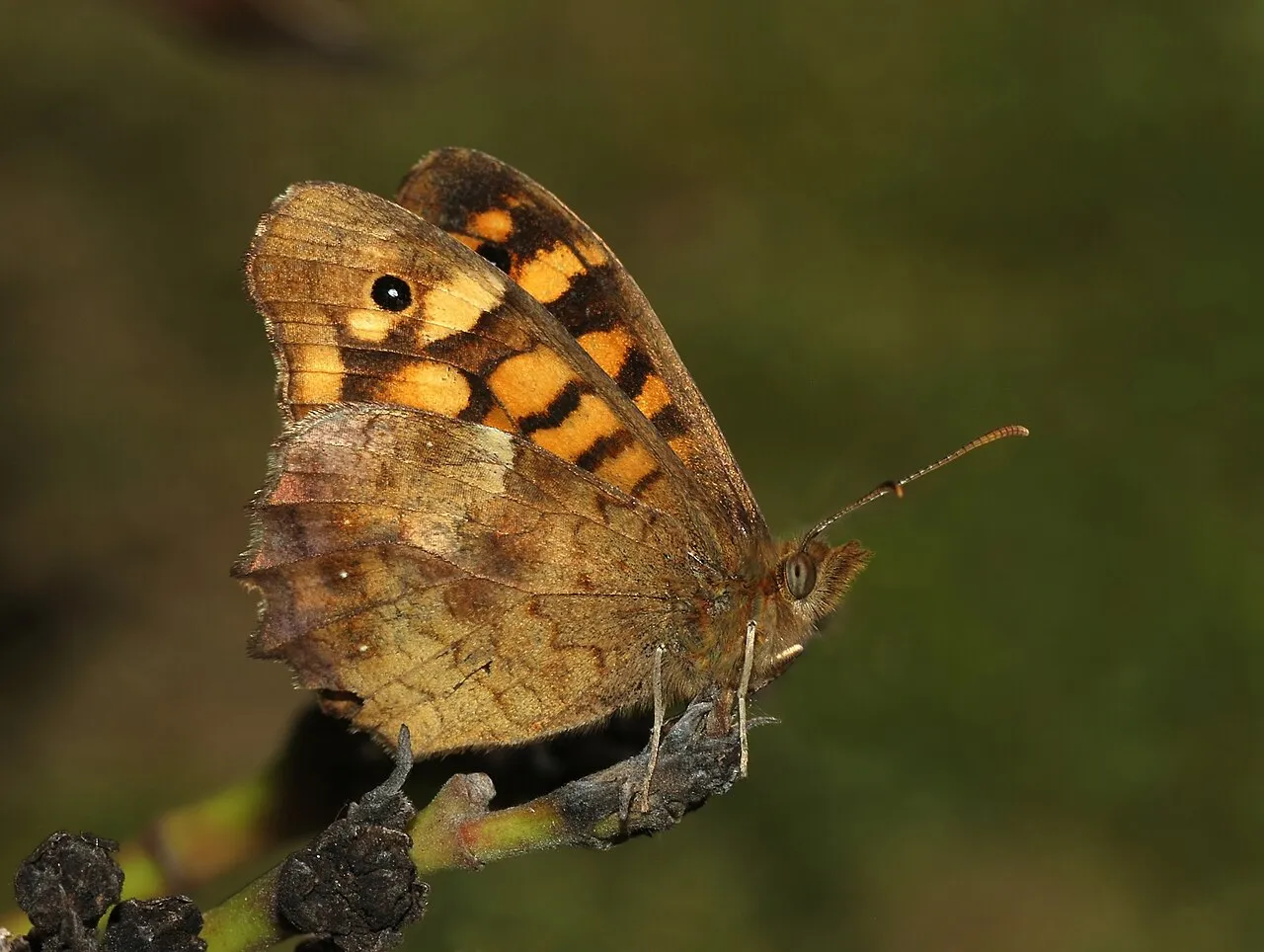
The speckled wood, Pararge aegeria, is a woodland butterfly patterned with pale cream, white or tawny-orange spots over a brown or orange ground colour. It belongs to the family Nymphalidae, in the genus Pararge. The species is found across much of the Palearctic realm, through Europe, North Africa, Asia Minor, Syria and parts of central Asia, and in Britain through England, Wales and Ireland and parts of Scotland.
Identification
The speckled wood has a wingspan of 46–56 mm, with males running 46–52 mm and the slightly larger females 48–56 mm. Both wing surfaces are dark brown broken up by pale cream or orange-buff spots, a pattern that works as camouflage in dappled shade. Males are slightly smaller than females and carry a row of greyish-brown scent scales on the forewings that females lack, while females tend to show brighter, more distinct markings. The species forms distinct regional subspecies that intergrade into one another: a brown form with pale yellow spots across northern and central Europe, an orange-background form in the southwest of Europe and North Africa, and a near-black form with white spots in Scotland. The underside carries its own regional differences: the northern and central European form has darker eyespots on the upperwing, the southwestern form shows reddish-brown rather than black or dark grey eyespots on the hindwing underside, and the Scottish form adds a row of conspicuous white spots to that same hindwing underside. Northern populations also tend to have larger forewings than southern ones, an adaptation that helps with thermoregulation in a cooler climate.
Range and habitat
This is above all a woodland butterfly. It favours woodland, but also grassy, flowery places such as meadow edges, glades, hedges and wooded parks and gardens, wherever there is enough scrub for shade. Unlike many grassland butterflies it does not need open sunshine all day: broken, patchy light through a canopy suits it well, and it is one of the few British butterflies as likely to be met in a shaded lane or a garden hedge as in a flowery meadow. Across its wide Palearctic range it reaches from the Atlantic coast of Europe to parts of central Asia, tracking woodland and scrub rather than any single climate.
Life cycle and host plants
Caterpillars feed on grasses, including cock’s-foot, common couch, false brome and Yorkshire-fog, with other Poa and Holcus species taken depending on region. The species overwinters as either a caterpillar or a chrysalis, uniquely able to pass the cold months in either stage rather than being fixed to one, an unusual flexibility that leads to a complicated pattern of several overlapping adult flights through the year. There are 2–3 generations a year, the number depending on location and weather, with southern populations fitting in more broods than those further north.
Behaviour and flight period
Adults are on the wing from April to September in Britain, occasionally appearing as early as March or as late as October, while further south several broods overlap so that adults can be seen for most of the year. Males are strongly territorial, perching on low vegetation in a sunny spot and flying towards any intruder almost as if to collide with it, the pair then rising together, spiralling upwards in dense understorey, with the resident male usually winning the contest and returning to his perch. Not every male defends a fixed perch: some instead patrol through the habitat looking for females rather than waiting at a sunspot, a second mating strategy alongside territory-holding. Females are choosier about mating than males: a female typically mates only once in her lifetime, while a male may mate several times, and she spends more of her time in shade, moving through the understorey in search of grasses on which to lay her eggs.
Similar species
- Wall (Lasiommata megera): a related grassland butterfly with orange-yellow wings and eyespots, strongly preferring open, sunny ground such as unimproved grassland, wasteland and cliff edges, where it often basks on bare ground or walls, rather than the speckled wood’s dappled woodland shade.
- Gatekeeper (Pyronia tithonus): a golden-brown butterfly of scrubby grassland, woodland rides and hedgerows, on the wing mainly from late June to August, later in the summer than the speckled wood’s long season.
_kkJaX.webp)
_2r3CXC.webp)
_2_rmr34.webp)