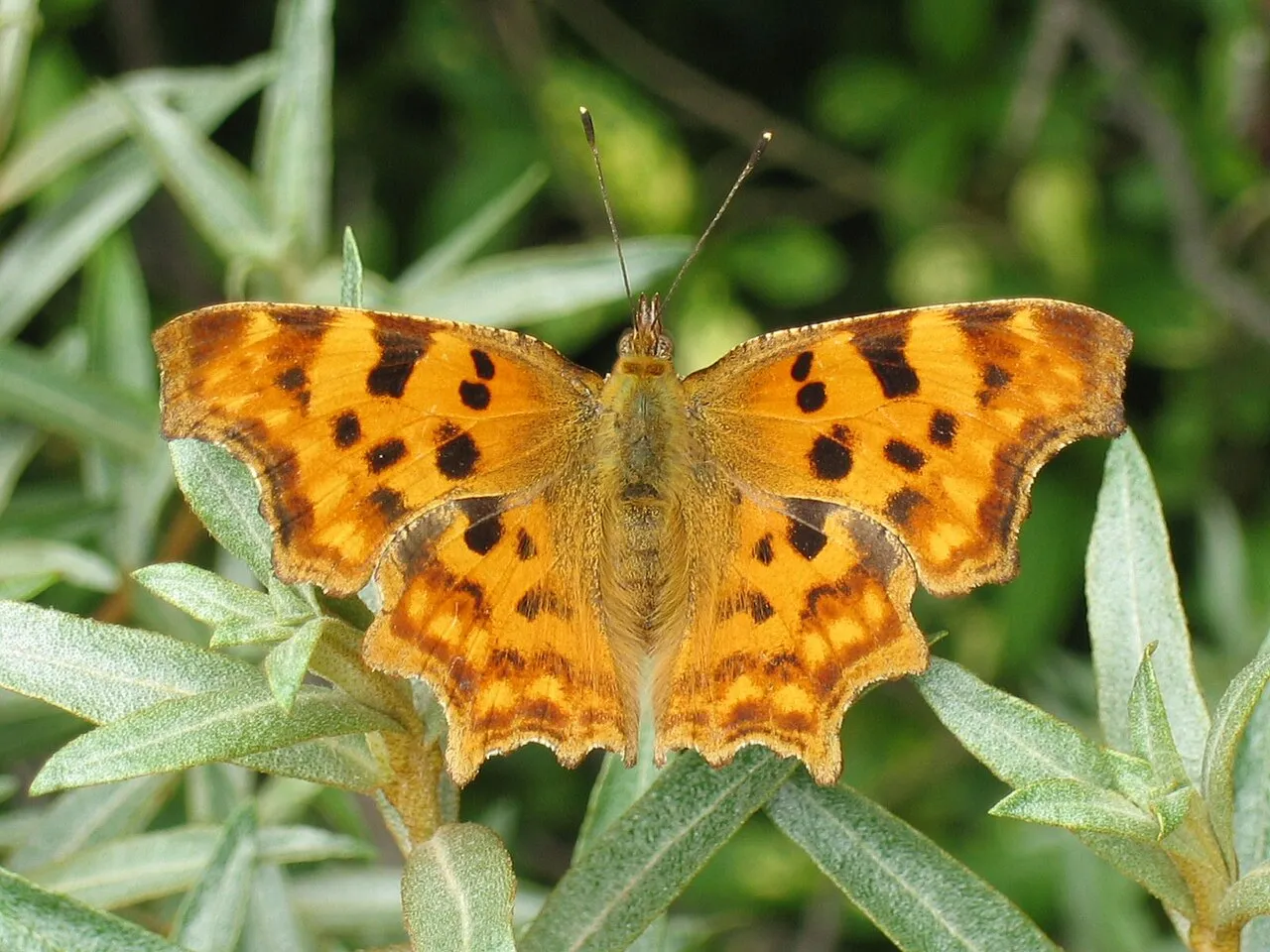
_Lasiommata_megera_-_Foret_de_Bouconne__France_-_male_Z1A3y4T.webp)
Contents
The wall brown, Lasiommata megera, is a small, fast-flying butterfly of the family Nymphalidae, named for its habit of resting on bare ground, stone and walls with its wings held open. It is a wide-ranging Old World species, found across North Africa, Europe, the Caucasus, Asia Minor, the Middle East, western Siberia, the northern Tian Shan, the Dzungarian Alatau, Kazakhstan and Dzungaria.
Identification
Wingspan runs about 45 to 53 mm. The upperside is orange-brown, crossed by a dark band that runs from the cell of the forewing to the rear edge of the hindwing, with short dark streaks crossing the disc and the cell, and both wings carry small dark eyespots near the margin. The underside is far quieter: a cryptic, mottled pattern that camouflages the butterfly against bare soil and rock, where it habitually rests. The two sexes are told apart at a glance. The male is the brighter, more conspicuous of the two, patrolling or perching to find mates, while the female is duller and more sedentary, staying hidden in vegetation once she has mated.
Range and habitat
Within its broad range, the wall brown favours forest edges and clearings, shrubby ground in ravines and river valleys, and sparse woodland, from sea level up to about 3,000 m. In Britain, where it is studied closely, it keeps mainly to coastal grassland, cliffs and hedgerows with patches of bare ground, the open, sun-warmed surfaces it needs for basking.
Life cycle and host plants
Caterpillars feed on a range of grasses. In Britain these include bents (Agrostis), Cock’s-foot (Dactylis glomerata), False Brome (Brachypodium sylvaticum), Tor-grass (Brachypodium rupestre), Wavy Hair-grass (Deschampsia flexuosa) and Yorkshire-fog (Holcus lanatus). The species overwinters as a caterpillar in its third instar, which keeps feeding through the colder months whenever the weather turns mild enough, rather than entering full hibernation. Across its range it fits in two to three generations a year, depending on locality and altitude.
Behaviour and flight period
Flight spans most of the warmer months, though the exact pattern varies with latitude. In Britain the first brood flies from early May, peaking in late May and early June, with a second brood from late July to mid-August and, occasionally, a small third brood in October. Males are the active, visible sex, patrolling open ground or perching on a favoured spot to intercept passing females, a territorial habit shared with other wall-resting browns. Once mated, females become far less conspicuous, keeping to cover in grass and scrub rather than patrolling in the open.
Similar species
- Speckled wood (Pararge aegeria): a close relative in the same subfamily, but patterned in brown and cream rather than orange, and a butterfly of dappled woodland shade rather than open, sunlit ground.
- Large wall brown (Lasiommata maera): the wall brown’s larger cousin, similar in colour and pattern but bulkier, and more a butterfly of rocky slopes and mountain ground than of lowland walls and bare paths.
_..._Macedonia_(53801668364)_(cropped)_Z2gAgeh.webp)
_kkJaX.webp)
_2r3CXC.webp)