Contents
The common buckeye, Junonia coenia, is a butterfly in the family Nymphalidae1, placed in the subfamily Nymphalinae and the tribe Junoniini2. It lives as a resident or vagrant across much of North America and Central America3, and in parts of northern South America.
Identification
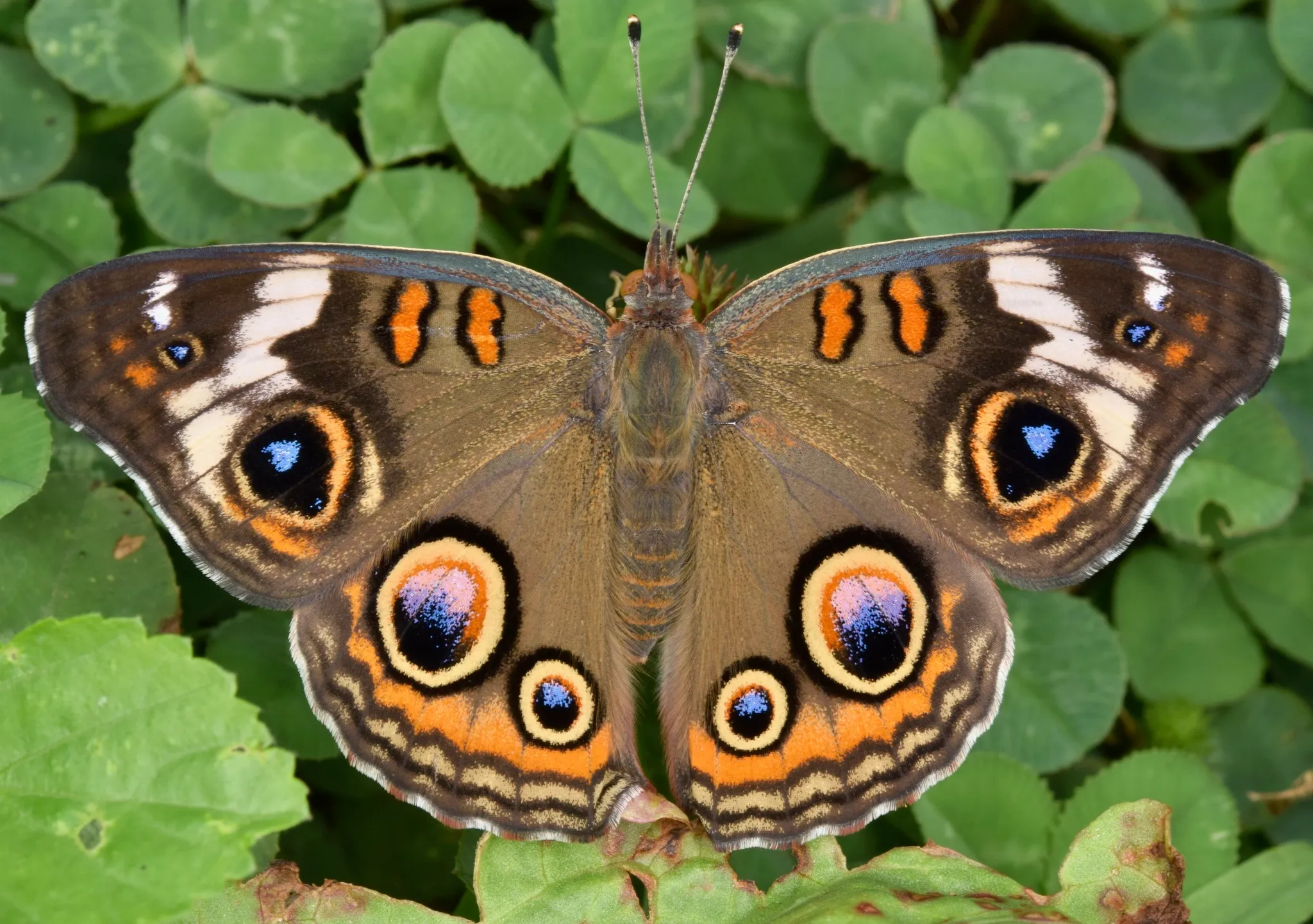
Animal Diversity Web gives a wingspan of 4 to 6 cm; the Florida Museum gives 2.3 to 3.0 in2. The adult has brown wings with three eyespots per wing1, orange bands on the forewing and a particularly large, reddish to purple eyespot on the hindwing.
The forewing carries two proximal orange bars and a postmedian white band around a prominent black eyespot, which borders a smaller eyespot further out; both eyespots have a bluish centre. The hindwing is mostly brown with an orange band towards the edge3 and a brown and white margin, with one larger and one smaller eyespot. Colour varies: a form called “rosa”, with red under-hindwings1, appears late in the fall in the eastern US and may be a result of short daylength or lower temperatures.
The eggs are dark green. The caterpillar’s back is mostly black with light-coloured markings, its sides carry white markings and red-orange spots, and its head is mostly red-orange with black markings on the face. Branching spines run along its back and sides, and it can reach 4 cm in length. Caterpillars of the painted lady, the Glanville fritillary and the red admiral look similar and can be confused with it. The chrysalis is mostly brown with beige markings and has a prickly texture, 18 mm long and 8 mm wide3; its colour varies from light with brownish-orange blotches to nearly black1.
Range and habitat
The species occurs in southern Canada east of Saskatchewan1 and throughout the United States except Montana, Idaho, Washington and western Wyoming, and from there south and east to Bermuda, the Bahamas, Cuba and nearly all of Mexico except southern Baja California. The Florida Museum gives its place of origin as southeast Canada to Mexico2. Established populations were recognised in Cuba and the Florida Keys in the 1930s3, and in the 1940s populations moved inland from the Florida coast and further into the southern United States.
It favours fields, parks, pastures, meadows and coastal dunes1, as well as roadsides and other disturbed, weedy places, often near its food plants. Its habitat includes fields, dunes and scrub, typically in sunny places up to 1,300 m in altitude3.
Life cycle and host plants
Females lay their eggs individually on buds and leaves of host plants; the caterpillars feed and grow there, moulting several times. Recorded food plants include plantains (Plantago), gerardia, toadflax (Linaria)1, wild snapdragons (Antirrhinum), false loosestrife (Ludwigia) and stonecrop (Sedum), and also narrowleaf plantain, Mexican petunia (Ruellia) and cudweed3.
Females detect iridoid glycosides in plants like Plantago lanceolata as cues for egg-laying. Predators such as ants, wasps, birds and small animals appear to select larvae fed on diets poor in iridoid glycosides. Too much of them in the diet can weaken the larvae’s immune response3 and raise their susceptibility to parasitism. The caterpillars feed individually, not as a group.
To pupate, the caterpillar hangs in the form of the letter J3 for a day or so before shedding its skin. In the northern part of the range it spends the winter as a pupa; in the southern half it may develop and reproduce continually with no winter dormancy. In the north there may be only one or two generations a year. Adults live about ten days in nature1, and larvae and adults may overwinter in warm climates such as the California lowlands.
Behaviour and flight period
In Florida, Texas, California and beyond, adults fly nearly all year. Migrations tend to fall between June and October1 and become common in late summer; on one such migration a population settled in Bermuda. Buckeyes move south with tailwinds after the cold fronts of September or October. They are sensitive to the cold3 and cannot spend the winter in northern regions with extreme cold, and they migrate back from the south in spring.
Males perch on the ground or low plants and watch for passing females. A female not inclined to mate may flap her wings hard, lift her abdomen or fly away. Adults feed mainly on nectar1 and occasionally on mud at the edge of puddles. On Lantana camara they feed more often on flowers in the yellow stage3, a preference that suggests associative learning.
Conservation
The common buckeye is listed as least concern on the IUCN Red List (version 2022.2)4.
Similar species
- Gray buckeye (Junonia grisea): found west of the Rocky Mountains5, while the common buckeye is absent from Montana, Idaho, Washington and western Wyoming1; it was formerly considered a subspecies of the common buckeye, Junonia coenia grisea, until its status as a separate species was found in 2018.
- Tropical buckeye (Junonia evarete): a butterfly whose range is limited primarily to South America, while the common buckeye reaches only parts of northern South America3; it lays its eggs preferably on mock vervain, Cayenne snakeweed and white mangrove6.