Contents
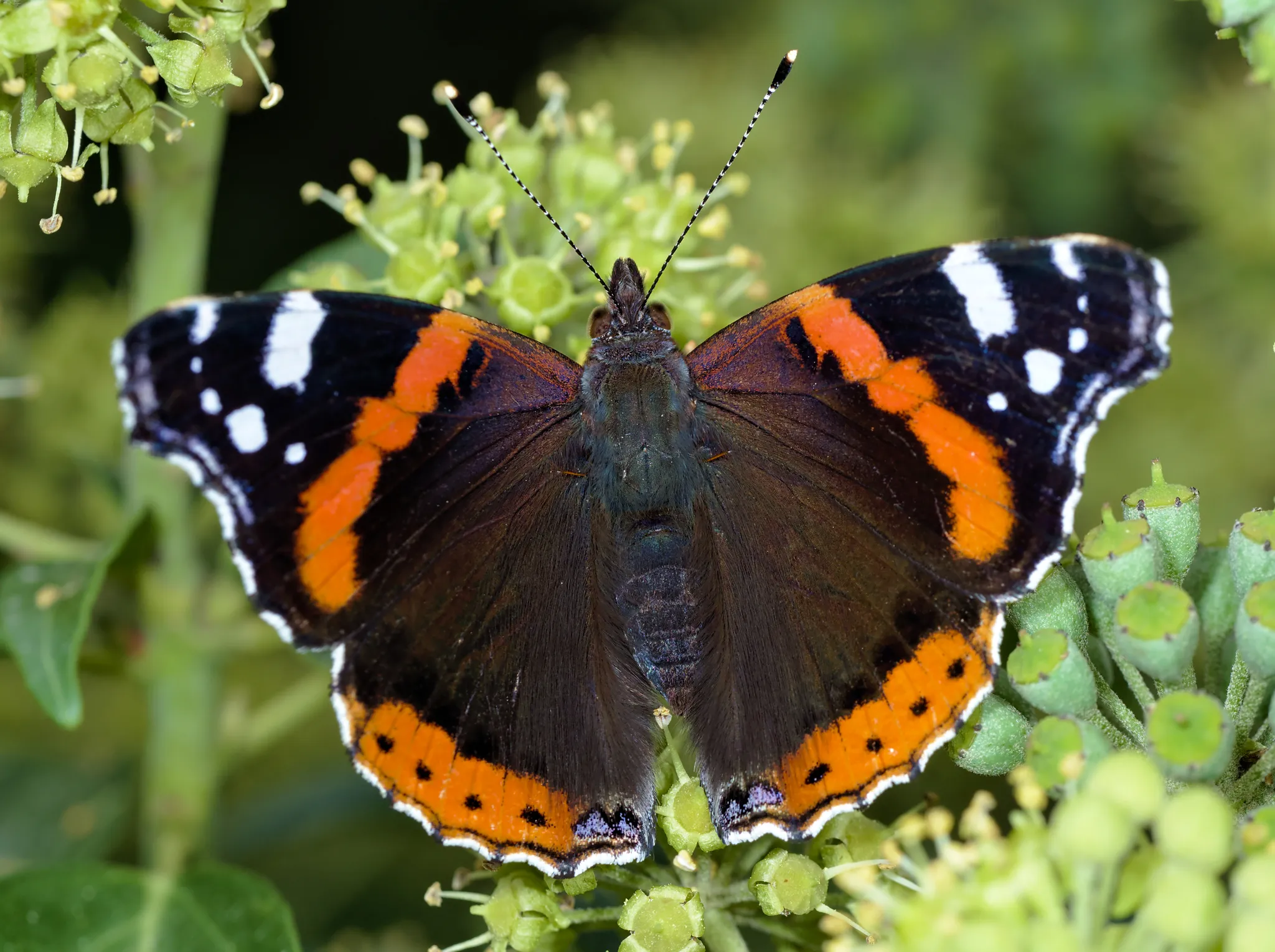
The red admiral, Vanessa atalanta, is a fast-flying butterfly of the family Nymphalidae, black with bold red-orange bands and white wingtip spots. It is a migrant species. In the west the species ranges from northern Canada to Guatemala; in the east, from Scandinavia and northern Russia to North Africa and China. It has also become established on Bermuda, the Azores, the Canary Islands, Hawaii and New Zealand1, and in the British Isles it is considered resident, though the resident population is only a small fraction of the numbers seen each year2, which are topped up by migrants arriving from the continent.
Identification
The red admiral has a wingspan of 64–78 mm; males run smaller, at 64–72 mm, and females larger, at 70–78 mm. The upperside is velvety black crossed by a broad orange-red band on each forewing and hindwing, with white spots near the forewing tips; the mottled, muted tones of the underside give superb camouflage2 when the butterfly rests with its wings closed. Adults also tend to be brighter and heavier-bodied in summer than in winter, and the legs and eyes are hairy, with a moderately large head1.
Range and habitat
The red admiral favours moist places such as marshes, woodlands, fields and gardens, found anywhere from the seashore to the tops of the highest mountains2. As a migrant it also turns up in habitats ranging from subtropics to tundra1.
Life cycle and host plants
Caterpillars feed on nettles, including the common nettle, and also on pellitory-of-the-wall and hops. A female lays her eggs singly, on the upper surface of a host plant’s leaves, and the caterpillar that hatches is cylindrical, with rows of branching spines along its body, coloured black, greenish-brown or pale yellowish-green depending on the individual. It lives inside a tent made by folding together the edges of a leaf, coming out only to feed, and builds a fresh tent as it grows. For pupation it draws several leaves together with silk into a tent and hangs head-down inside it; the chrysalis is pale buff-brown with a grey powdery bloom and gilded metallic markings, with a blunt head, unlike the paired horns of closely related species, and the stage lasts 2 to 3 weeks. The number of broods depends on latitude: a single generation is typical in Canada and the northern United States, two across most of the range, and three in the southern United States1, while Britain normally manages only one brood a year2.
The species overwinters as an adult1, though in the British Isles most individuals are unable to survive the winter, and the population there is renewed each year mainly by migrants arriving from central Europe2.
Behaviour and flight period
The red admiral is on the wing from March to November, with activity peaking across much of its range in spring and again in autumn. It is a fidgety, swift flier that changes direction rapidly in the air, and adults take fermenting fruit, sap from trees and bird droppings, as well as nectar from flowers such as aster, milkweed and alfalfa. Males are strongly territorial, holding a patch of ground roughly 4 to 13 m wide and 8 to 24 m long, and patrolling its edges up to thirty times an hour; each afternoon a male typically perches in a sunlit spot to wait for passing females, driving off rivals by outflying and outmanoeuvring them. In Britain the flight pattern is driven by migration: most migrants arrive in May and June, and numbers peak again with a wave of emergence from mid-August to early October2. The species is also people-friendly, often approaching and perching on humans, and is valued for its aesthetic beauty; its caterpillars can damage the leaves of their host plants1, without being an agricultural pest.
Conservation
The IUCN’s 2022.2 assessment lists the red admiral as Least Concern3. In Britain, occurrence rose by 14% and abundance by 234% between 1976 and 2019, with occurrence up 3% and abundance up 29% between 2010 and 2019; on the strength of that increase, the species is not considered one of conservation concern there2.
Similar species
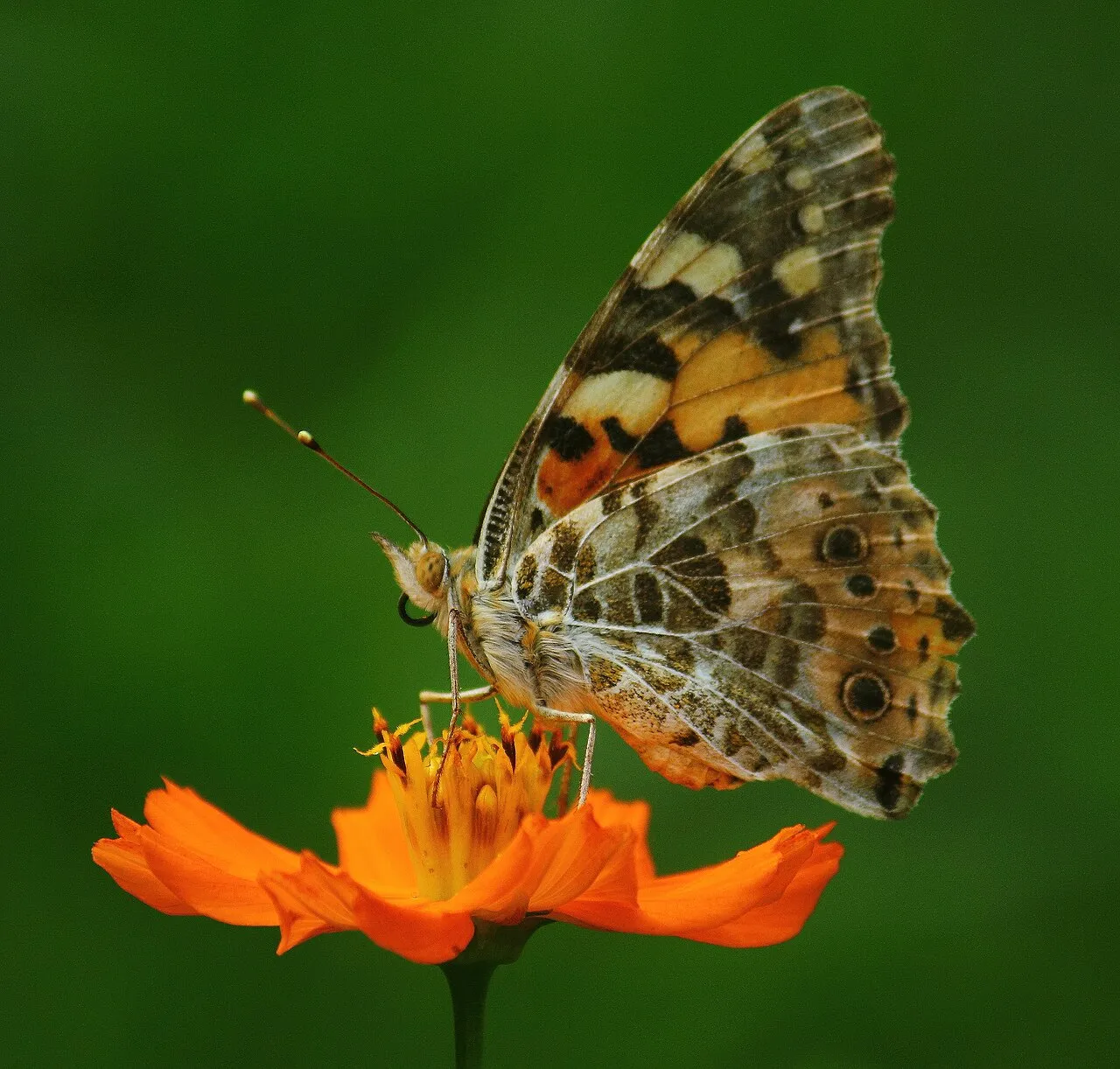
- Painted lady (Vanessa cardui): told apart from the red admiral’s oblique red band on each black forewing4 by its mainly orange, black-spotted wings5, with no such band.
- American lady (Vanessa virginiensis): has two large eyespots on the underside of each hindwing5, rather than the red admiral’s mottled, camouflaging underside2.