_-_Blue_Pansy_(Female_DSF)_(5)_WLB_1XtyjN.webp)
Contents
The Blue pansy, Junonia orithya, is an eyespotted butterfly of the family Nymphalidae and the genus Junonia, found across Africa, through South Asia, Southeast Asia and Australia. The name varies with the place: in India it is the blue pansy, in southern Africa the eyed pansy, and in Australia the blue argus1.
Identification
The species has a wingspan of 58–76 mm2. The sexes look markedly different. The male’s forewing base is velvety black, its boundary with the paler outer wing running in an obliquely zigzag line, and the hindwing carries blue patches shaded with velvety black toward the base; Singapore’s National Parks Board describes that hindwing blue as bright, with an orange-red mark near the tornus. The female is duller, with fuliginous (sooty) brown instead of velvety black at the wing bases and scarcely any blue on the hindwing, appearing brown across the upperside; she makes up for the lost colour with larger, more clearly defined ocelli and markings than the male, whose own ocelli are orange-ringed, set against white discal bands. Both sexes share pale brown undersides marked with eyespots3, including white-centred postdiscal ocelli on the hindwing1.
Range and habitat
The Blue pansy’s range runs from Africa, through South Asia and Southeast Asia, to Australia, with central and southern Africa, South and Southeast Asia and Australia2 naming the same broad sweep. Within that range it keeps to open areas, often sitting on bare ground1; in Singapore it turns up in forests, parks and gardens, and in urban environments generally3.
Life cycle and host plants
Caterpillars feed on plants from eight families, including Acanthaceae, Convolvulaceae and Violaceae, among them Ipomoea batatas, Viola odorata, and species of Justicia and Hygrophila; in Singapore the caterpillars are recorded on Asystasia gangetica subspecies micrantha3. The larva is very dark, shining black, with perpendicular spines armed with strong radial hairs. The pupa hangs by the tail, without a cocoon, its wing-covers muddy yellow against a purplish body1.
Behaviour and flight period
Adults fly with a stiff flap and glide and maintain a territory, driving away other butterflies that enter it1.
Conservation
The Blue pansy is listed Least Concern, per the IUCN Red List version 2022.24. Singapore’s National Parks Board, in a species record last updated in August 2019, classed it as common3 there.
Similar species
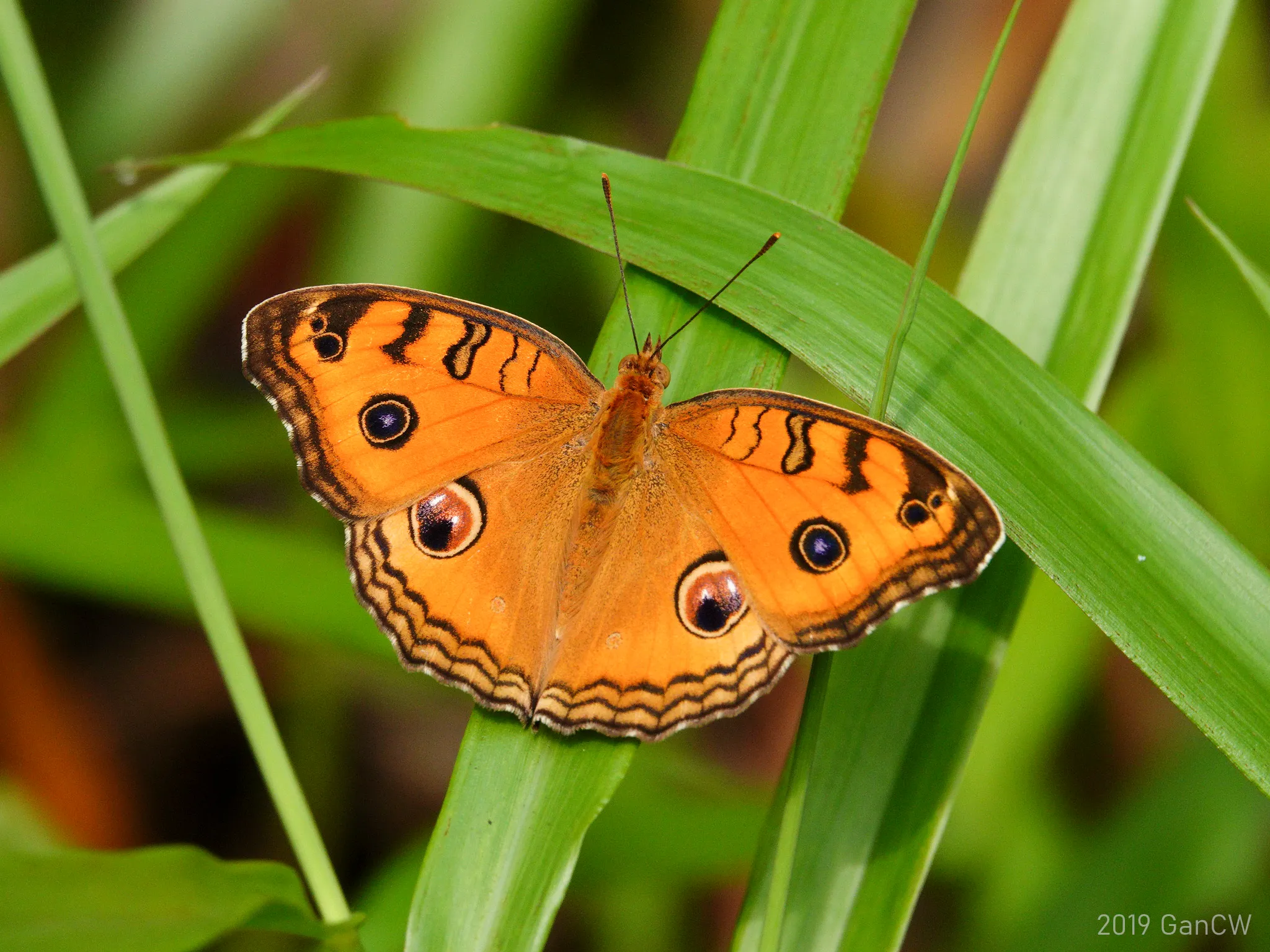
- Peacock pansy (Junonia almana): upperside rich orange-yellow rather than blue or brown, with a large, minutely white-centred ocellus on each forewing instead of the Blue pansy’s blue hindwing patches; its range runs from India and Sri Lanka eastwards to China and Japan5, overlapping the Blue pansy’s South and Southeast Asian range but not its African or Australian populations.
- Yellow pansy (Junonia hierta): the male’s upperside is bright yellow instead of blue or black, with a jet-black triangular projection from the forewing costa and a sizeable blue spot in the hindwing’s black anterior area; the hindwing’s terminal margin is black too and its dorsum broadly shaded with brown, against the Blue pansy’s shaded blue hindwing; it shares part of the Blue pansy’s range, found in Africa and Southeast Asia6.
_female_Dobruja_26TKKb.webp)
_female_Macedonia_Z3684v.webp)