Contents
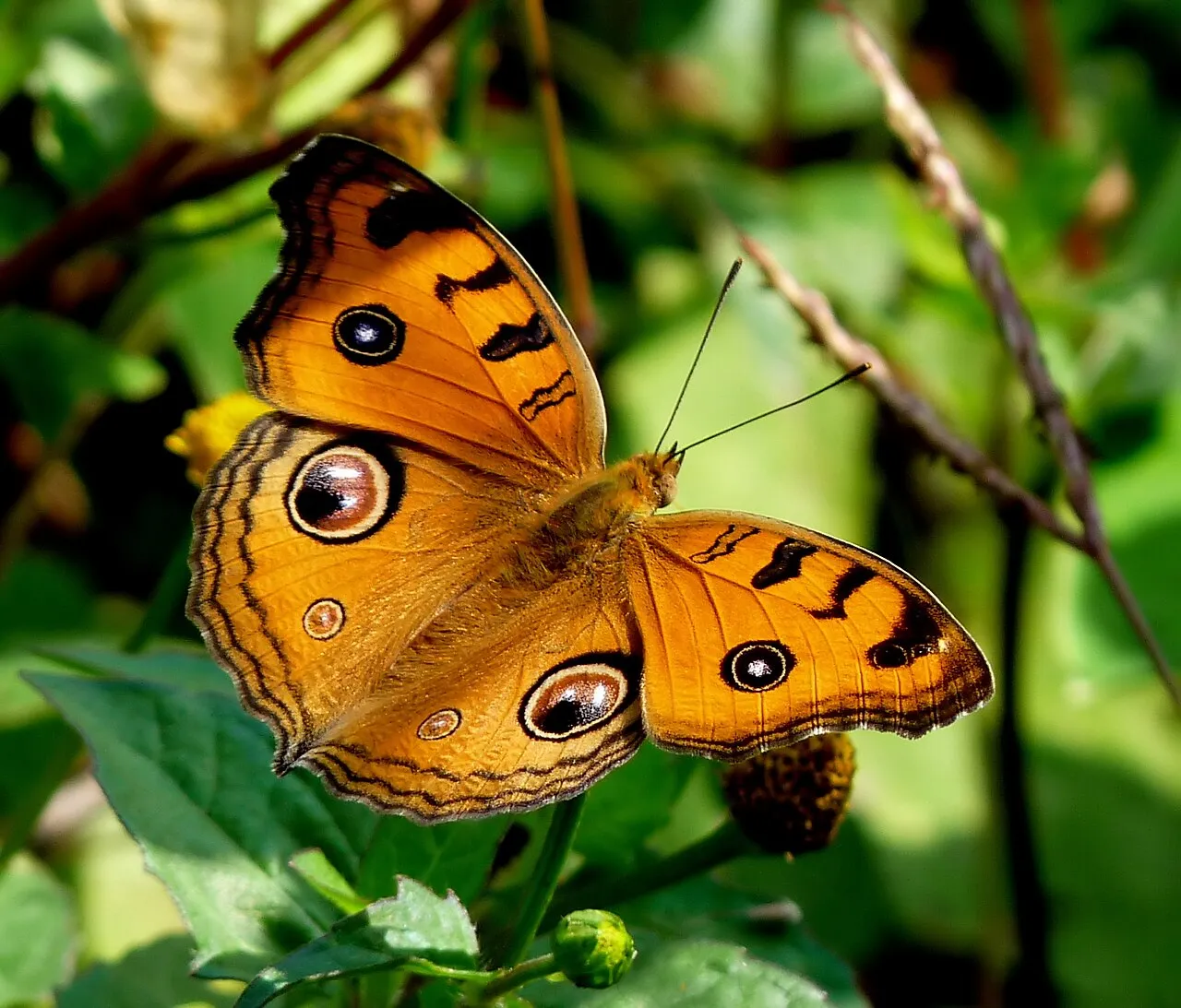
The Peacock Pansy, Junonia almana, is an orange-yellow butterfly of the family Nymphalidae, named for the large eyespots on its wings. It belongs to the genus Junonia, the pansies, a group of butterflies known for strong seasonal changes in wing pattern. The species is found in India, Sri Lanka and South East Asia, and eastwards to China and Japan.
Identification
The butterfly has a wingspan of 54–62 mm. The upperside is rich orange-yellow with black markings: the forewing carries a pale dusky bar and a much darker, short transverse bar across the cell, along with two smaller geminate subapical ocelli, while the hindwing shows both a small and a large eyespot, each with a bluish-black outer ring.
The underside changes with the season. In the dry-season form it is ochraceous brown and very variable, with the cell crossed by three dark sinuous bands and only faint lines elsewhere. In the wet-season form the underside turns pale ochraceous, the forewing cell gains short sinuous dark brown lines, and the hindwing shows a whitish discal band that is more prominent than in the dry-season form. This seasonal polyphenism gives the dry- and wet-season adults a noticeably different look, with the wet-season form carrying additional eyespots and lines compared to the plainer dry-season pattern.
Range and habitat
The Peacock Pansy’s range runs from India and Sri Lanka across South and Southeast Asia to China and Japan. A detailed account of its habitat is not yet available from a source this site can cite; see the facts box.
Life cycle and host plants
Caterpillars feed on Hygrophila auriculata and Phyla nodiflora, and are also recorded on the genera Acanthus, Barleria and Gloxinia. The caterpillar is cylindrical, with a blackish, slightly hairy head and a pale ochreous-brown body marked by a dorsal, subdorsal and lateral blackish line. The chrysalis is rather short and thick, with a broad head and thorax, a headpiece pointed beneath, short tubercular points on the thorax and abdomen, and a brownish-ochraceous colour.
Behaviour and flight period
The clearest behavioural signature of this species is its seasonal change in appearance rather than a documented pattern of flight: the wet- and dry-season forms differ enough in their markings that they can look like different butterflies, a trait shared with other Asian pansies in the genus. A sourced description of its flight period is not yet available.
Conservation
The facts box gives the Peacock Pansy’s IUCN category, sourced from its Wikidata record.
Similar species
- Lemon Pansy (Junonia lemonias): also brown-based with numerous eyespots and black and lemon-yellow spots and lines on the upperside, and found over much of the same range in Cambodia and South Asia. It shows the same kind of seasonal change, since its wet- and dry-season forms differ considerably in coloration and even shape.
- Blue Pansy (Junonia orithya): told apart by its blue hindwing shading, as the male has the basal half of the forewing velvety black with a blue patch near the tornus and a broad white oblique discal band, and a hindwing that is blue shaded with velvety black toward the base. It ranges more widely still, from Africa through South Asia, Southeast Asia and Australia.
_kkJaX.webp)
_2r3CXC.webp)
_2_rmr34.webp)