Contents
The false heath fritillary, Melitaea diamina, is a dark, chequered butterfly of damp meadows across much of Eurasia. It belongs to the family Nymphalidae, in the same genus as the heath fritillary, and is a variable species with eight recognised subspecies across its range. The species ranges across central and southern Europe, from northern Spain through France and Italy to southern Scandinavia and Bulgaria, and eastward through southern Siberia, northeastern China, the southern Ussuri region, Korea and Japan, one of the broadest east-west spans of any European fritillary.
Identification
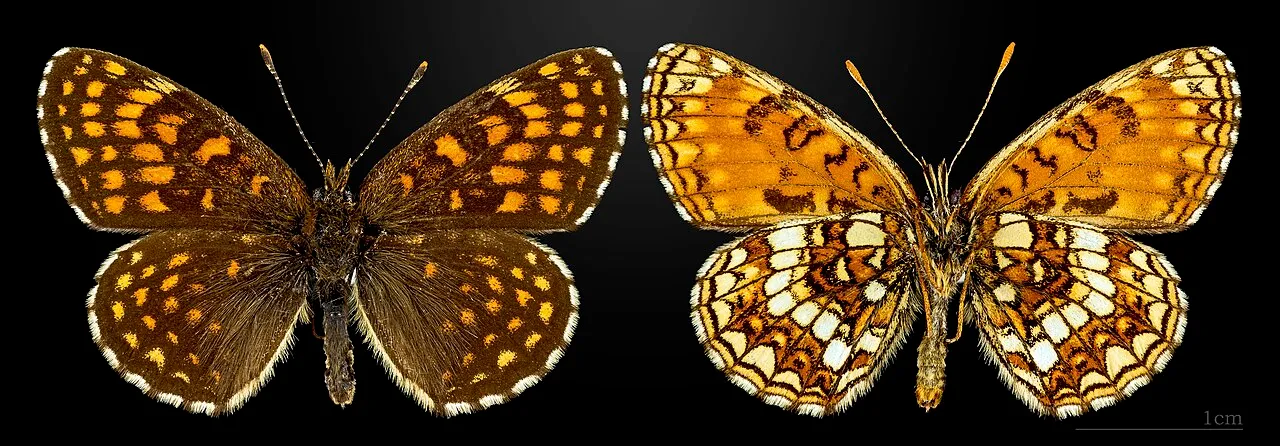
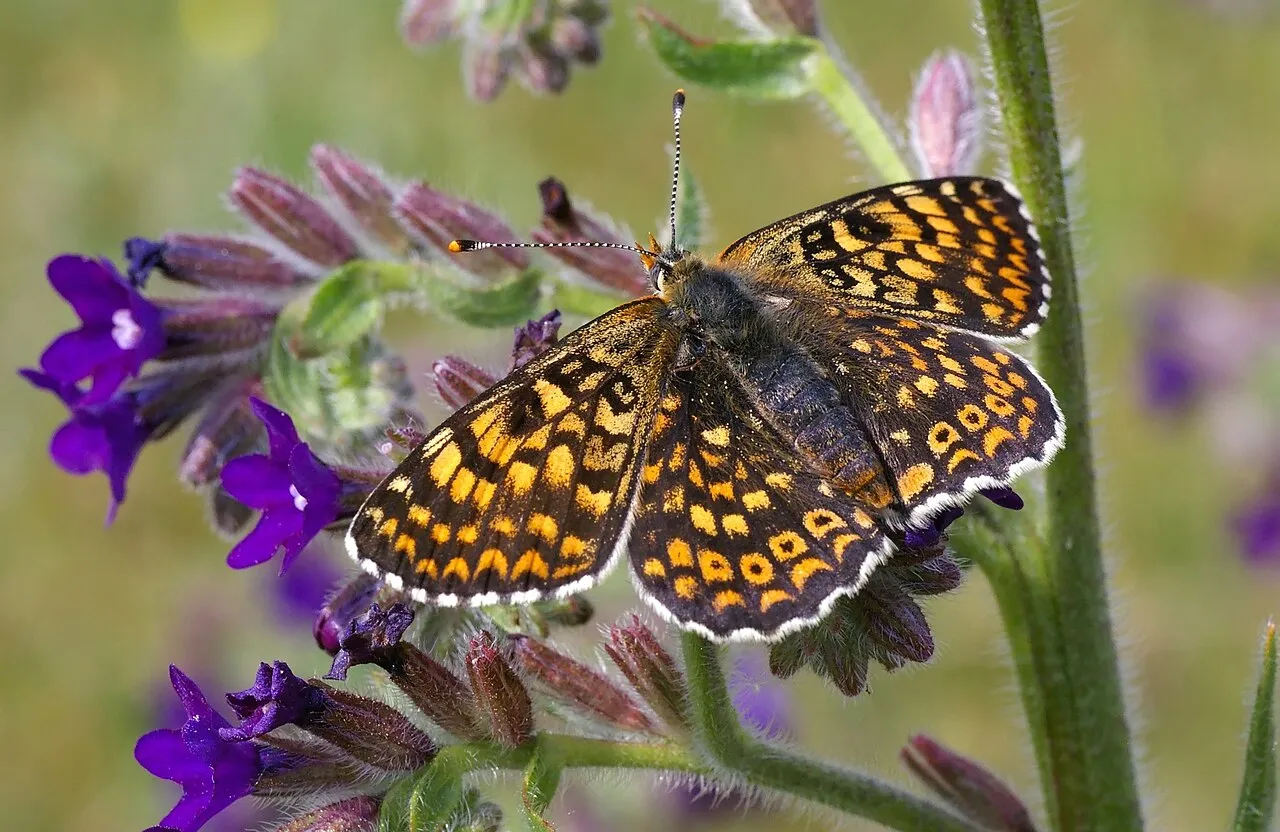
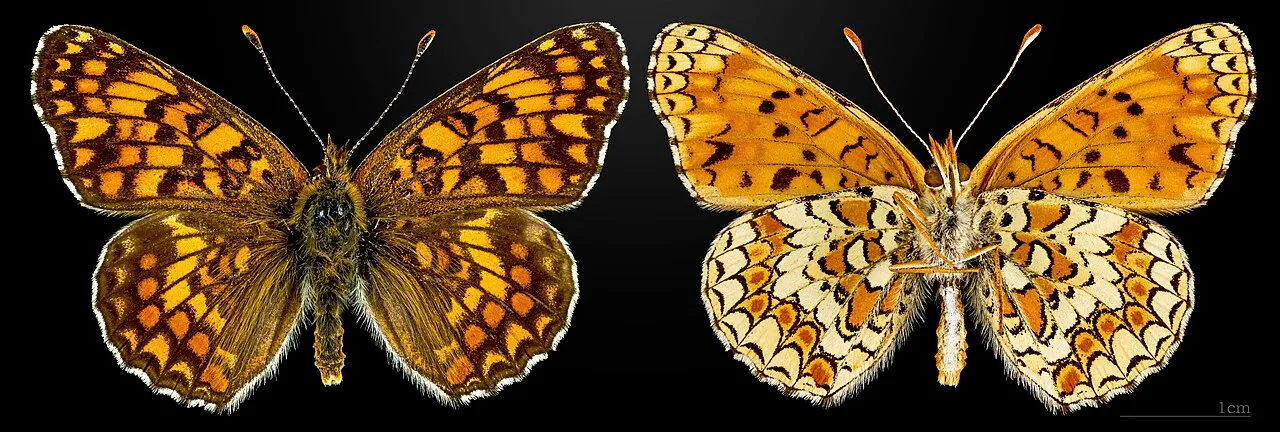
It is a small to medium-sized fritillary, with a wingspan of 36–42 mm. The upperside is usually black-brown with a yellowish-orange ground colour and a white chequered fringe, the hindwings carrying particularly heavy dark markings; some individuals appear almost uniformly dark brown, which makes the species darker overall than most of its relatives. The underside of the hindwing shows a submarginal row of white half-moons and bands of creamy-white and orange checkers, a paler and more orderly pattern than the heavily marked upperside, and often the quickest way to confirm the species on a resting butterfly.
The sexes differ. Females are noticeably larger than males; males carry small rounded reddish-yellow spots on the forewing, while females show the outer half of the upperside variegated with ivory-yellow and ochreous spots. The overall darkness of the species, together with its chequered white fringe, is usually enough to separate it from paler relatives sharing the same meadows.
Range and habitat
The species favours damp, flowery meadows, woodland margins and rides, from low ground up to an altitude of 2,200 m. Across its wide Eurasian range it is tied to these wetter grasslands rather than the drier ground many other fritillaries prefer. That dependence on damp ground, and on the moisture-loving plants its caterpillars eat, keeps colonies clustered around wet meadows, streamsides and boggy clearings even where the surrounding countryside is much drier.
Life cycle and host plants
Caterpillars feed on Valeriana officinalis and Valeriana dioica, together with meadowsweet, germander speedwell, ribwort plantain, common cow-wheat, bistort and Patrinia species, a broader menu than many of its relatives, which helps the species persist wherever at least one of these damp-ground plants grows. The species overwinters as a caterpillar, shown in the facts box, feeding through autumn and remaining active from autumn until May on these plants before completing its growth in spring. There is usually one brood a year, though a second generation appears in some warmer regions, a pattern typical of fritillaries at the warmer edge of their range.
Behaviour and flight period
Adults are on the wing from May to September, usually as a single brood flying from May to July depending on altitude, with the later end of that window reached mainly by the occasional second generation in warmer parts of the range, or by colonies flying at higher, cooler altitudes. The false heath fritillary is a notably slow flier, described as perhaps the least fast of all the Melitaea fritillaries, and it keeps close to the damp ground it breeds on rather than ranging far afield. That unhurried flight, combined with its dark colouring, makes it an easy butterfly to watch settle and feed at close range once a colony is found.
Similar species
- Heath fritillary (Melitaea athalia): a close relative with a similar chequered pattern, but generally paler and more orange, and found in drier grassland and woodland clearings rather than damp ground.
- Marsh fritillary (Euphydryas aurinia): another dark, chequered butterfly of damp meadows across much of the same range, distinguished by its silver-edged hindwings and caterpillars that feed on Devil’s-bit scabious rather than Valerian.
_kkJaX.webp)
_2r3CXC.webp)