Contents
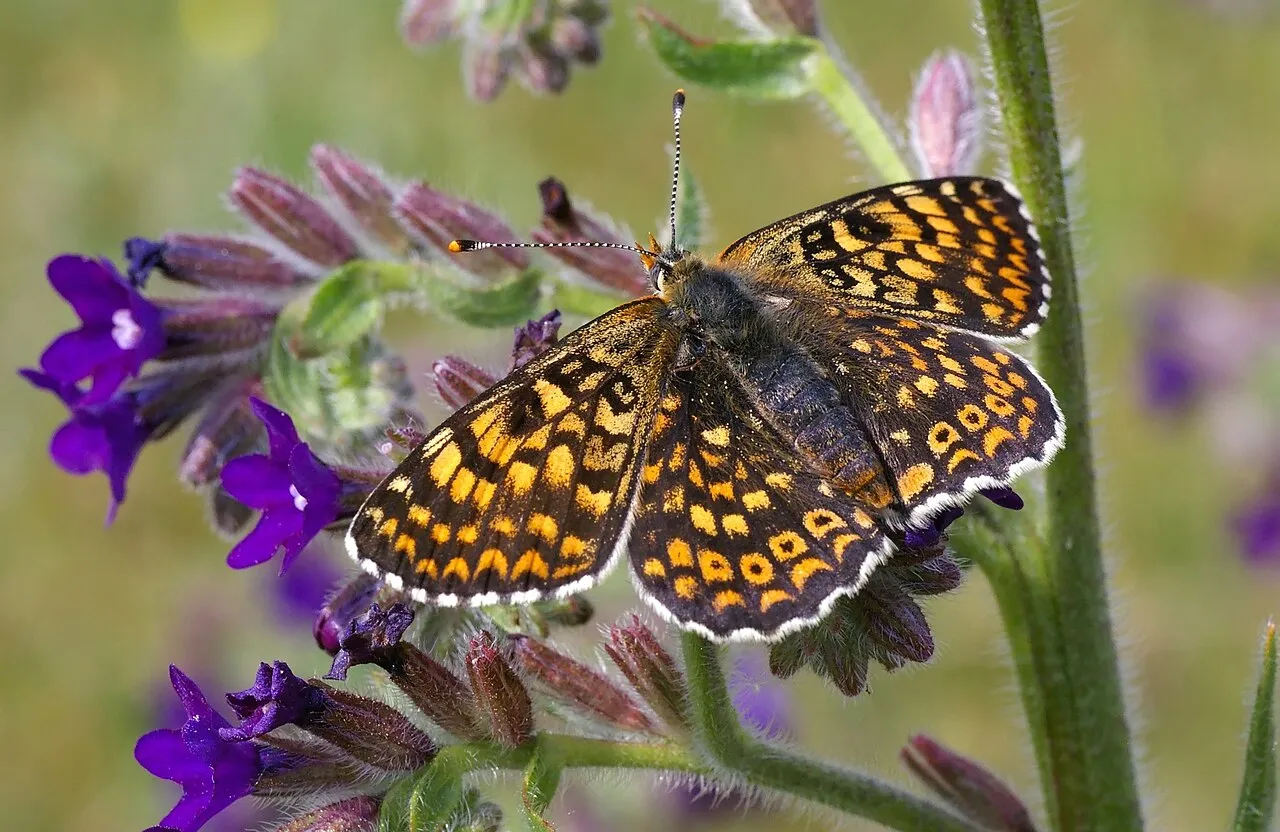
The Glanville fritillary, Melitaea cinxia, is a small orange, black and white “checkerspot” butterfly of the family Nymphalidae. It ranges across most of Europe, northwest Africa, Turkey, Russia, northern Kazakhstan and Mongolia, and is especially widespread in Finland, though it is absent from the far north of Europe and parts of the Iberian Peninsula. In Britain it survives only on the south coast of the Isle of Wight, with small colonies on the South Hampshire coast, North Somerset and the Channel Islands of Guernsey and Alderney. The common name honours the naturalist Eleanor Glanville, who caught the first British specimens in Lincolnshire in the 1690s; “fritillary” itself comes from the Latin fritillus, a dice box, for the chequered wings.
Identification
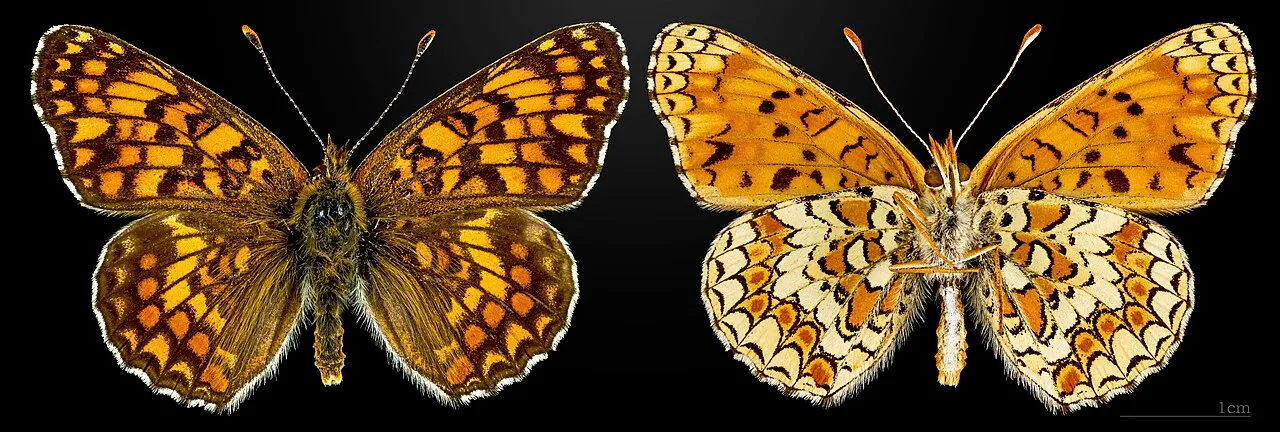
The species has a wingspan of about 33–40 mm, but Isle of Wight males measure 38–46 mm and females 44–52 mm, noticeably larger than that general figure. The upperside is orange, black and white in the “checkerspot” pattern typical of the genus, with a row of heavy black dots in the submarginal row of spots on the hindwing. The underside hindwing carries white and orange bands crossed by a series of black dots, while the underside forewing is a more uniform reddish leather-yellow with scattered black spots. The sexes are close in pattern, but females tend to look duller than males and carry more developed black dots; on the Isle of Wight the size difference between the smaller males and larger females is the easier field clue.
Range and habitat
The species lives in open grassland from sea level to about 2,000 m. Its English colonies depend on a very particular setting: sheltered, south-facing undercliffs and chines on the Isle of Wight that are kept open by landslips, where fresh falls expose bare ground for young host plants to colonise alongside older growth. Regular disturbance of the cliff face allows the foodplant to keep growing, so a colony typically shifts along the coast over time as older patches become overgrown and new falls open elsewhere; coastal defences that stop this natural erosion are one of the threats the species faces in Britain.
Life cycle and host plants
Across most of the range the caterpillars feed on ribwort plantain (Plantago lanceolata) and spiked speedwell (Veronica spicata), with buck’s-horn plantain (Plantago coronopus) also used in some regions; on the Isle of Wight, ribwort plantain is the primary foodplant. A female may lay up to ten clutches of eggs in her lifetime, each clutch holding 50 to 300 eggs, glued to the underside of a host leaf, and she mates only once in her life. The caterpillars, about 25 mm long with a reddish-brown head and a spiny black body dotted with small white marks, hatch into gregarious sibling groups and spin a communal silk web for shelter while feeding together; a single group can strip an entire plant bare. They overwinter as caterpillars, hibernating in their web low in the vegetation before resuming feeding in spring, and if disturbed will instantly roll into a ball. There is normally one generation a year, occasionally with a partial second generation in exceptionally warm years when adults emerge early.
Behaviour and flight period
Adults are on the wing from June to early July across the range; Isle of Wight colonies typically emerge from late May to early June, occasionally producing a partial second brood in August in a warm year. It is a sun-loving species, flying only in bright conditions, with rapid wingbeats followed by a short glide, and both sexes are eager nectar feeders, favouring thrift and bird’s-foot trefoil, and roosting communally on grass flowerheads overnight. Males patrol their breeding grounds, investigating any brown object in the hope of finding an unmated female, and a mated pair may stay active together, flying between shrubs and even stopping to nectar while still paired. Dispersal happens mostly through females: after mating within their home colony they often move with their mate to lay eggs in a different population, which keeps gene flow going between the isolated meadows and cliffs the species depends on.
Similar species
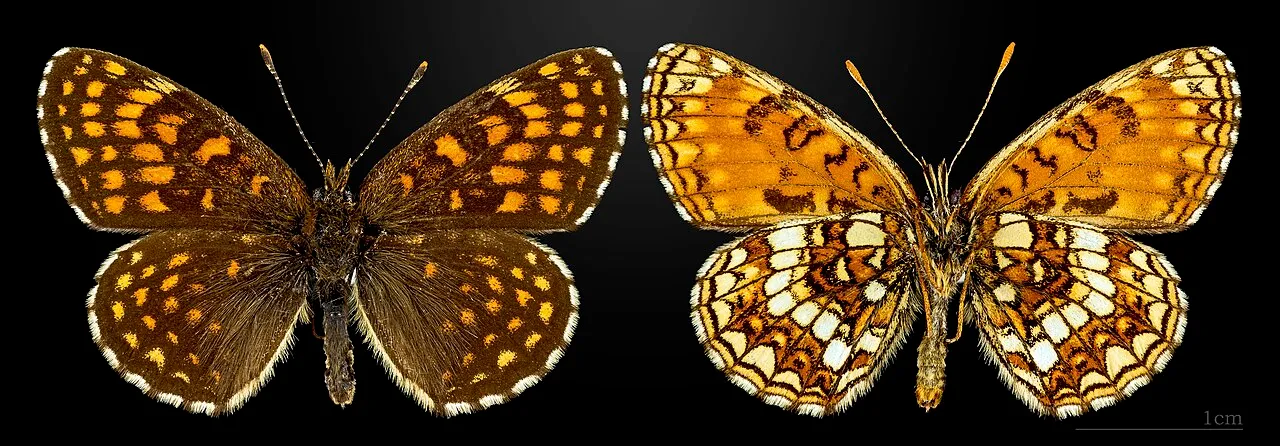
- Heath fritillary (Melitaea athalia): another chequered orange, black and white fritillary of open ground, though its British colonies are inland woodland clearings rather than coastal cliffs.
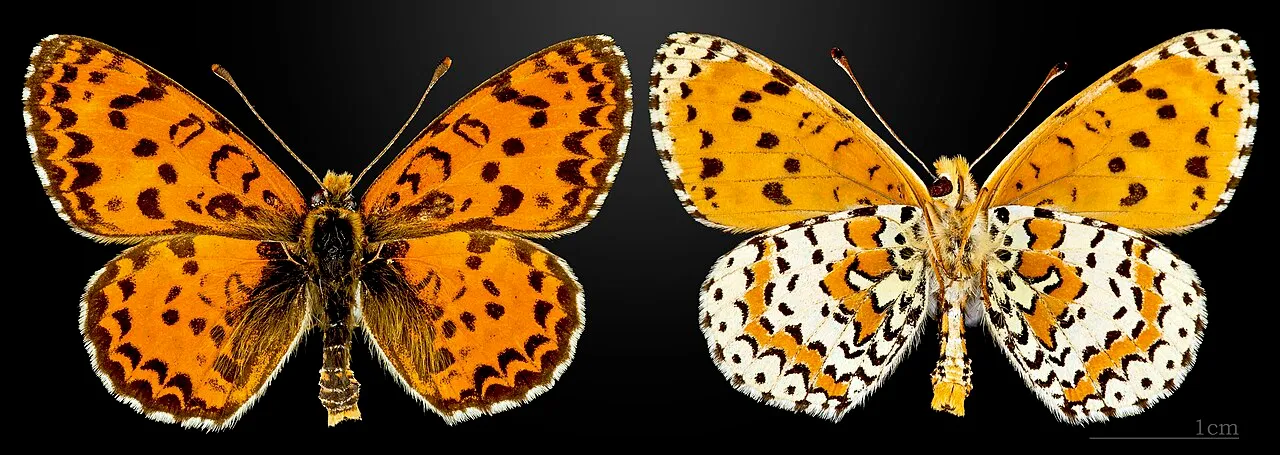
- Spotted fritillary (Melitaea didyma): a similarly patterned, more southerly relative that ranges across southern and central Europe, North Africa, the Middle East, central Asia and Siberia but, unlike the Glanville fritillary, does not reach England.
_kkJaX.webp)
_2r3CXC.webp)