Contents
The heath fritillary, Melitaea athalia, is a butterfly of the family Nymphalidae found throughout the Palaearctic from western Europe to Japan. Its altitudinal range runs from sea level to 2,600 m1. In Britain it is one of the rarest butterflies, confined to a few sites in Somerset, Devon, Cornwall and Kent2, with reintroduced colonies in Essex.
Identification
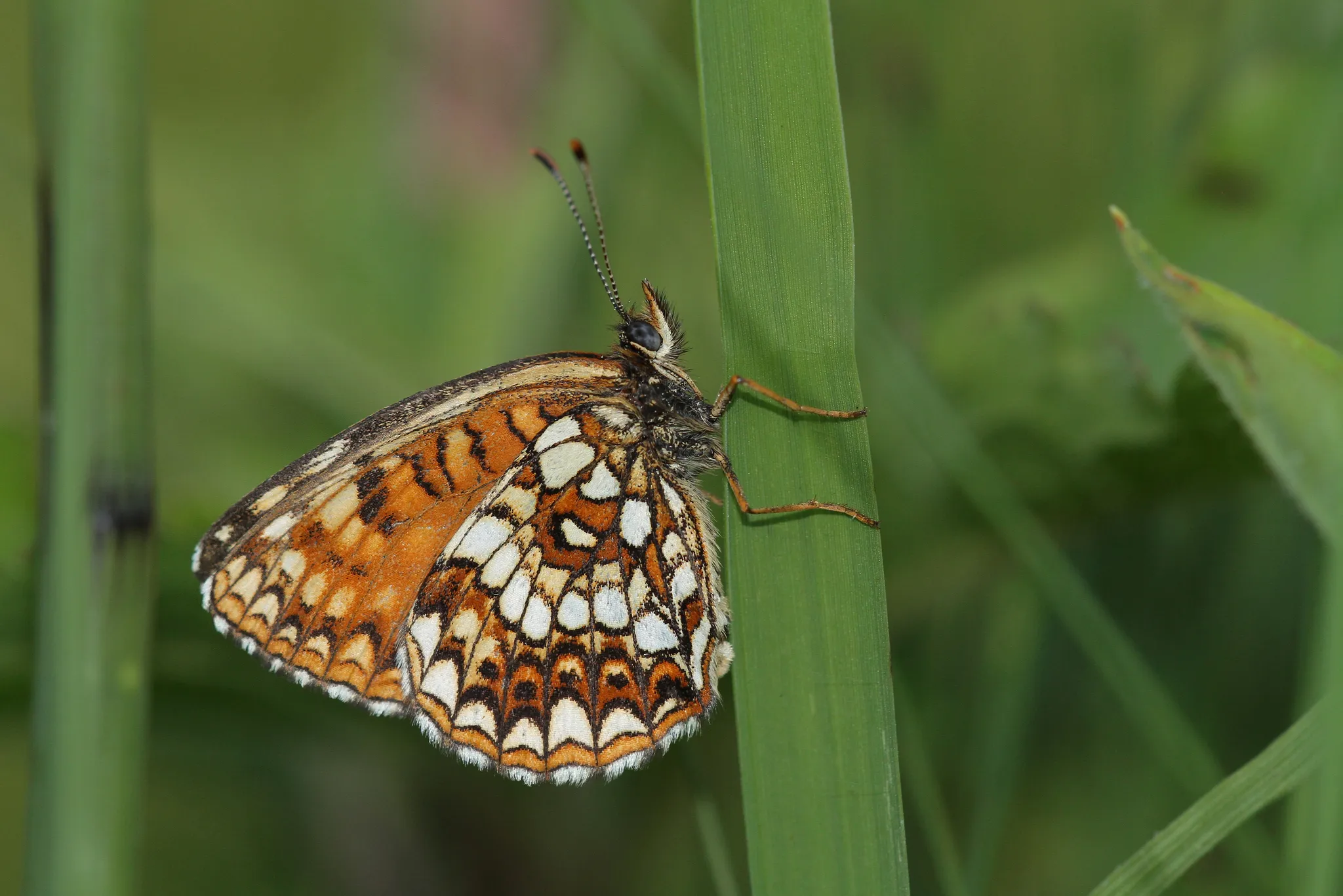
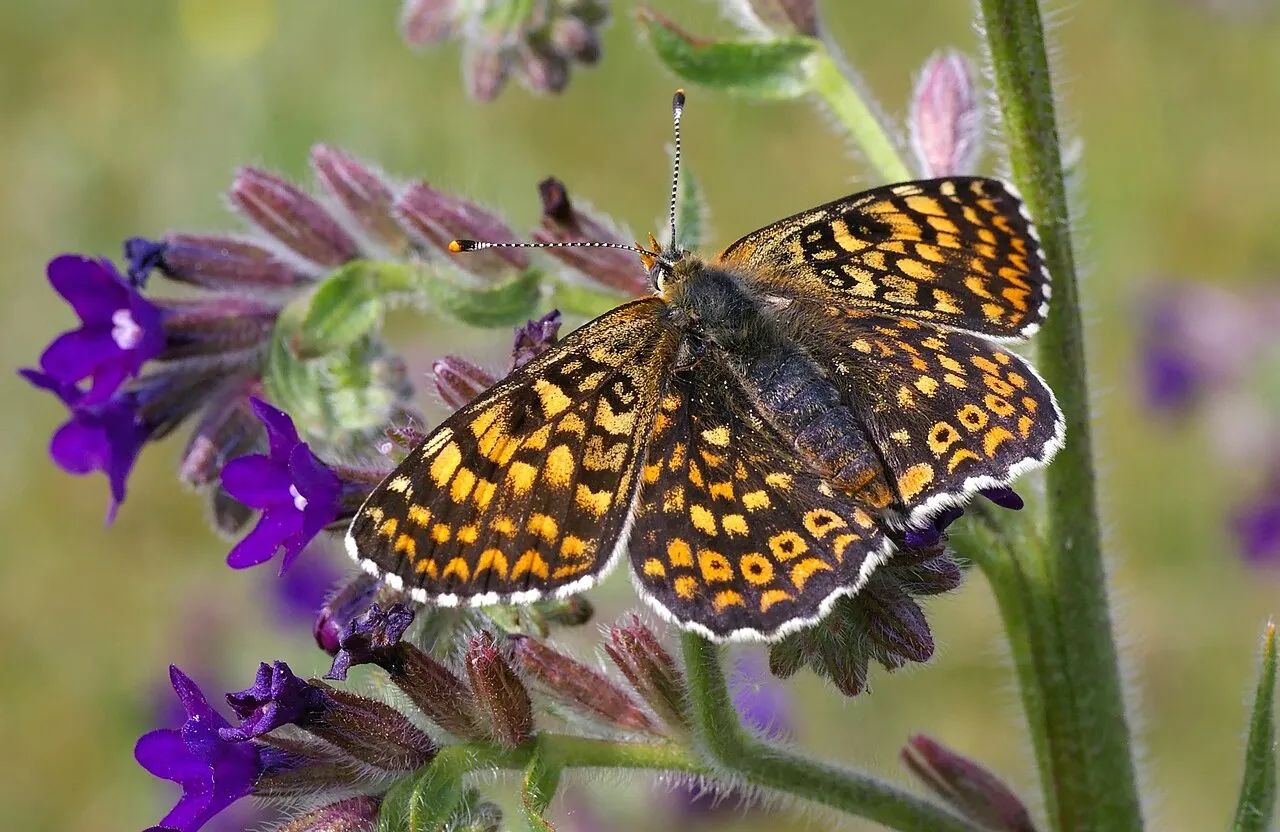
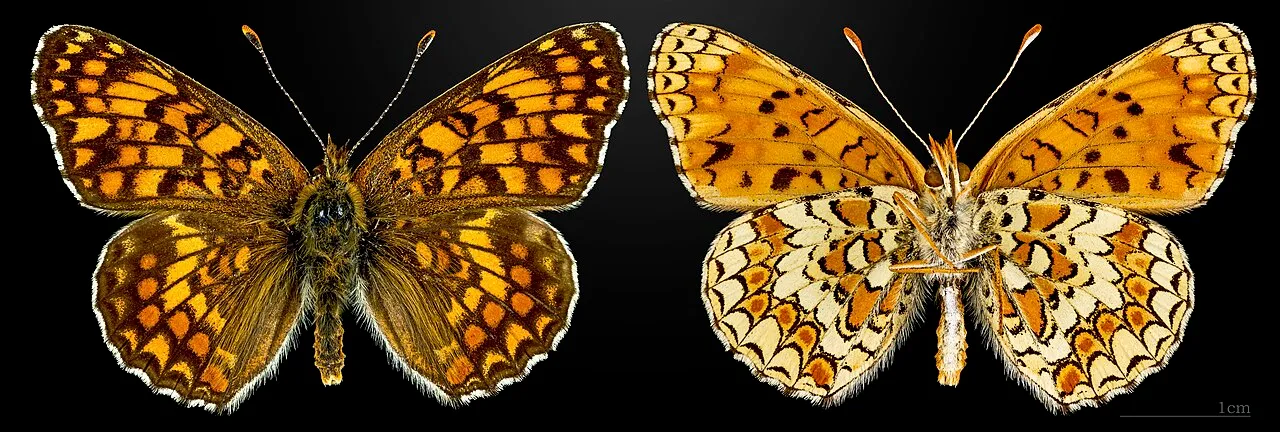
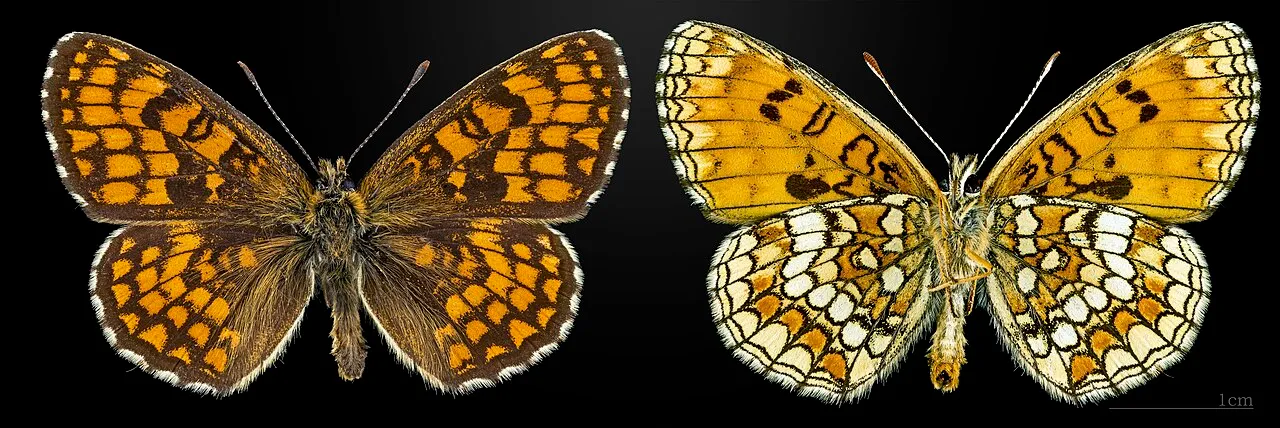
The wingspan is 39–44 mm in males and 42–47 mm in females. The upperside is predominantly dark brown and orange brown, the orange-brown spots outlined in dark brown along and across the veins, with a white fringe to the wings. The underside shows bands of red and off-white1, each vein dark brown, and the pattern of white spots at the base of the hindwing, visible at rest, is diagnostic. Butterfly Conservation describes it as distinguished by its dusky wing colours3. Individuals are very variable in both colour and pattern2.
Range and habitat
In Europe it is absent from Iceland, Ireland, Scotland, Wales, southern Portugal, southern Spain, the Mediterranean islands and southern Greece. Within Europe it occupies grassy, flowery habitats1, dry or damp, upland or lowland, with or without shrubs or trees.
In England, colonies in the south-west live on heathland and rich grassland, and those in the south-east in woodland. Whatever the habitat, it needs relatively warm areas, which could be a patch of recently burned heathland or a newly coppiced clearing. It readily colonises such clearings, which earned it the name “woodman’s follower”2. On Exmoor it uses sheltered heathland valleys3, where common cow-wheat grows as scattered plants among bilberry.
On the GB Red List (2022) it is classed as Endangered, and it is fully protected in Great Britain; its European status is not threatened. Its UK abundance fell by 90% between 1981 and 2019, and it would almost certainly have become extinct in the UK3 without conservation efforts over the past two decades.
Life cycle and host plants
Woodland colonies tend to use common cow-wheat and foxglove2 as the larval foodplant, whereas colonies on other sites tend to use ribwort plantain and germander speedwell. Foxglove can be a secondary foodplant, especially on Exmoor3.
The female lays an untidy batch of up to 150 eggs, typically close to the foodplant on the underside of a bramble leaf or on a dead leaf. The eggs are pale green when first laid, soon turn pale yellow and hatch in around 2 weeks2.
Newly hatched caterpillars eat their eggshells before moving together to the foodplant, where they spin a loose silk web on which they bask and from which they feed. They later split into smaller groups before separating to hibernate in a curled-up dead leaf. In spring they resume feeding and bask in full sun2. There are six instars in total. The pupae last 15–25 days and are usually found close to the ground in or beneath dead leaves. Adults probably live for 5–10 days1.
In the UK there is one generation each year2. In southern Europe the subspecies M. a. celadussa flies in a single brood at high altitude1 but is bivoltine below the subalpine level.
Behaviour and flight period
Adults fly close to the ground, alternating a few flicks of the wings with a short glide. The male patrols clearings in search of a mate, while the female has a much more laboured flight, weighed down by her eggs. Both sexes bask on shrubs, often in company. Adults feed primarily on brambles2, and also visit bugle, buttercups, heathers, knapweeds and tormentil.
Colonies tend to be compact, and adults rarely move more than 100 m, though some have been recorded dispersing up to 2 km. Suitable habitat over 600 m from an existing colony1 is colonised slowly.
Across its range the subspecies M. a. athalia flies from mid-May to mid-August1, and in favourable localities or seasons a partial second brood has been recorded from mid- or late August to September. In the west of England adults emerge from the second week of May2, peaking in early June; elsewhere in Britain they emerge at the end of May and peak in mid-June.
Similar species
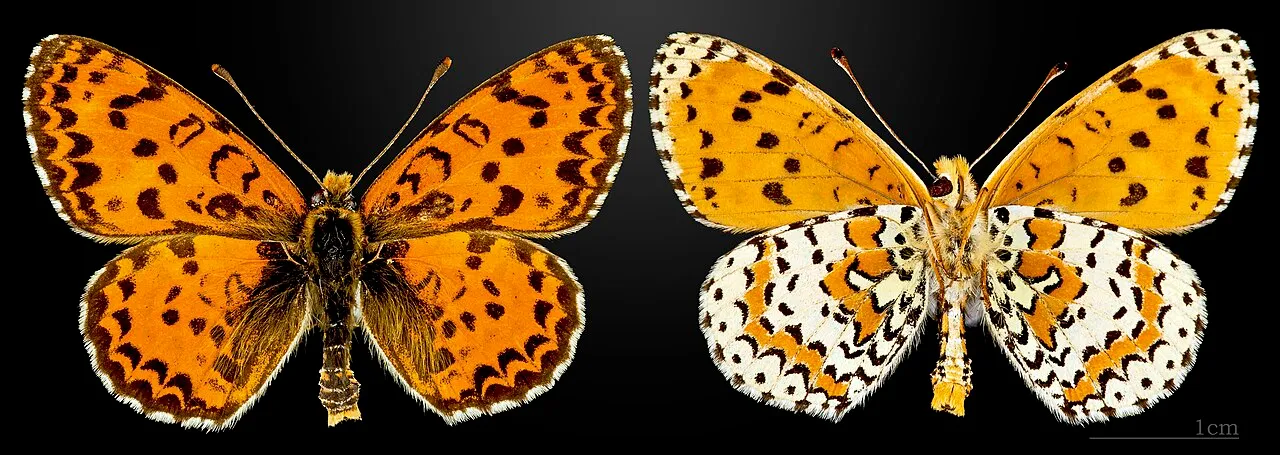
- Glanville fritillary (Melitaea cinxia): its wing pattern is very similar1, but the dark brown bands on the underside are more distinct in the heath fritillary. In Britain it is found mainly on the south coast of the Isle of Wight4.
- Marsh fritillary (Euphydryas aurinia): it has the most colourful uppersides5 of the British fritillaries, a chequered pattern of orange, brown and yellow, and is primarily a wetland species.