Contents
The spotted fritillary, Melitaea didyma, is a small orange-brown butterfly of the family Nymphalidae, widespread across warmer parts of the Old World and also known as the red-band fritillary. It ranges across southern and central Europe, North Africa, the Middle East, central Asia and Siberia, though it is absent from northern Europe, including England, Ireland, northern France, Germany, Poland and Scandinavia.
Identification
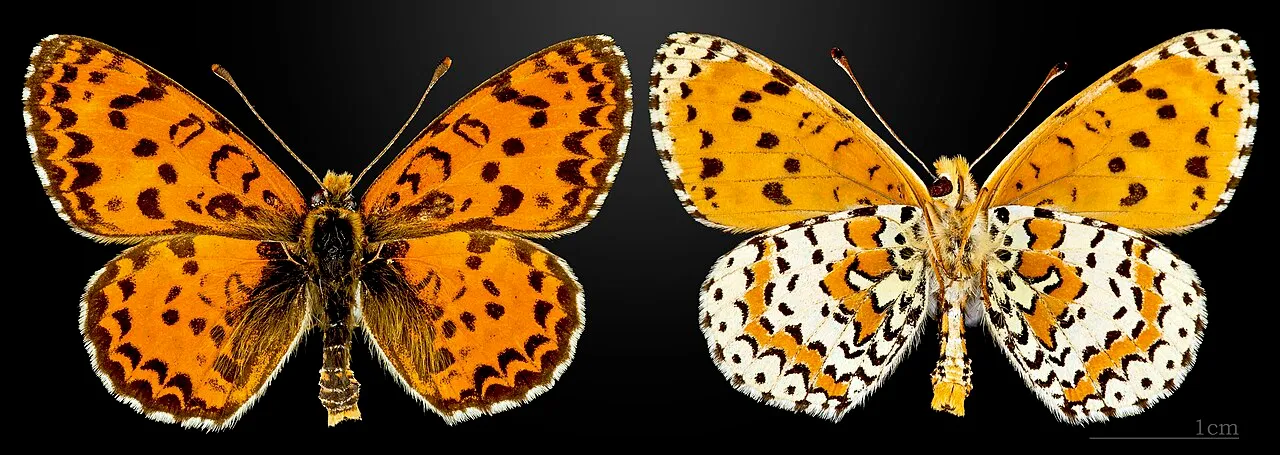
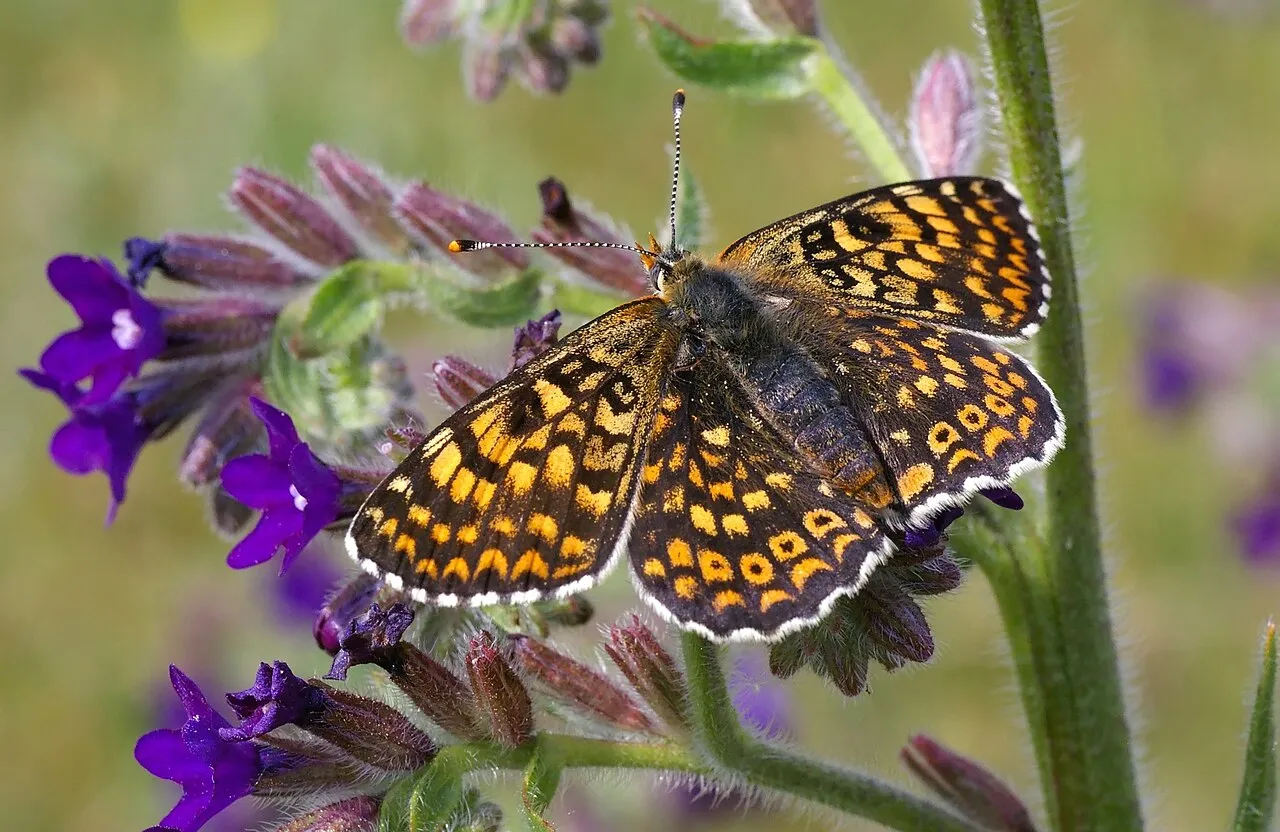
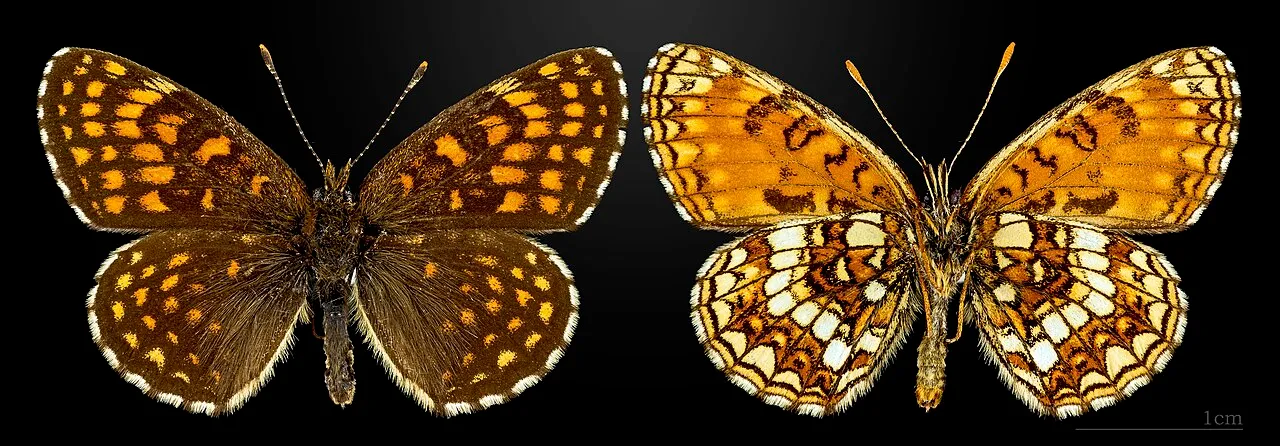
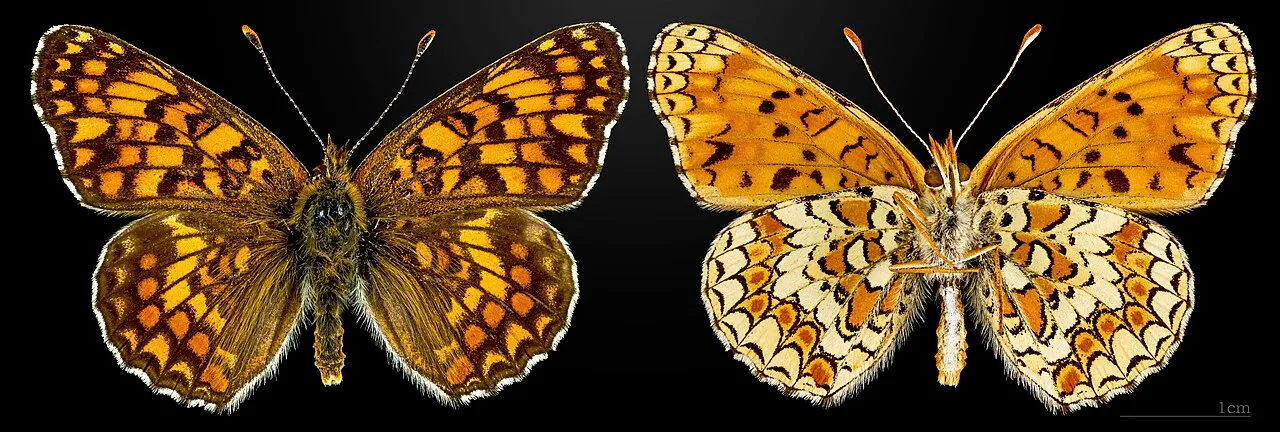
The spotted fritillary has a wingspan of 35 to 50 mm, and observers in Britain who examined stray individuals recorded males at 40 to 48 mm and females at a slightly larger 42 to 50 mm. The upperside is bright orange-brown with dark brown markings arranged in rows. The sexes differ clearly: the male is fiery red with a narrow, dentate black border along the edge of the wing, while the female is much paler, with forewings and hindwings dusted with blackish scales that give her a duller, more washed-out look. The underside is chequered pale yellow and pale orange, with a ground colour that can look delicately greenish or yellowish-white, scattered with small black dots and crossed by bands.
Range and habitat
Within its wide range, the butterfly favours flowery and grassy areas, meadows and roadsides, the kind of open, flower-rich ground that supplies both nectar for adults and low-growing host plants for caterpillars. Across this range entomologists recognise about nine named forms, including the nominate M. d. didyma, M. d. occidentalis and M. d. orientalis.
Though not a British resident, the spotted fritillary has turned up there twice as a stray. A single specimen was caught near Dumfries in Scotland in June 1866, believed to be an accidental introduction, and the species was not seen again in Britain until 6 August 1986, when several individuals appeared at Fobbing Marshes in south Essex, probably the offspring of an accidentally introduced, already-mated female. Neither episode established a lasting population.
Life cycle and host plants
Caterpillars feed on a mix of low-growing plants, among them Linaria, ribwort plantain (Plantago lanceolata), speedwells (Veronica), brown knapweed (Centaurea jacea) and foxglove (Digitalis purpurea). The species overwinters as a young caterpillar, sitting out the coldest months before resuming feeding and growth in spring, and it produces two or three generations a year, depending on climate and location.
Behaviour and flight period
Adults are on the wing over a long stretch of the year, flying from March to October depending on the location: an early start in the warmer, southern parts of its range and a shorter season further north and at altitude. The long flight period matches its two or three broods, with adults of one generation overlapping the caterpillars or chrysalides of the next across the milder parts of its range.
Similar species
- Heath fritillary (Melitaea athalia): a closely related species that shares much of the spotted fritillary’s Palaearctic range and similar chequered wings, but tends toward duller, more uniformly brown upperside markings.
- Knapweed fritillary (Melitaea phoebe): another orange-brown fritillary that flies alongside the spotted fritillary over parts of Europe, North Africa and Asia, and feeds on knapweeds as a caterpillar.
_kkJaX.webp)
_2r3CXC.webp)