Contents
The marsh fritillary (Euphydryas aurinia) is a butterfly of the family Nymphalidae. It is widespread in the Palearctic, from Ireland in the west to Yakutia in the east and to north-west China and Mongolia in the south. Within the British Isles it is more frequent in the south and west, with a stronghold in Wales. The species is represented by many subspecies1, and the insect may be best considered a superspecies.
Identification
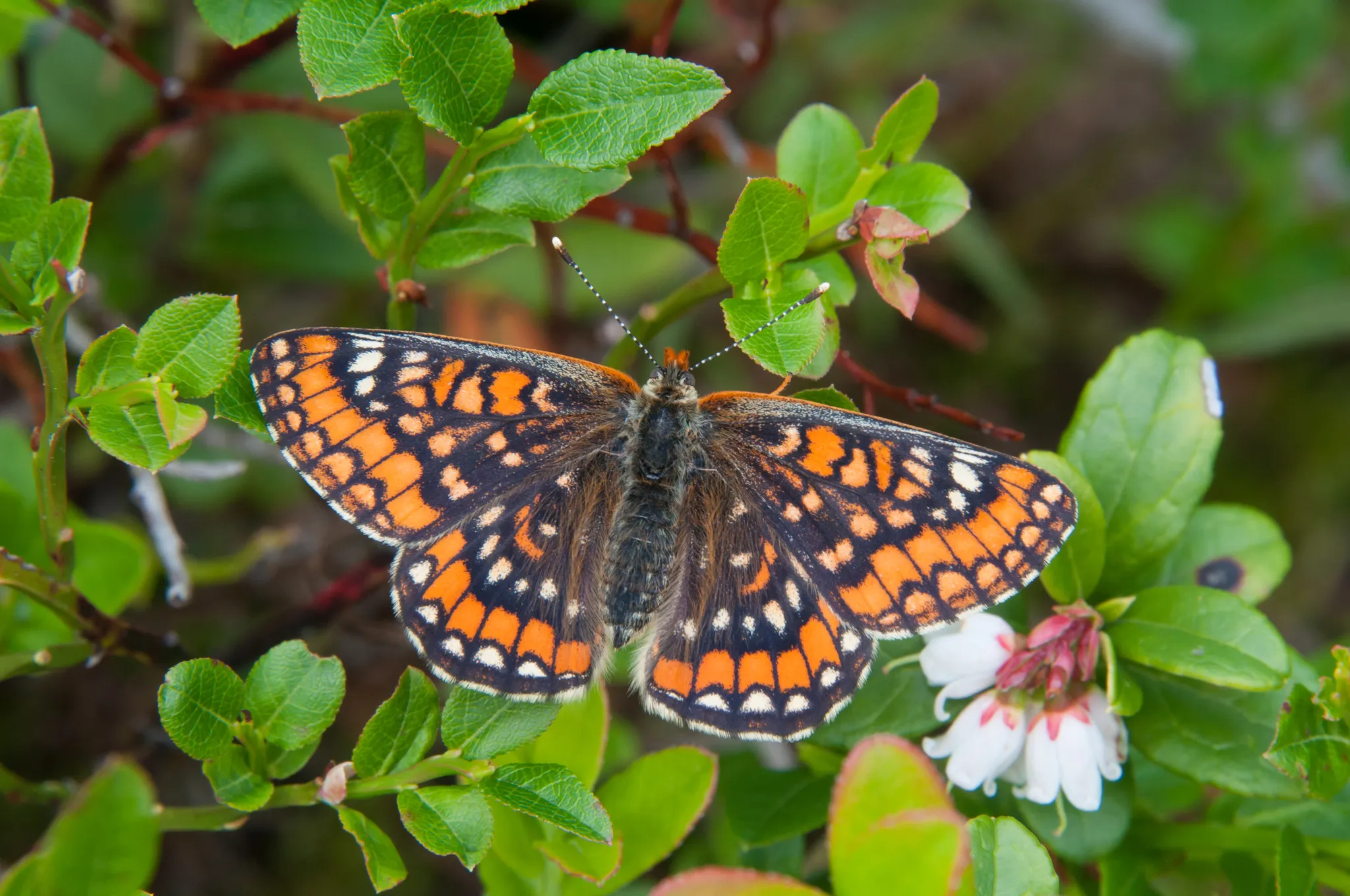
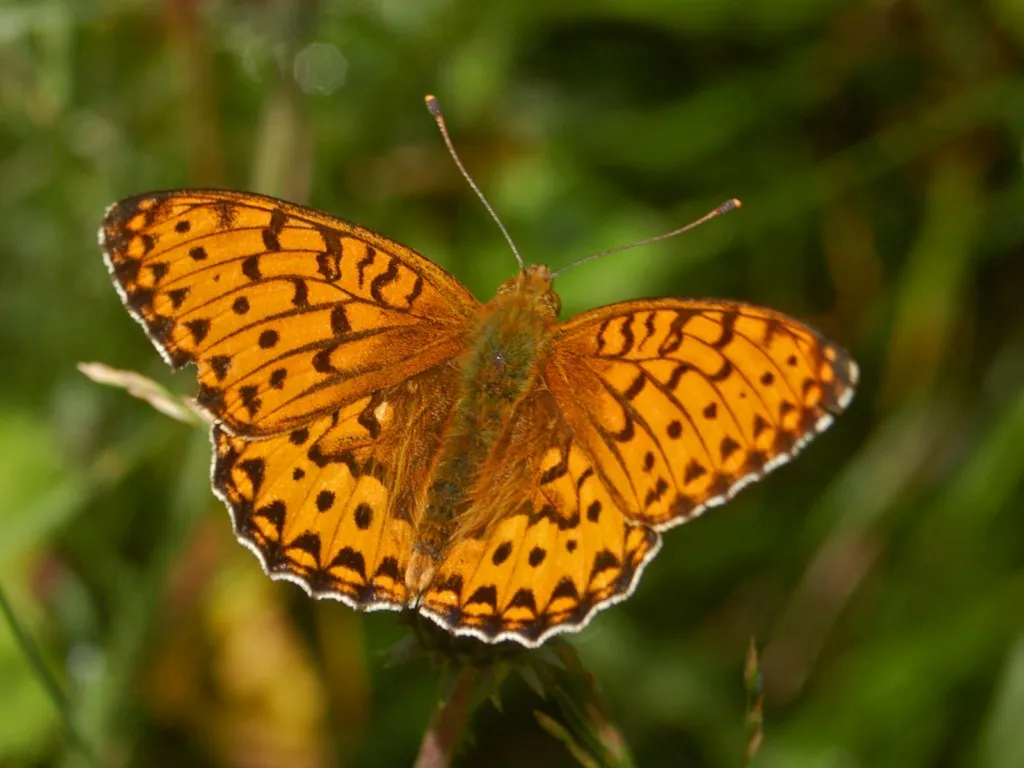
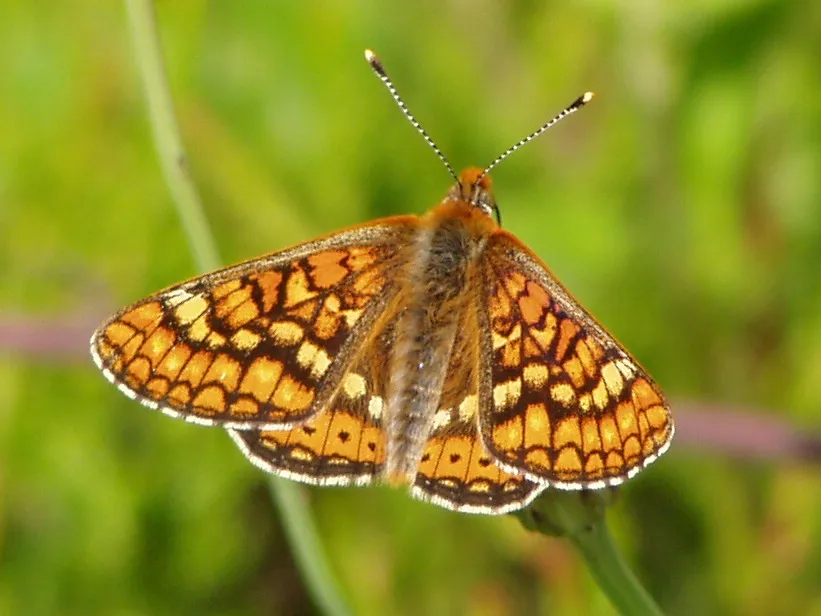
Males have a wingspan of 30–42 mm, females 40–50 mm. The upperside is a highly variable chequered pattern of orange, brown and yellow, the most colourful upperside of any British fritillary. Silver markings are present on the hindwing edge. The underside is patterned with yellow, orange and brown without any silver. Females are larger than males and less brightly coloured. The bright colours fade after a few days2 and leave the butterfly with a shiny look, which led early lepidopterists to name it the “Greasy Fritillary”. The eggs are yellow and easily identified1 by their large batch size, and the larvae are black.
Range and habitat
The species lives in calcareous grassland, woodland clearings, damp marshy areas and heathy grassland, the marshes giving it its common name. It can reach an elevation of 10–2,200 m1 above sea level. On British sites it uses chalk hillsides, heathland, moorland and damp meadows2, all of them in full sun, where the higher temperature aids larval development. Its open habitats have in common that they are managed only very extensively and quite nutrient-poor. Agricultural intensification, especially in the lowlands, has pushed it back to marginal sites3 such as fens and dry grasslands.
The butterfly forms discrete colonies, and even the slightest barrier, such as a hedge or a river, will prevent dispersal. Colonies are typically part of a metapopulation2 with several colonies located close to one another. A sward that is too short can expose the larvae to predators and limit their food, while one that is too tall and dense makes it hard for adults to find the host plant. As of 20191 the butterfly had become regionally extinct over much of its former range in the UK.
Life cycle and host plants
The primary larval foodplant is Devil’s-bit scabious2 (Succisa pratensis), and field scabious (Knautia arvensis) and small scabious (Scabiosa columbaria) are also used. Other recorded foodplants include Digitalis, ribwort plantain (Plantago lanceolata) and Lonicera implexa1. In the alpine region the caterpillars live mostly on gentians such as Gentiana punctata and Gentiana acaulis3, and on Scabiosa lucida.
Eggs are laid in large batches on the underside of a leaf, with around 300 eggs on average and up to 600 in some batches. Females prefer to lay on large host plants1, which prevents food shortage and starvation of the larvae. The eggs typically sit in 3 or 4 neat layers and turn from pale yellow to dark grey just before hatching. This stage lasts between 3 and 4 weeks, and there is one generation each year2.
On hatching, the larvae spin a silk web by binding together leaves of the foodplant, and live and feed inside it. They build new webs as they grow and even move to a new plant if necessary. In later instars the webs can be quite conspicuous on the foodplant. After changing into the 4th instar, the larvae build a dense silk nest low down in the vegetation and hibernate in it. A second overwintering3 occurs partially in the plains and more often in the mountains. Larvae leave the nest with the onset of spring and can be seen basking as early as February. Basking raises their body temperature, which makes them relatively independent of the air temperature and promotes faster development. There are 6 instars in total. Pupae start forming around the end of March or beginning of April1. The pupa hangs head down from a twig or plant stem, and this stage lasts between 2 and 4 weeks2, depending on temperature.
Behaviour and flight period
Adults fly between May and June. In Britain they emerge in the middle of May and reach a peak in early June. Adults have short lives, usually lasting about two weeks. Males emerge a few days before the females and set up small territories centred on a particular plant or flower. They dart up to investigate any passing butterfly and also patrol suitable areas for newly emerged females. A female is quite conspicuous on her slow flight in search of plants to lay on, no doubt weighed down by her eggs. Neither sex wanders far from where it emerged, though adults emerging late in the season are often seen some distance from the main breeding grounds. Adults feed primarily on betony, bugle, buttercups, cuckooflower, dandelions, hawkweeds and knapweeds, and also on ragged-robin, thistles and tormentil. Colonies fluctuate wildly in numbers2. The caterpillars are liable to attack by the parasitoid wasp Apanteles bignellii1, especially in warm spring weather.
Similar species
- Small pearl-bordered fritillary (Boloria selene): named for the “pearls” along the outside edge of the hindwing underside, where the marsh fritillary has no silver1; its eggs are laid singly4.
- Glanville fritillary (Melitaea cinxia): lays its yellow eggs in untidy batches of between 50 and 200, and is found mainly where regular disturbance of the ground5 lets its foodplant flourish, as on coasts with frequent cliff falls.
- Heath fritillary (Melitaea athalia): woodland colonies tend to use common cow-wheat and foxglove, and the female lays an untidy batch of up to 150 eggs6, typically on a bramble leaf or a dead leaf close to the foodplant.