Contents
The silver-washed fritillary, Argynnis paphia, is a large orange butterfly of the family Nymphalidae, named for the metallic green-and-silver underside that shows when it settles. It is Britain’s largest fritillary and one of the most powerful fliers among European woodland butterflies. The species ranges from Algeria and across Europe and the Palearctic to Japan.
Identification
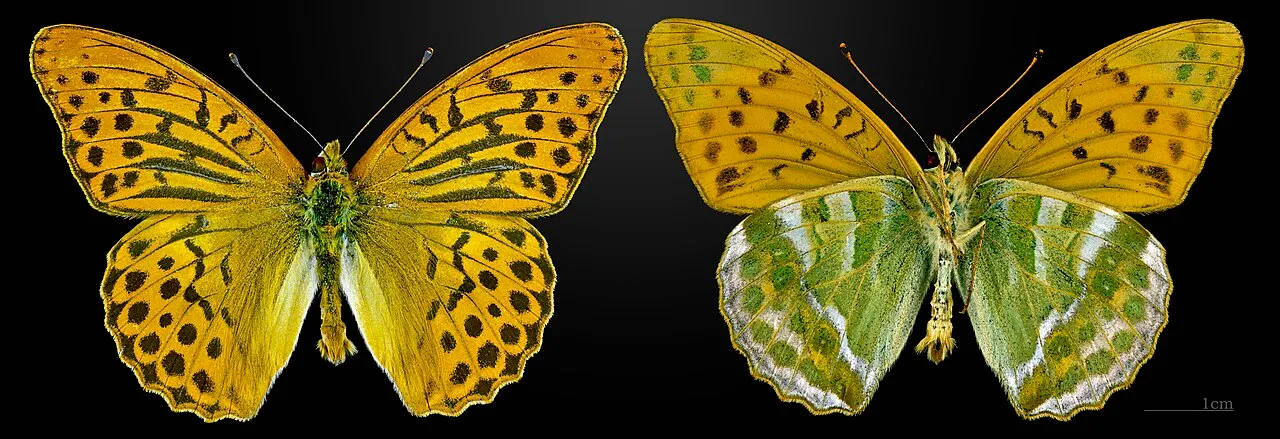
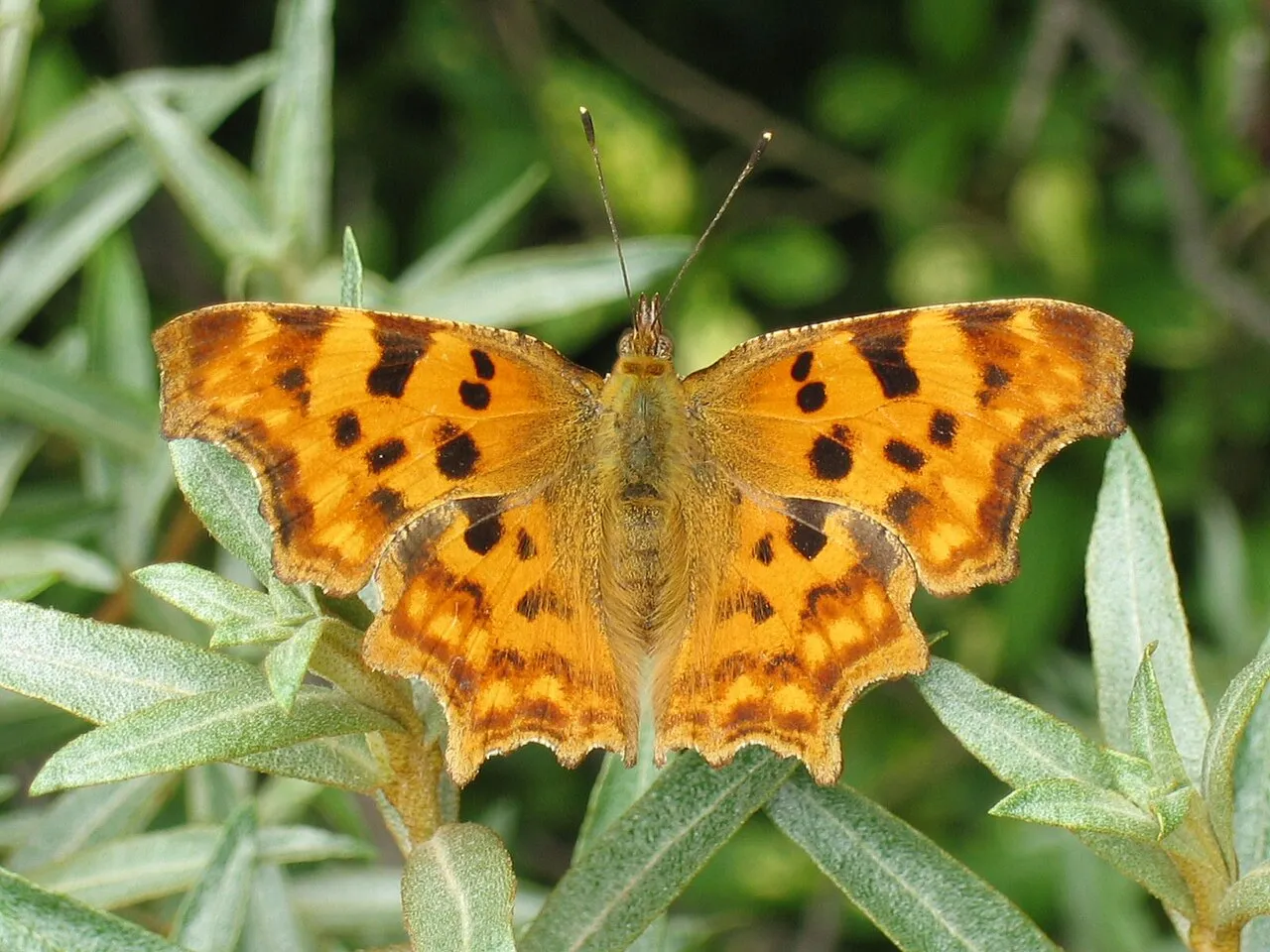
The upperside is deep orange with black spots, while the underside is green (verdigris) with a metallic gloss and broad, partly curved silver bands — the “silver wash” that gives the species its name. Wingspan runs 54–70 mm overall, or 69–76 mm in males and 73–80 mm in females, with males smaller and paler than females, and the male’s forewings rather pointed where the female’s are more rounded. Males carry black “sex brands” along four veins on the forewing, scent scales whose fragrance attracts females and helps tell the species from other fritillaries.
A minority of females belong to the dark form valesina, in which the ground colour is grey with greenish reflections rather than orange; UK Butterflies describes this form as deep olive-green, enough that in flight it can be mistaken for an overgrown ringlet. At this size, with an orange ground colour and silver-washed underside, the species is unlikely to be confused with most other European fritillaries.
Range and habitat
The species favours thin, sunny deciduous woodland, especially oak, and also coniferous forest, wherever broad rides and wood edges let its violet foodplants grow. In Britain it is found through southern England and Wales, south of a line from Montgomeryshire to East Kent, with outlying colonies as far north as Westmorland and West Lancashire; it is widely distributed in Ireland but absent from Scotland, the Isle of Man and the Channel Islands. Adults are not confined to the trees, and also fly along lanes and open countryside in some areas. Outside Britain and Ireland, the same wide Palearctic range, Algeria and across Europe to Japan, means the species turns up in woodland across most of the continent wherever violets grow on the floor and nectar plants line the rides.
Life cycle and host plants
Caterpillars feed on common dog-violet (Viola riviniana), and also other violets including V. canina, V. odorata and V. palustris. The species has an unusual way of getting its larvae to them: rather than laying on the foodplant itself, the female lays her eggs singly, one or two metres up, in crevices of tree bark, typically on moss-covered, north-facing trunks. The caterpillar hatches and goes straight into hibernation as a first-instar larva until spring, then drops to the ground on waking and feeds on violets growing close to the base of the tree. It passes through five instars, growing from about 2.2 mm to around 38 mm before forming a chrysalis head-down beneath a leaf, a pupal stage lasting two to three weeks, so that the full journey from egg laid in July or August to adult emerging the following late June to August takes close to a year. There is one generation a year.
Behaviour and flight period
Adults are on the wing from June/July to September in Europe (late June to the end of August in Britain), and into October in eastern Asia. Wikipedia calls it a strong flier, more mobile than other fritillaries, capable of gliding above the tree canopy at high speed, while males typically power along woodland rides, pausing briefly to feed or to pursue passing females.
Courtship is a flying display rather than a chase. UK Butterflies describes how the female flies in a straight line while the male loops continuously under, in front of and over the top of her; Wikipedia adds that the male circles the female as she flies with steady wingbeats toward a bush. Once the pair has landed, the male showers the female with scent scales from his sex brands before mating.
Similar species
- Dark green fritillary (Argynnis aglaja): a similarly sized orange fritillary of open grassland and coastal sites rather than woodland rides; its underside shows green patches but lacks the silver-washed fritillary’s broad silver bands.
- Niobe fritillary (Argynnis niobe): a Continental European fritillary of similar size and colour, best told apart by underside pattern and habitat, since it favours open flowery slopes rather than shaded woodland.
_female_Dobruja_26TKKb.webp)
_kkJaX.webp)
_2r3CXC.webp)
_2_rmr34.webp)