Contents
The small heath, Coenonympha pamphilus, is a butterfly of the family Nymphalidae in the subfamily Satyrinae, the browns1, and it is the smallest butterfly in that subfamily. Its range runs from Northwest Africa across Europe and Asia to Mongolia2, and it is widespread in Britain and Ireland3. Despite its name, it is not confined to heathland4 and can be found in a wide variety of habitats.
Identification
The main distinguishing feature is size: this is the smallest of the British “browns”, closer in size to a skipper, Common blue or Brown argus than to relatives such as the Meadow brown. The wingspan is 33 mm in the male and 37 mm in the female4.
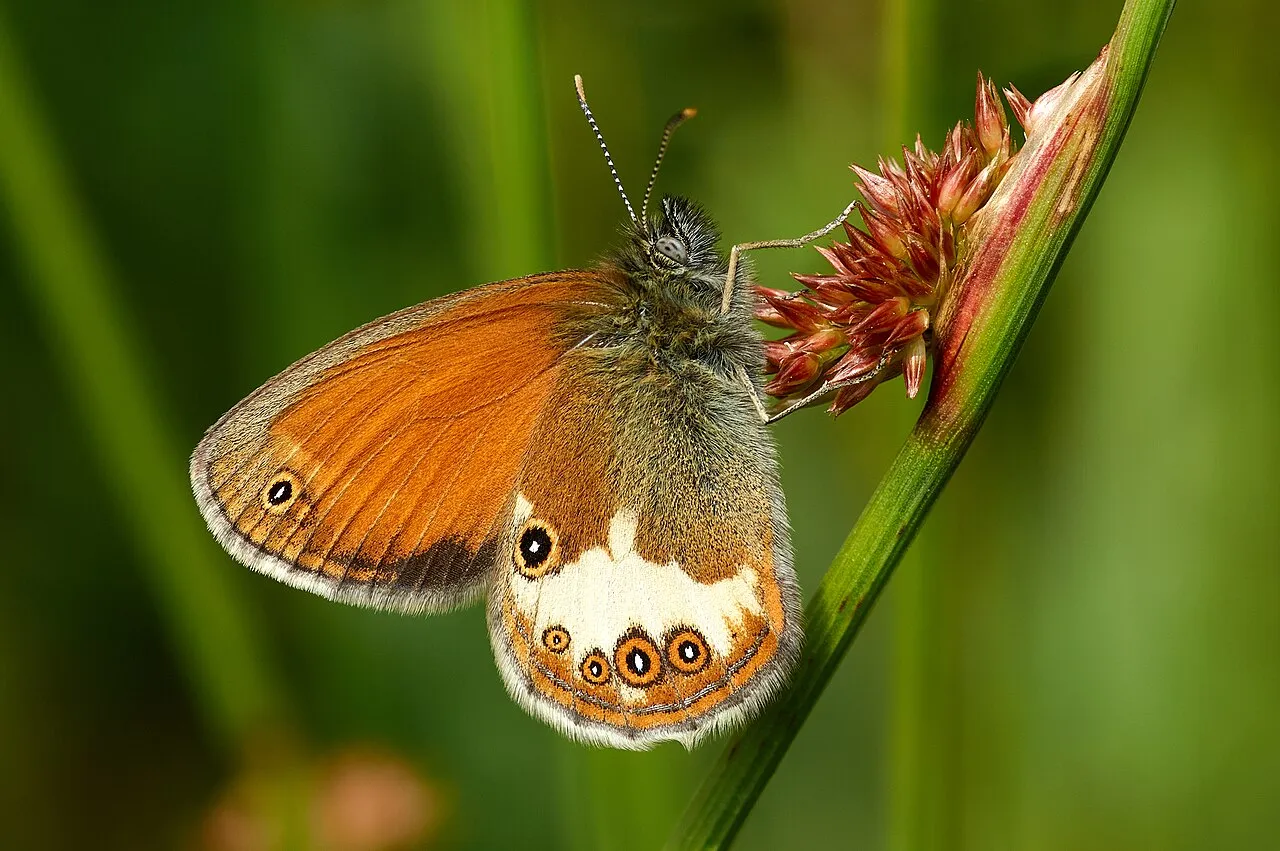
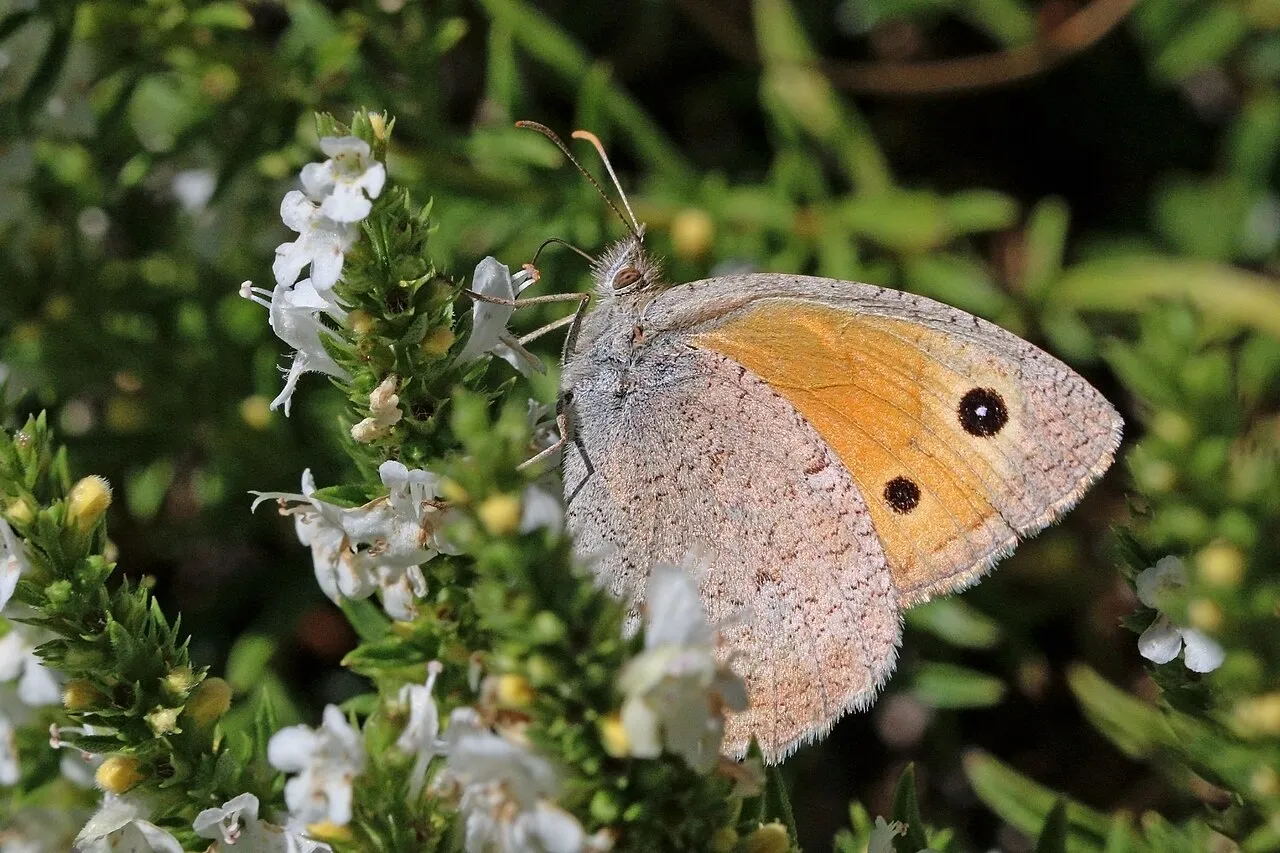
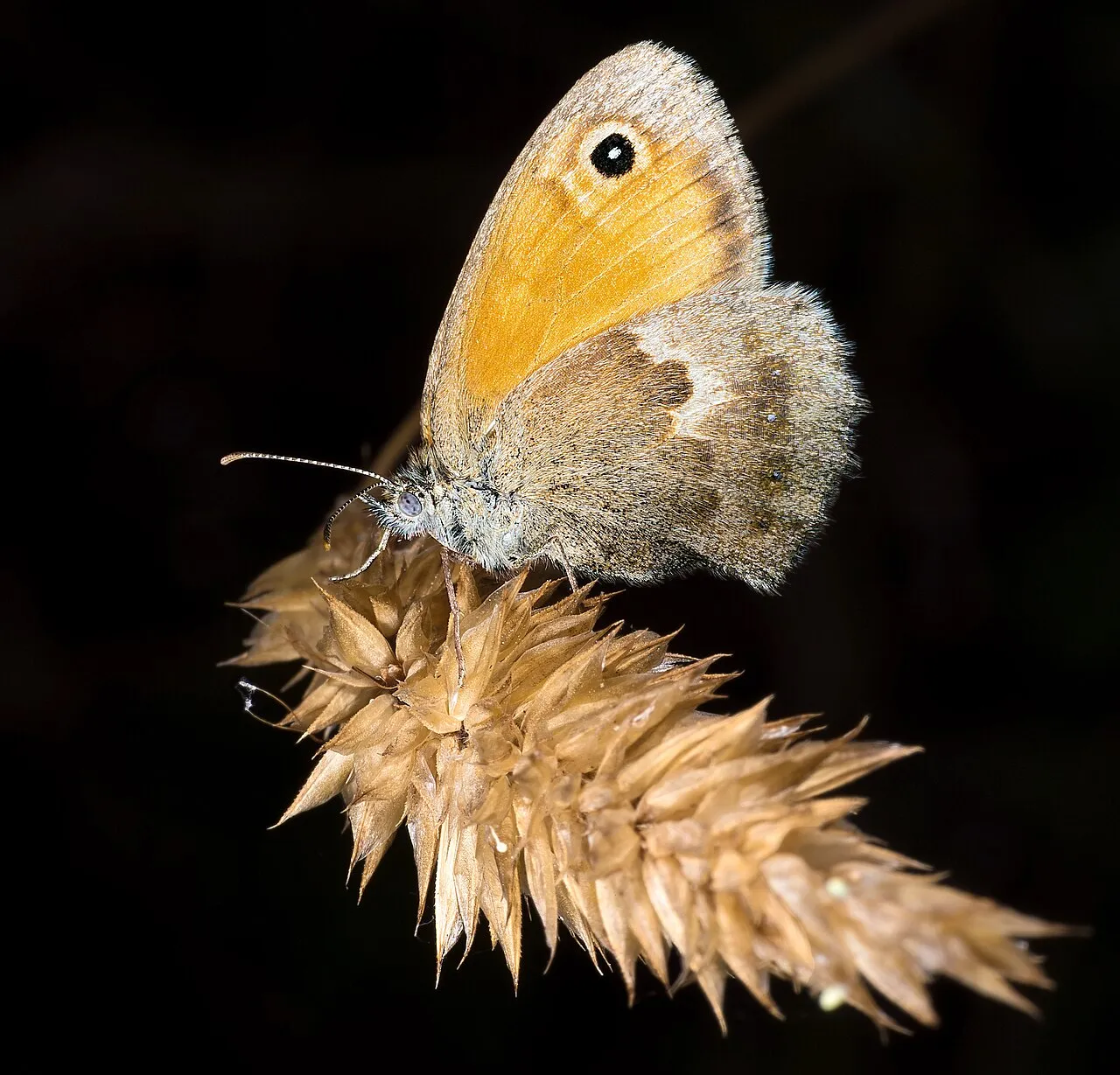
The wings are light brown, and colour is where the sexes differ: males are darker and sometimes have grey-brown hues, while females are paler and occasionally white-brown or yellow-white. Other individuals show a redder or yellower pigment1, occasionally purple-brown. Both sexes can have a brownish-grey border around the wing edge, which varies in thickness and appears to be more common in males than in females.
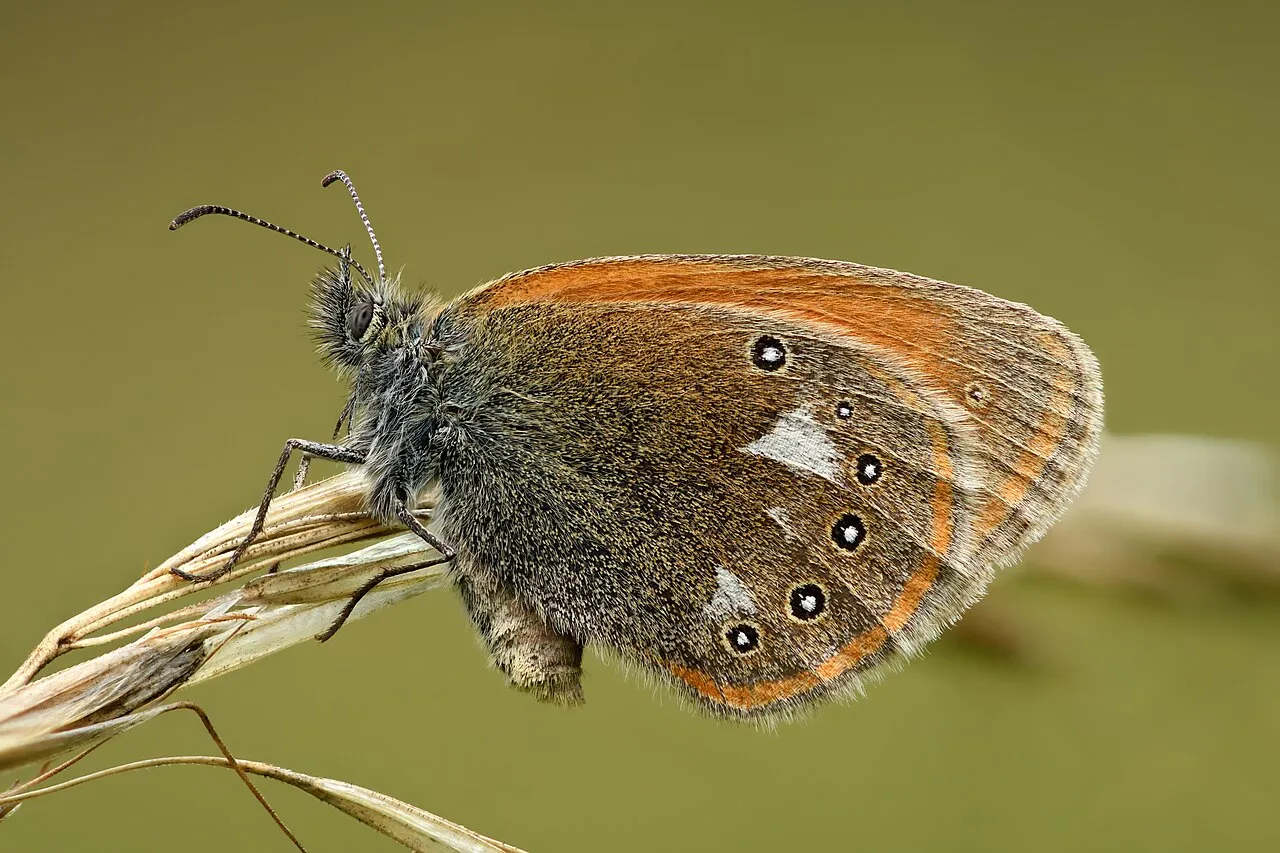
The butterfly always settles with its wings closed, and the eyespot on the underside of the forewing is usually visible, acting as a decoy to any predator. That eyespot sits at the forewing tip3, and the hindwing underside is banded with brown, grey and cream. The forewing spot can be prominent or faint1, or sometimes missing altogether; a white band runs along the underside and varies in width and fullness, and the hindwings may also have eyespots or white dots. When roosting for long periods, or in dull weather, it tucks its forewings behind the hindwings4, and the browns and greys of the hindwing underside blend in with the surroundings.
Range and habitat
The small heath is spread throughout the Western Palearctic, particularly in Europe, where it has been reported in at least 40 countries since 20021, and populations are also found in southwest Siberia, parts of Asia and north Africa. In the British Isles it can be found almost everywhere except Orkney, Shetland and mountainous regions4. It lives in discrete colonies, and adults rarely venture far from the colony.
It favours open habitats such as grassland, heathland, railway embankments, disused quarries, meadows and sand dunes, and occurs only sparingly in woodland, in ones and twos along wide woodland rides. Wherever it occurs, the adults prefer a shorter grass sward4 than closely related species. It needs grassland with fine grasses3, especially in dry, well-drained places where the sward is short and sparse; typical habitats are heathland, downland and coastal dunes, and it is also found on road verges and moorland.
Other open land it inhabits includes extensive meadows, fens, nutrient-poor grasslands and pastures, and sometimes larger woodland clearings. In the foothills of the northern Alps it occurs on pastures up to around 1400 m2 above sea level. In towns it lives in greenways, gardens and parks1.
Its range in Britain has changed little, but many colonies have disappeared in recent decades: UK abundance fell by 49% between 1976 and 2019 and distribution by 67% between 1971 and 20193.
Life cycle and host plants
The caterpillars feed on fine grasses3, especially fescues (Festuca), meadow-grasses (Poa) and bents (Agrostis). Grasses recorded as larval food include Anthoxanthum odoratum, Poa pratensis, Agrostis stolonifera and Festuca rubra1.
The almost-spherical eggs are laid singly on a grass blade or nearby vegetation. They are pale green when first laid and eventually turn straw-coloured and blotched; this stage lasts around 2 weeks4.
Caterpillars spend most of their time at the base of a tuft of grass, feeding at night on the tender tips of grass blades. The caterpillar typically goes through four instars and moults three times1, and by the end of the fourth instar it is leafy green with a green stripe along its back. In all locations it is the larva that overwinters4, in the penultimate instar2.
The pupa is formed head down, attached to a plant stem, and this stage lasts around 3 weeks4. It is light yellow-green and 8.5 mm1 long.
Northern populations have one generation each year4, while southern populations have two, and possibly three in exceptional years.
Behaviour and flight period
In Britain, adults can be found continuously from late May until mid-September4, and on some sites in southern England they may be seen from late April to September3. Across Europe the butterflies are on the wing from the end of April until October1. Another account has the adults flying from April or May to early or mid-October2, and in the south from as early as late February.
The small heath flies only in sunshine and rarely settles more than a metre above the ground3. Its fluttering flight4 is quite different from that of the skippers and blues. It is a lateral basker, only ever resting with its wings closed and angled at 90° to the sun1.
Males set up territories where they can be found perching, although they also spend time patrolling in search of a mate. When a male meets another, the pair flies a few metres up into the air before separating. Virgin females zig-zag over the vegetation in search of a mate, while mated females tend to avoid male territories and fly over sparse grassland, where they lay their eggs. A mating pair may remain coupled from 10 minutes up to 5 hours4.
Adults take nectar from brambles, buttercups, Common Fleabane, Devil’s-bit Scabious and Yarrow4, among other flowers.
Similar species
- Meadow brown (Maniola jurtina): the small heath loosely resembles a small meadow brown1, but its wings look noticeably paler in flight, and unlike the meadow brown it rests only with its wings closed.
- Large heath (Coenonympha tullia): a closer look-alike, told apart by its smaller forewing apical spot1.