Contents
The Common Jezebel, Delias eucharis, is a white, black and vermilion butterfly of South and Southeast Asia. It belongs to the family Pieridae, the whites and yellows, and its caterpillars feed on parasitic mistletoes rather than on ordinary leaves. The species ranges throughout India except the desert areas, and also occurs in Bangladesh, Sri Lanka, Myanmar, Thailand and Indonesia.
Identification
The Common Jezebel has a wingspan of 65–85 mm. The male’s upperside is white, with the forewing veins broadly black and a broad black band crossing the wing. The hindwing carries similar but narrower black veins, and beyond its black band the interspaces show pink, a hint of the colour that dominates the underside. The female looks similar but with much broader black edging on the veins and bands of both wings, making her markings heavier and darker than the male’s.
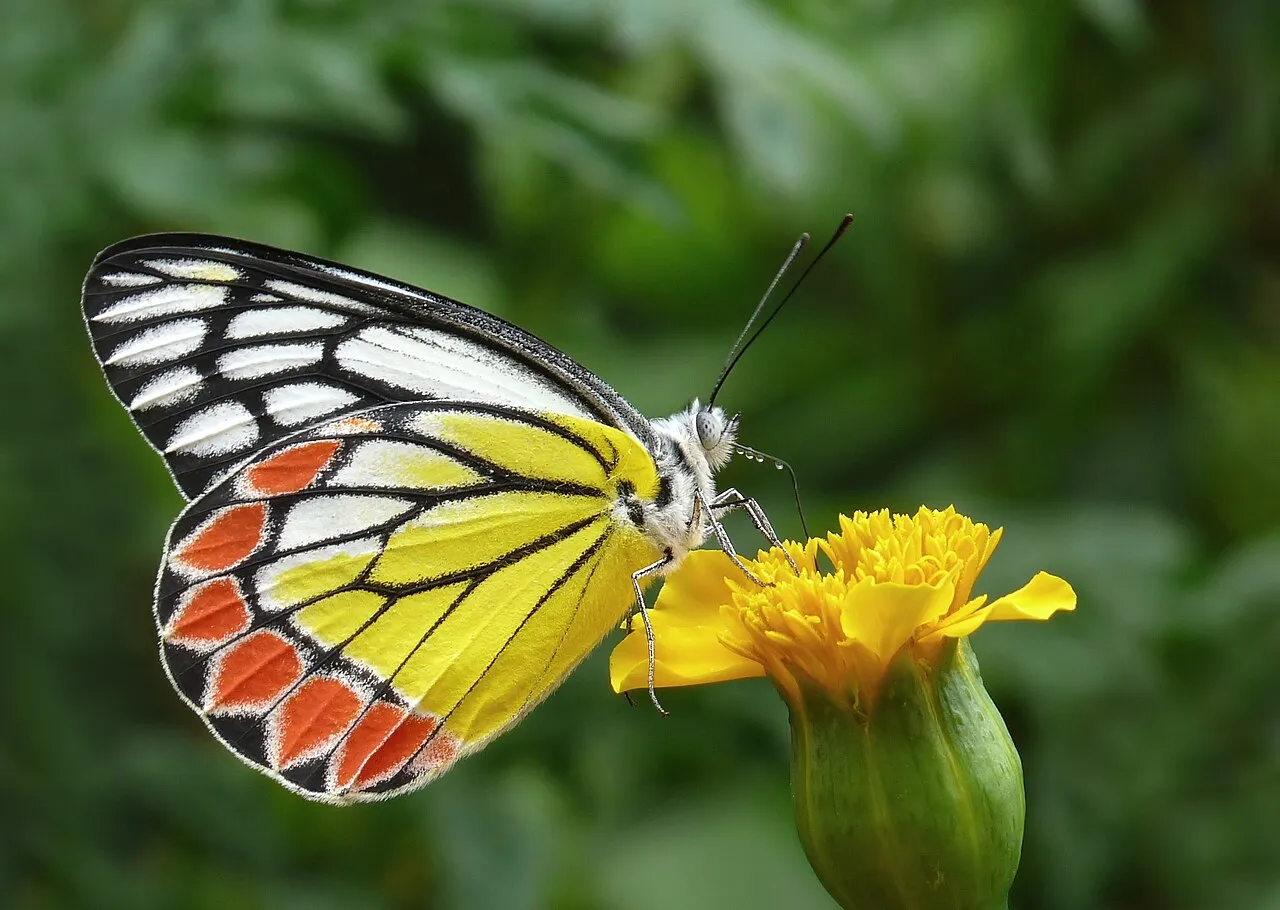
The underside is the butterfly’s signature. On the forewing it repeats the upperside pattern but with broader black edging, while the hindwing is bright yellow, crossed by black veins and a black band, and carries a row of lanceolate or cone-shaped vermilion-red spots. The butterfly rests with its wings closed, showing off this brightly coloured underside rather than the plainer white upperside.
Range and habitat
Within its range the species lives in temperate hill forests, tropical rainforest, dry open woodland and beach hinterland, and also in gardens and towns wherever trees grow. It is a nomadic butterfly, not tied to one patch of forest, which lets it turn up well outside wilder habitat as long as its host plants are present.
Life cycle and host plants
Caterpillars feed on parasitic mistletoes, chiefly species of Loranthus, including L. cordifolius, as well as Dendrophthoe and Scurrula parasitica; they have also been recorded on Butea monosperma, Abelmoschus moschatus, Pterospermum acerifolium and Viscum album. Because mistletoes themselves grow as clumps on host trees, a female must search the trees of a wood rather than its undergrowth to find a place to lay.
Eggs are laid in parallel rows of 20 to 30 on a leaf. The caterpillars are gregarious through their first few instars, yellow-brown with a black head and white, hair-bearing tubercles, and when disturbed they drop from the leaf on a silken thread. The chrysalis is bright yellow, marked with black spots and lines, and hangs from a vertical surface by a tail pad and a body band of silk.
Behaviour and flight period
The Common Jezebel is on the wing year-round across South Asia, with multiple broods. The sexes divide the day’s work differently: males visit flowers for nectar, while females spend their time searching trees for the mistletoe food plants rather than feeding. When at rest the butterfly keeps its wings folded, holding its vermilion-spotted underside on display.
Similar species
- Painted sawtooth (Prioneris sita): a Batesian mimic sharing the Common Jezebel’s white, black and red-spotted pattern over part of its range in the Western Ghats and Sri Lanka. The two can be told apart because the painted sawtooth has a much broader hindwing, and its orange-red marginal spots are more squarish, where the Common Jezebel’s are arrowhead-shaped; it also flies faster, keeps to denser forest and visits mud puddles, which the Common Jezebel does not.
- Painted Jezebel (Delias hyparete): the closest look-alike among its own genus, overlapping with the Common Jezebel across South and Southeast Asia. Its male upperside has more diffuse black margins on the veins and an ill-defined, oblique black band, and its hindwing underside runs to a deeper chrome-yellow, with red spots that grow larger toward the rear of the wing rather than staying arrowhead-shaped.
_Anthocharis_cardamines_-_Foret_de_Bouconne__France_-_male_2lyp2N.webp)
_Aporia_crataegi-_Foret_de_Soreze_Tarn_France_-_male_25HPdB.webp)
_Gonepteryx_rhamni_-_Pr%C3%A9serville_France_-_male_KFu9N.webp)
_Pieris_napi_napi_-_Foret_de_Bouconne__France_-_male_Z19U1qT.webp)
_Colias_croceus_-_Durfort_Tarn_France_-_male_ZvAIWE.webp)