Contents
The Cleopatra, Gonepteryx cleopatra, is a medium-sized butterfly of the family Pieridae, found across the Mediterranean basin. It is a close relative of the common brimstone, and the male’s bright orange forewing patch gives the species its name. The Cleopatra ranges across southern Europe, North Africa and West Asia, with ten subspecies occupying areas from Portugal and Spain to Libya, Cyprus and Syria.
Identification
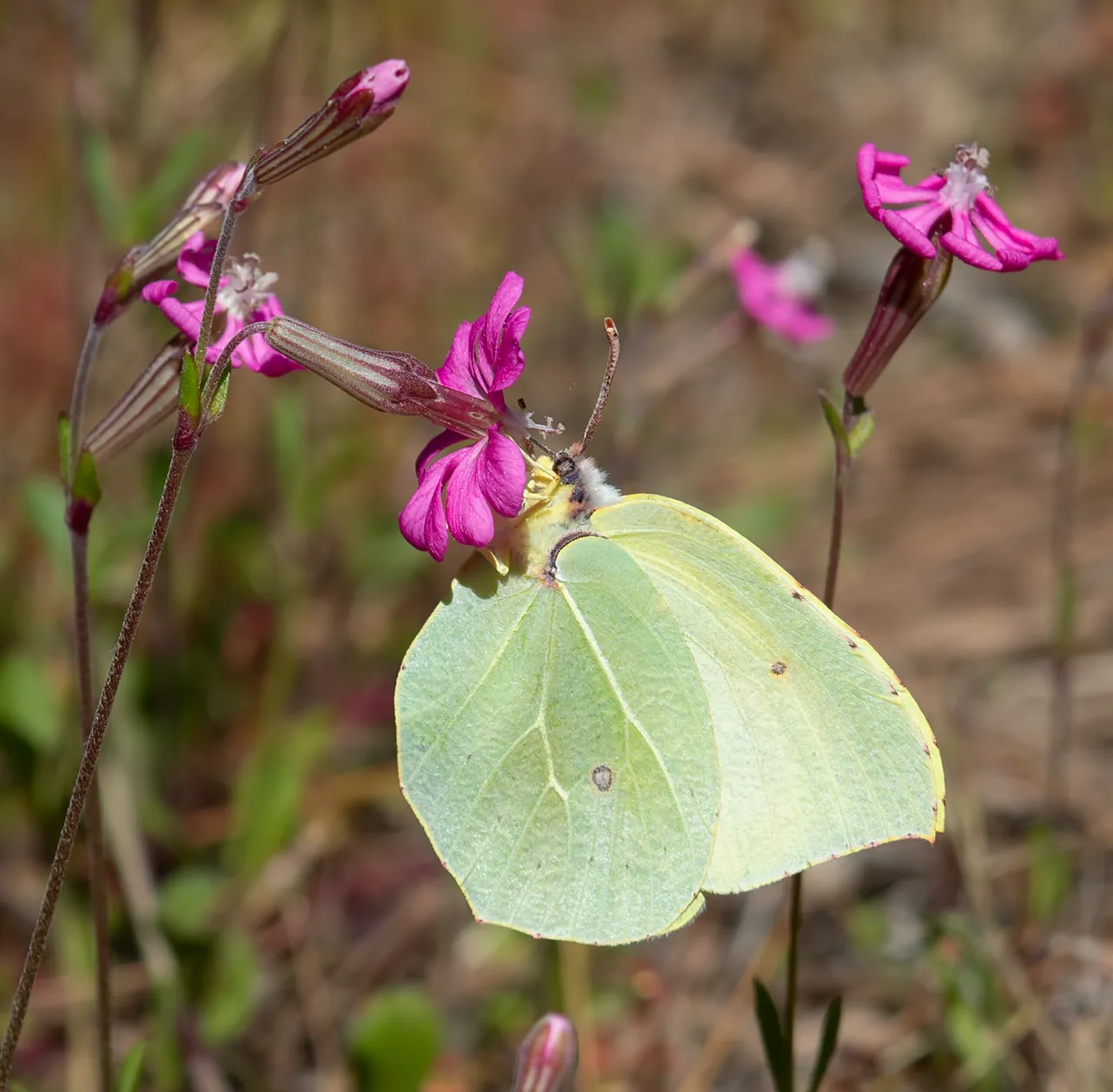
The Cleopatra has a wingspan of about 50 to 70 mm (2.0 to 2.8 in). The sexes are easy to tell apart. The female has pale yellow or greenish wings, while the male is a darker yellow with an orange patch on the forewing that gives the species its common name. Both sexes carry a forewing apical hook and a brown dot in the centre of each wing, and the underside of the wings is light greenish yellow. At rest, the greenish colour, the leaf-like shape and the pronounced veining on the hindwings camouflage the butterfly among foliage.
Range and habitat
The Cleopatra inhabits open woodland and scrub. In the drier parts of its range it moves with the seasons: adults emerge in spring at low altitudes, then migrate to higher ground in the mountains and stay there through the summer months.
Life cycle and host plants
Caterpillars feed on buckthorns, especially Mediterranean buckthorn (Rhamnus alaternus). When ready to pupate, a green caterpillar ties itself to the host plant with a silk girdle, on the underside of a leaf. The green chrysalis gradually turns yellow and red as the wing colours show through. Most of the range produces one generation a year, but Spanish populations run to two.
Behaviour and flight period
Adults are on the wing from May to August across most of the range, while Spanish populations are double-brooded and can be seen flying almost all year. The adult overwinters in evergreen trees and shrubs, tucked among foliage its wing shape and colour already mimic.
Similar species
- Common brimstone (Gonepteryx rhamni): the closest look-alike and a fellow member of the genus; ranges overlap across much of southern Europe, but the brimstone male lacks the Cleopatra’s orange forewing patch.
- Canary Islands brimstone (Gonepteryx cleobule): another close Gonepteryx relative, confined to the Canary Islands, where the Cleopatra does not occur.
_Gonepteryx_rhamni_-_Pr%C3%A9serville_France_-_male_KFu9N.webp)
_Anthocharis_cardamines_-_Foret_de_Bouconne__France_-_male_2lyp2N.webp)
_Aporia_crataegi-_Foret_de_Soreze_Tarn_France_-_male_25HPdB.webp)
_Pieris_napi_napi_-_Foret_de_Bouconne__France_-_male_Z19U1qT.webp)
_Colias_croceus_-_Durfort_Tarn_France_-_male_ZvAIWE.webp)