_Colias_alfacariensis_-_Novy_Jicin__Moravie_Tch%C3%A9quie_-_female_Zgm502.webp)
Contents
Berger’s clouded yellow, Colias alfacariensis, is a yellow butterfly of the family Pieridae so close in looks to the pale clouded yellow that the two are often impossible to tell apart on the wing. It ranges across South and Central Europe, Asia Minor, the Caucasus and Transcaucasia, south Russia, the Russian Far East, Siberia, Central Asia and temperate China, with occasional vagrants reaching southern England, the North German plain and Denmark.
For a long time nobody realised there were two species here at all. The butterfly was first described as distinct from the pale clouded yellow by Heinrich Ribbe in 1905; before that the two had been treated as a single species. Several regional populations across its wide range have since been named as subspecies, among them vihorlatensis in the Carpathians, remota in southern Europe and the Caucasus, fontainei in Armenia and the Kopet-Dagh, and saissanica in southeastern Kazakhstan. The species has also travelled under other names in the literature, including Colias sareptensis, described by Staudinger in 1871, and Colias australis, described by Verity in 1911, both now treated as synonyms of C. alfacariensis.
Identification
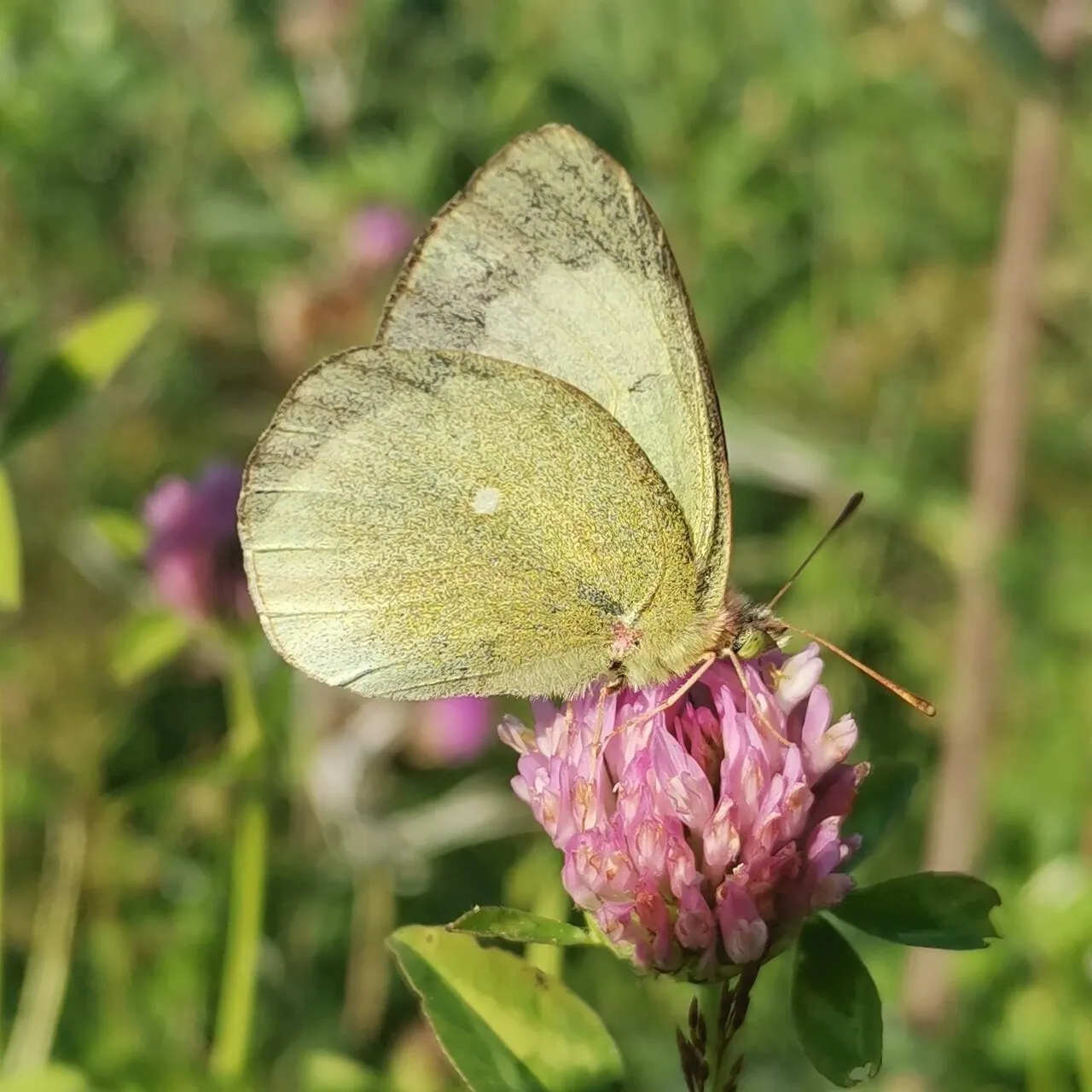
The male has a yellow ground colour with a dusted dark brown to black marginal band on both wing surfaces, a black cell spot on the forewing, and an orange spot bordered in red on the underside of the hindwing. The female is paler, with a greenish-white ground colour above, a yellowish hindwing underside, the same dark marginal bands and forewing cell spot, but an orange hindwing spot that lacks the male’s red border. Wingspan runs to about 50–60 mm.
Identification on the wing is, in practice, close to impossible: the species and the pale clouded yellow cannot be told apart by morphology or by examining the genitalia, and even experienced lepidopterists cannot separate them unless the butterflies have been reared from caterpillars. The caterpillars give the only reliable clue, since Berger’s clouded yellow larva carries four eye-catching yellow lines marked with black dots, where the pale clouded yellow larva has only two thin side lines; UK Butterflies puts it more simply, noting that the larva’s yellow side stripes are what allow it to be told apart from other Colias species in the first place.
Range and habitat
The species favours calcareous dry and marshy grasslands, dry shrubbery and lightly forested slopes, and avoids cool, rainy regions, a preference for warm, lime-rich ground that holds across its whole range. In Britain, where it turns up only as a vagrant, it has been found on coastal cliffs and open downland, the same ground favoured by the clouded yellow.
Life cycle and host plants
Caterpillars feed on horseshoe vetch and, on the continent, crown vetch. Eggs are laid on these low-growing legumes of dry grassland, and the yellow-striped caterpillars remain the one dependable way to separate this species from its close relative: a lepidopterist who finds a clouded-yellow caterpillar on horseshoe vetch cannot be sure which of the two it is without counting the stripes.
Behaviour and flight period
The species flies in two generations, in May–June and August–September, in the cooler parts of its range, or in up to three generations from May to October further south, with adults feeding at flowers across the warm, dry grassland and scrub they favour. As a vagrant to Britain it most often appears in August or early September, occasionally as early as May or June, with the latest-ever sighting on 27 October 1945 at Glynde, East Sussex. It has been one of the rarer migrants recorded there, most frequent between 1947 and 1949, and absent from the record in some years altogether.
Similar species
- Pale clouded yellow (Colias hyale): the species it is most often confused with, to the point of forming a true species complex; adults of the two cannot be reliably separated by wing pattern or genitalia, only by rearing the caterpillars, which carry different stripe patterns.
- Clouded yellow (Colias croceus): a deeper orange relative sharing similar open grassland habitat, distinguished by its stronger colour and more black on the hindwing.
_Colias_croceus_-_Durfort_Tarn_France_-_male_ZvAIWE.webp)
_Colias_hyale_-_Novy_Jicin_Moravie_Czech_Republic_-_male_Z1RdClK.webp)
_Colias_myrmidone_myrmidone_-_Star%C3%A1_Tur%C3%A1_Slovaquie_-_male_ZJNmUp.webp)
_Anthocharis_cardamines_-_Foret_de_Bouconne__France_-_male_2lyp2N.webp)
_Aporia_crataegi-_Foret_de_Soreze_Tarn_France_-_male_25HPdB.webp)