Contents
The moorland clouded yellow, Colias palaeno, is a pale butterfly of the family Pieridae, built for cool, wet ground, not warm meadows. First described by Linnaeus in 1761, it also goes by the names palaeno sulphur and pale Arctic clouded yellow. The species has a Holarctic range, found across Asia, Europe and North America, running from eastern France across the Baltic states and Scandinavia to eastern Siberia, the Chukchi Peninsula, Japan and northern North America. Across so wide a range the species has split into ten recognised subspecies: the nominate palaeno across Sweden, Norway, Finland and Estonia; synonyma in Sweden and Denmark; europome from Belgium and Germany east to Slovakia, Romania and Ukraine; the larger Alpine form europomene; orientalis in Kamchatka; sachalinensis on Sakhalin; poktusani in North Korea; and, in North America, baffinensis and chippewa. The Japanese form, aias, is the largest of the ten, with an unusually broad dark forewing margin and a richer green underside, and like chippewa is distinct enough that some authors treat it as a separate species rather than a subspecies of C. palaeno.
Identification
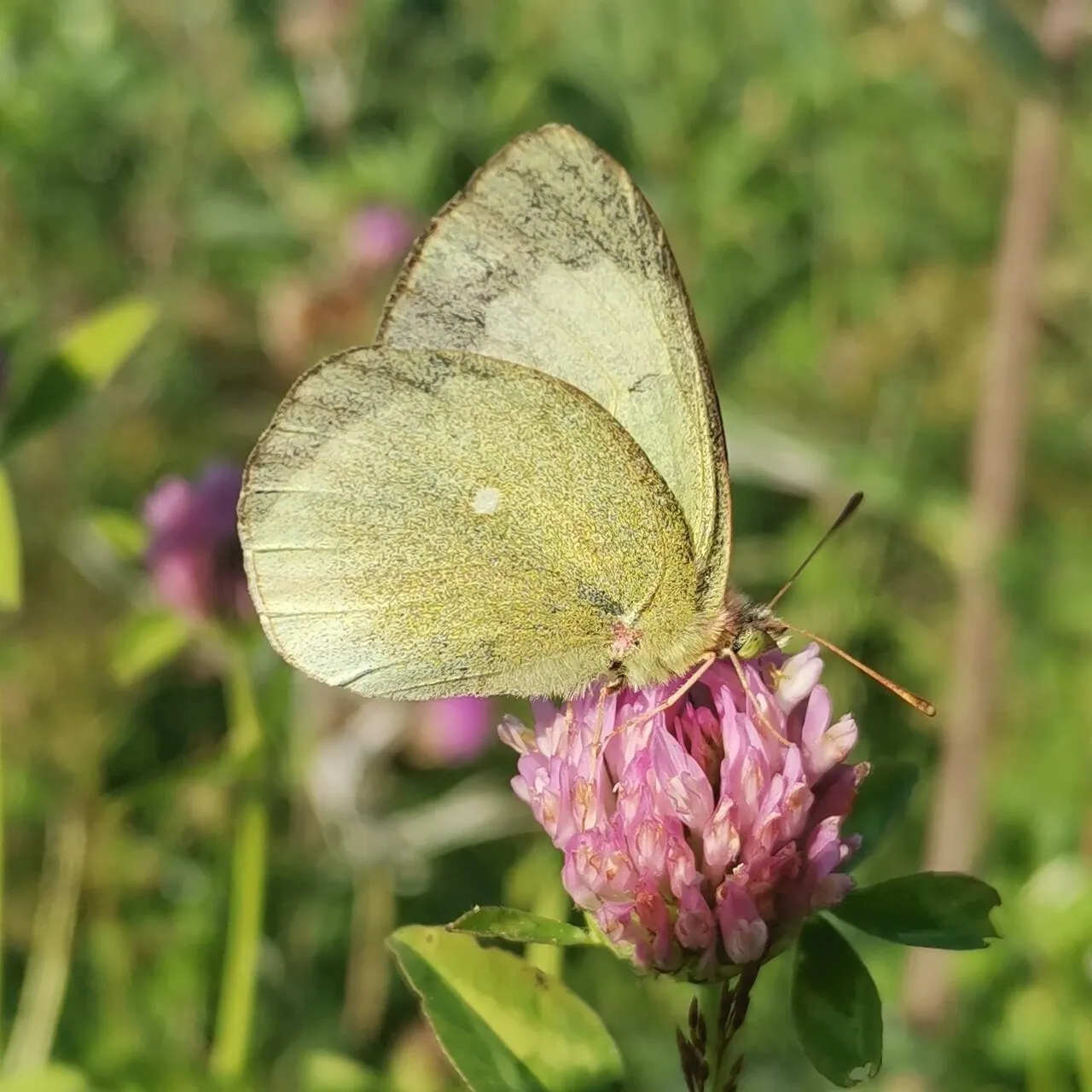
This is a modest-sized Colias, with a wingspan of about 46 to 52 mm, males running smaller at 46 to 50 mm and females larger at 50 to 52 mm. The sexes look quite different from above. The male is pale yellow with blackish-brown margins on both wings and a pale-centred dark spot on the forewing, while the female carries a white ground colour above instead of yellow. Underneath, the female forewing is white near the body and yellow toward the tip, a detail that helps separate a pale female from the all-white females of other pierid butterflies sharing the same bogs. Both sexes share the same underside pattern on the forewing, pale yellow with a white-centred dark middle spot, while the hindwing underside is yellow and heavily dusted with dark scaling around a large, mother-of-pearl-coloured central spot, a mottled finish that helps the resting butterfly disappear against lichen and bog moss.
The caterpillar is just as distinctive as the adult. It is sea-green and velvety, marked with minute black dots, and carries a bright yellow lateral stripe edged with black on its underside, a pattern that breaks up its outline against the bilberry leaves it feeds on.
Range and habitat
Across its wide range the species favours moorland of various kinds, forest meadows, open coniferous forests and upland bogs. Towards the warmer, southern edge of its distribution it retreats uphill, becoming a high alpine butterfly found above roughly 1,500 m, while further north it can be found on lowland bogs. The pattern is typical of a cold-adapted species: as the climate gets milder, the butterfly climbs to stay in the cool, boggy ground its caterpillars need. Most other clouded yellows spread freely across open farmland; this species stays tied to bog and moorland instead of ordinary flower-rich meadows.
Life cycle and host plants
The caterpillars feed on bog bilberry (Vaccinium uliginosum) together with Vaccinium myrtillus and Vaccinium cespitosum, low shrubs typical of the moors and bogs the adults frequent. All three are plants of acidic, waterlogged or nutrient-poor ground, which is part of why the butterfly is tied so closely to bog and moorland rather than to the richer grasslands that feed its clover- and vetch-eating relatives. The species is univoltine, producing one generation a year, a single-brooded life suited to short, cool summers, where many southern relatives fit in more than one brood.
Behaviour and flight period
Adults are on the wing from June to August, the one flight period of their single annual generation. Like other members of its genus it is an avid flyer, covering open moorland and bog in search of nectar and, for the males, patrolling for females across the bog pools and heather that stand in for the flower meadows used by other Colias species.
Similar species
- Pale clouded yellow (Colias hyale): the species most often confused with it. Colias hyale’s own description names C. palaeno among the Colias species closest to it in appearance; the two share the same washed-out yellow males and whitish females, though C. hyale flies in warmer lowland meadows rather than bogs and moorland.
- Arctic clouded yellow (Colias tyche): a congener of the far north and high alpine zones, similarly pale-winged, that shares much of the moorland clouded yellow’s taste for cold, open ground.
_Colias_croceus_-_Durfort_Tarn_France_-_male_ZvAIWE.webp)
_Colias_hyale_-_Novy_Jicin_Moravie_Czech_Republic_-_male_Z1RdClK.webp)
_Colias_alfacariensis_-_Novy_Jicin__Moravie_Tch%C3%A9quie_-_female_Zgm502.webp)
_Colias_myrmidone_myrmidone_-_Star%C3%A1_Tur%C3%A1_Slovaquie_-_male_ZJNmUp.webp)
_Anthocharis_cardamines_-_Foret_de_Bouconne__France_-_male_2lyp2N.webp)
_Aporia_crataegi-_Foret_de_Soreze_Tarn_France_-_male_25HPdB.webp)