Contents
The Bath White, Pontia daplidice, is a small butterfly of the family Pieridae1, the whites and yellows. It is the western member of a species pair: it ranges over North Africa, the Canaries and southwestern Europe2 to west Germany and northwest Italy, while the eastern taxon, Pontia edusa, takes over from Central Europe and most of Italy to East Asia. In the British Isles it is an extremely scarce immigrant3 and, in some years, is not seen at all.
The English name comes from a piece of needlework that figures this species, supposedly showing a specimen taken in or near Bath in 1795. Before that it was known as Vernon’s Half Mourner3, after the first recognised capture by William Vernon in Cambridgeshire in May 1702. The Hope Entomological Collection at Oxford holds a specimen of this species dating from 17021, the oldest pinned entomological specimen still on its original pin.
Identification
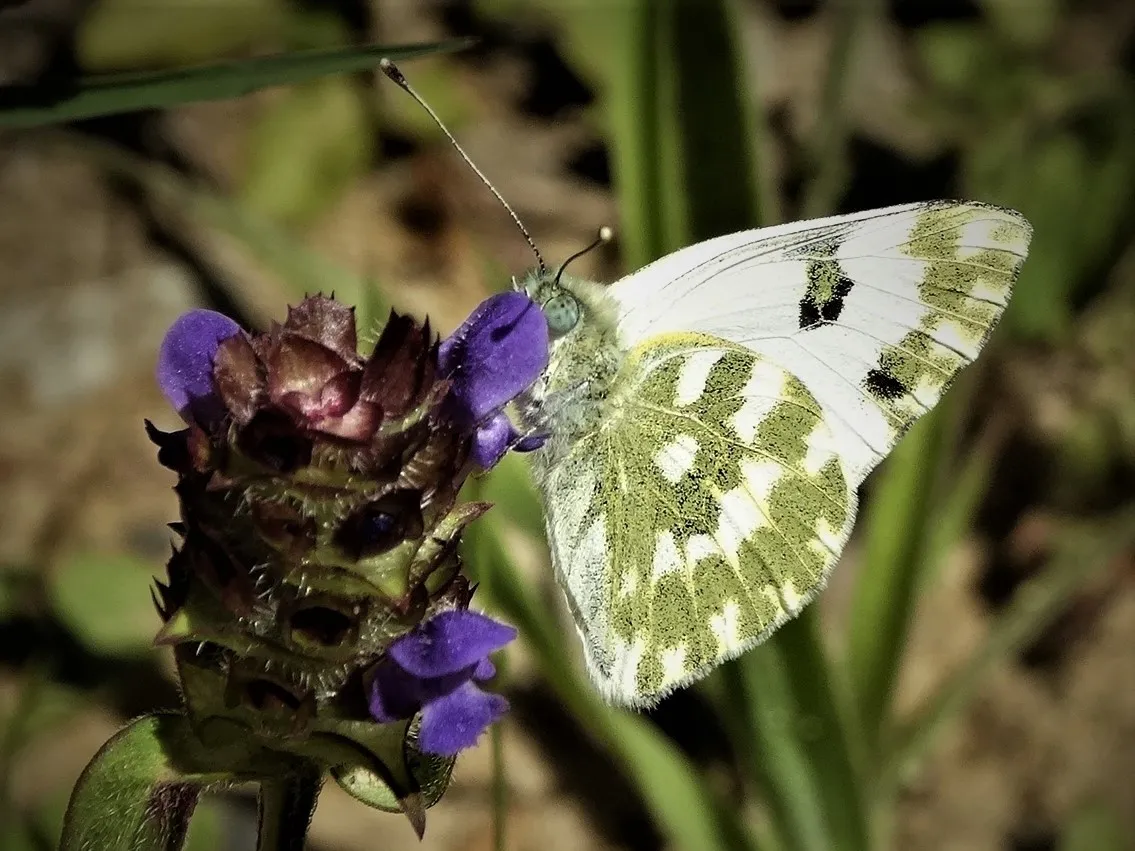
The wingspan is 45 to 50 mm. On the upperside the apex of the forewing is black with white spots and lines, and there is a black spot at the end of the cell. The sexes differ on the upperside: the female has an additional discal spot1 on the forewing and an obscure row of terminal and marginal spots on the upper hindwing, while in the male the upperside of the hindwing is unmarked4.
The hindwing underside has a pattern of greenish blotches1, which is characteristic of the Bath whites and easily identifies it from other pierids.
The eggs are laid singly on the foodplant and are yellow-green when first laid, gradually turning orange3.
Range and habitat
The Bath White inhabits hot-dry open land: Mediterranean coastal dunes and rocky, hot slopes. In western parts of Central Europe it is observed in sandy, hot habitats, mostly as a rare migrant2. It is usually found on dry slopes and rough ground with little vegetation1, and it prefers open habitats of any kind3; on the continent it will even breed on derelict sites.
Most British records come from the south coast of England, but it has been reported as far north as Lincolnshire and Yorkshire, and in County Wexford in south-east Ireland, with a record from 1893. The first specimen in the British Isles was recorded in the late 17th century. The great years were between 1944 and 1950, with over 700 seen in 1945, mostly in Cornwall. Since then it has been extremely scarce, with less than 20 individuals recorded since 19523.
Life cycle and host plants
The host plants are Brassicaceae and Reseda. They vary according to locality1 and include tower mustard (Arabis glabra) and sea rocket (Cakile maritima). Eggs found in the British Isles in 1945 were laid on the flower heads of Wild Mignonette, Hedge Mustard and Sea Radish3. In the French Crau, eggs and caterpillars were found on Diplotaxis tenuifolia, and in the Italian Susa Valley on Reseda. In the Canaries the species oviposits on a broad variety of Brassicaceae, such as Hirschfeldia incana and Lobularia canariensis. Oviposition occurs mostly in the inflorescence2 and more rarely on stems.
Eggs hatch in approximately a week. The caterpillar feeds during both day and night, and this stage typically lasts between 3 and 4 weeks3. The species occurs in several generations per year2, and the pupa overwinters.
In the British Isles it was potentially capable of producing 2 or 3 broods in good years. It is believed that this species cannot survive3 the British winter, although some offspring of the 1945 invasion may have survived into the following year.
Behaviour and flight period
According to Lafranchis, its flight period is March to October4 in two to four generations, and it is resident in the Mediterranean region. In the Canaries the butterflies can be found all year round2. In the British Isles, adults are typically seen in July, August and September3.
This is a highly mobile species, and its last mass immigration came in 1945. Given its similarity to other, more common whites, it is probably overlooked and therefore under-recorded3.
Conservation
It is listed as Least Concern in the IUCN Red List 2022.25. As of 2026, north of the Alps it is endangered by the decline of sandy grasslands2 and of warm fallow areas, while in southwestern Europe it is more common and still not particularly threatened. UK Butterflies lists no conservation action as relevant3 for this species.
Similar species
- Small White (Pieris rapae): a widespread white found almost everywhere6 in the British Isles; the Bath White’s greenish-blotched hindwing underside1 easily separates it from this and other pierids.
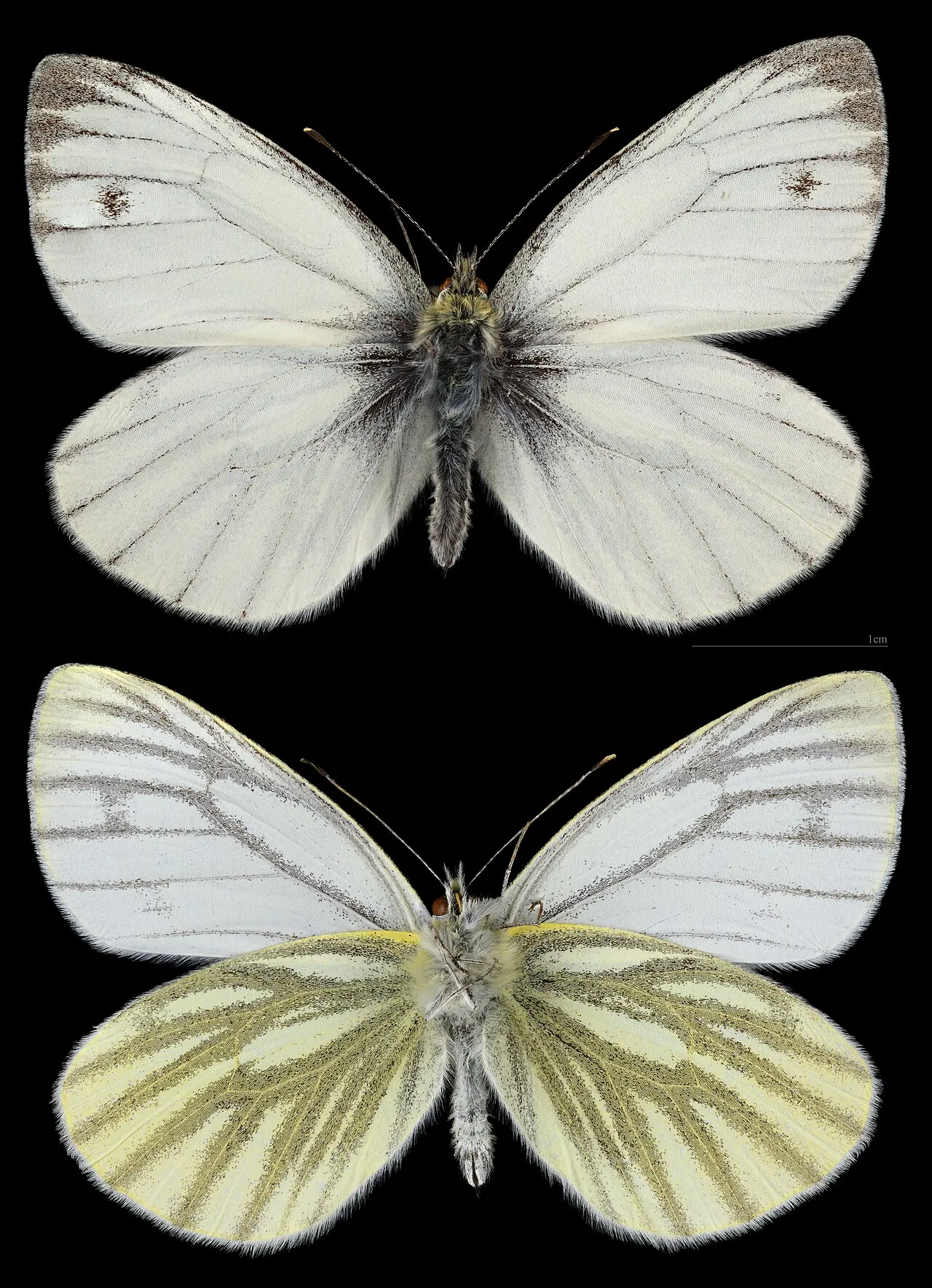
- Green-veined White (Pieris napi): its underside shows so-called green veins7, an illusion created by yellow and black scales, where the Bath White carries greenish blotches1.
- Pontia edusa: the eastern vicarious species of Pontia daplidice8, apparently distributed in Italy, eastern Europe from central and northern Germany eastwards, and the Middle East to East Asia, where the Bath White reaches only west Germany and northwest Italy2.