Contents
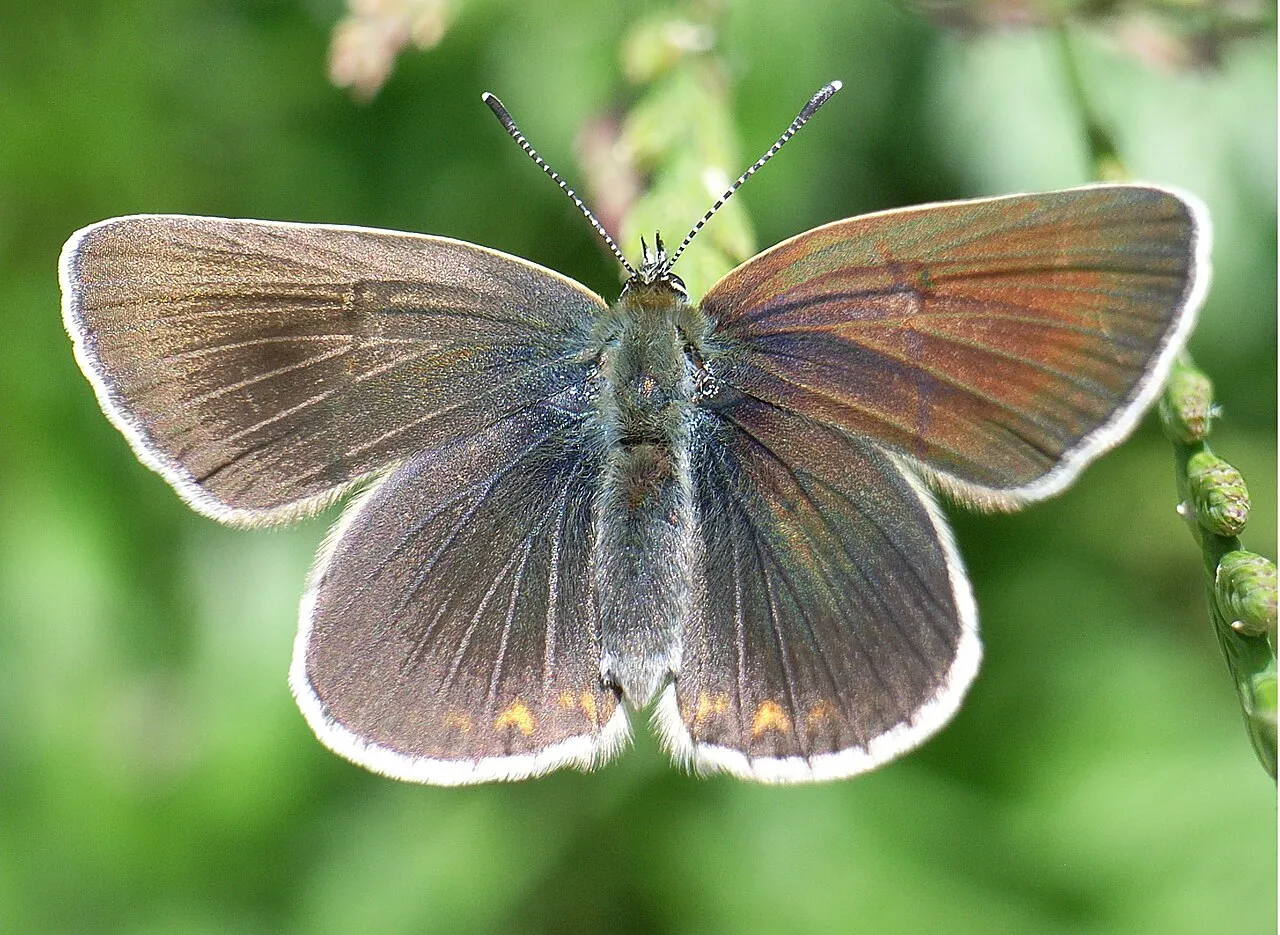
The Geranium argus, Eumedonia eumedon, is a small brown butterfly of the family Lycaenidae, named for the crane’s-bills its caterpillars eat. The species occurs across the Palearctic realm, from the Pyrenees to the Pacific coast and from Scandinavia to Italy, though it is absent from England. Within that range it turns up wherever its host plants grow, rather than forming one continuous population. It has moved between genera over the years, classified at various times in Plebejus, Plebeius, Polyommatus and Aricia before recent molecular studies confirmed Eumedonia as a genus of its own. The species was first described by Eugenius Esper in 1780 as Papilio eumedon, and those earlier generic placements survive today as synonyms rather than separate names.
Identification
This is a modestly sized butterfly, with a wingspan of 26 to 30 mm. The upperside is dark brown with white fringes and a dark spot at the centre of the forewing. The underside is more patterned: brown, crossed by a red-yellow band near the outer margin that may run unbroken or break into separate spots, over a base of very glossy, metallic scaling marked with small dark ocelli. Many individuals also show a distinct white streak running from the central spot of the hindwing out to the margin, a feature that helps separate it from brown look-alikes. The sexes are close in colour, but females carry small red spots near the margin of the hindwing, and sometimes the forewing too, which males lack. The white hindwing streak and the glossy metallic underside scaling are the most reliable field marks, together making the species unmistakable against the other brown butterflies sharing its range.
Range and habitat
The butterfly favours dry calcareous, mesophile and humid grasslands, meadows, stream valleys and woodland edges, wherever crane’s-bill host plants grow. Across its wide Palearctic range it is sporadic rather than continuous, appearing locally wherever the habitat and the host plant line up; even within a suitable meadow or stream valley, it is usually found only in the places where Geranium grows rather than spread evenly across the whole site. The species’ hold on a patch of habitat is therefore tied closely to the local abundance of its host plants rather than to the broader landscape around them.
Life cycle and host plants
Caterpillars feed on crane’s-bills (Geranium spp.) and storksbills (Erodium spp.), two closely related genera in the family Geraniaceae. Females lay their eggs in the flowers, and the newly hatched caterpillar first bores into the ovary for about a week before switching to feed mainly on the leaves and stems. The species passes the winter as a caterpillar, half-grown, sheltering in the litter layer before climbing back onto the food plant to pupate in spring. It completes one generation a year.
Behaviour and flight period
Adults are on the wing from May to August, with the high alpine populations flying later, into August. The butterfly is not a strong flier: it flies rather slowly and somewhat clumsily, almost always around the flowers of its Geranium host, beating its wings in a steady, regular rhythm. It often hovers in front of a flower for a moment before settling on it, a habit that, together with the host plant itself, is usually the quickest way to find the species in the field. Away from the daytime search for nectar and mates, adults are frequently found resting overnight on flower blossoms. Males and females appear in roughly equal numbers, and mating pairs are a common sight wherever the species is on the wing.
Similar species
Field guides call the Geranium argus unmistakable once its markings are seen clearly; two other grassland butterflies are nonetheless worth ruling out, since all three share the same flowers.
- Brown Argus (Aricia agestis): a similarly small brown butterfly that overlaps much of the Geranium argus’s range and shares the orange submarginal spots on the female, but lacks the white streak across the hindwing underside and the glossy metallic underside scaling of E. eumedon.
- Mazarine Blue (Cyaniris semiargus): flies alongside the Geranium argus in many of the same grasslands and has a comparably patterned underside, but the male’s upperside is blue rather than brown, making the two easy to tell apart in flight.
_male_Turna_Ewa2f.webp)
_07-05-2006_1_ZJyP4Y.webp)
_Lycaena_virgaureae_-_Radawa_Poland_-_male_Z25L2d2.webp)