Contents
The purple hairstreak, Favonius quercus, is a small butterfly that spends most of its life out of sight, high in the canopy of oak trees. It belongs to the family Lycaenidae, and its caterpillars feed on oak buds and leaves. Taxonomists have shuffled the species between genera more than once, and older books may list it as Neozephyrus quercus or Quercusia quercus. The species occurs across much of Europe, North Africa, Anatolia, Caucasia and Transcaucasia, and within Britain and Ireland it is common and widespread through southern England and Wales, becoming rarer and more isolated further north, with scattered colonies in Ireland.
Identification
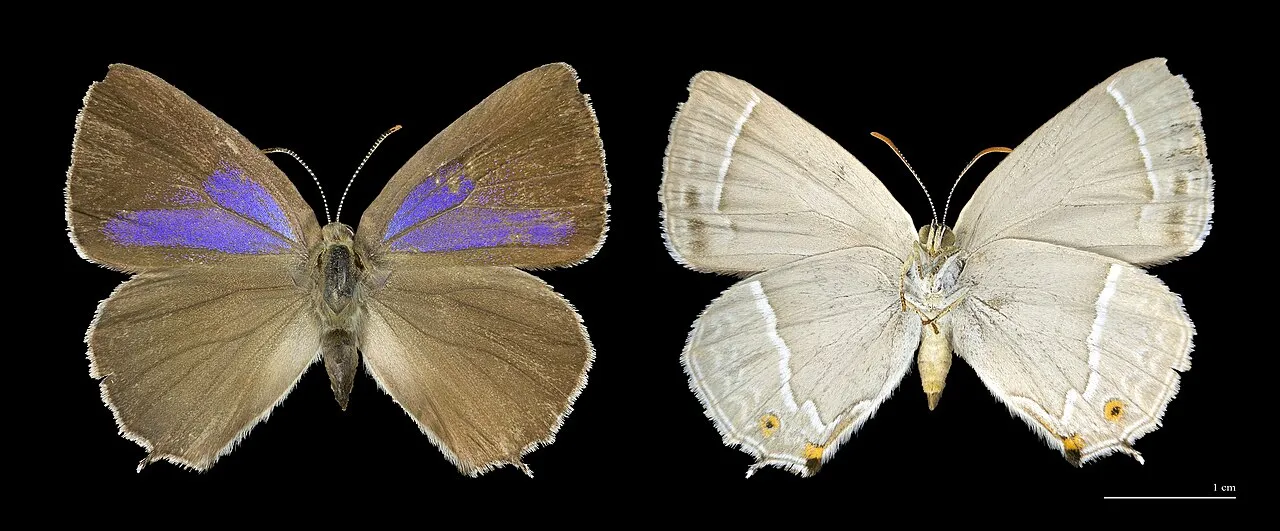
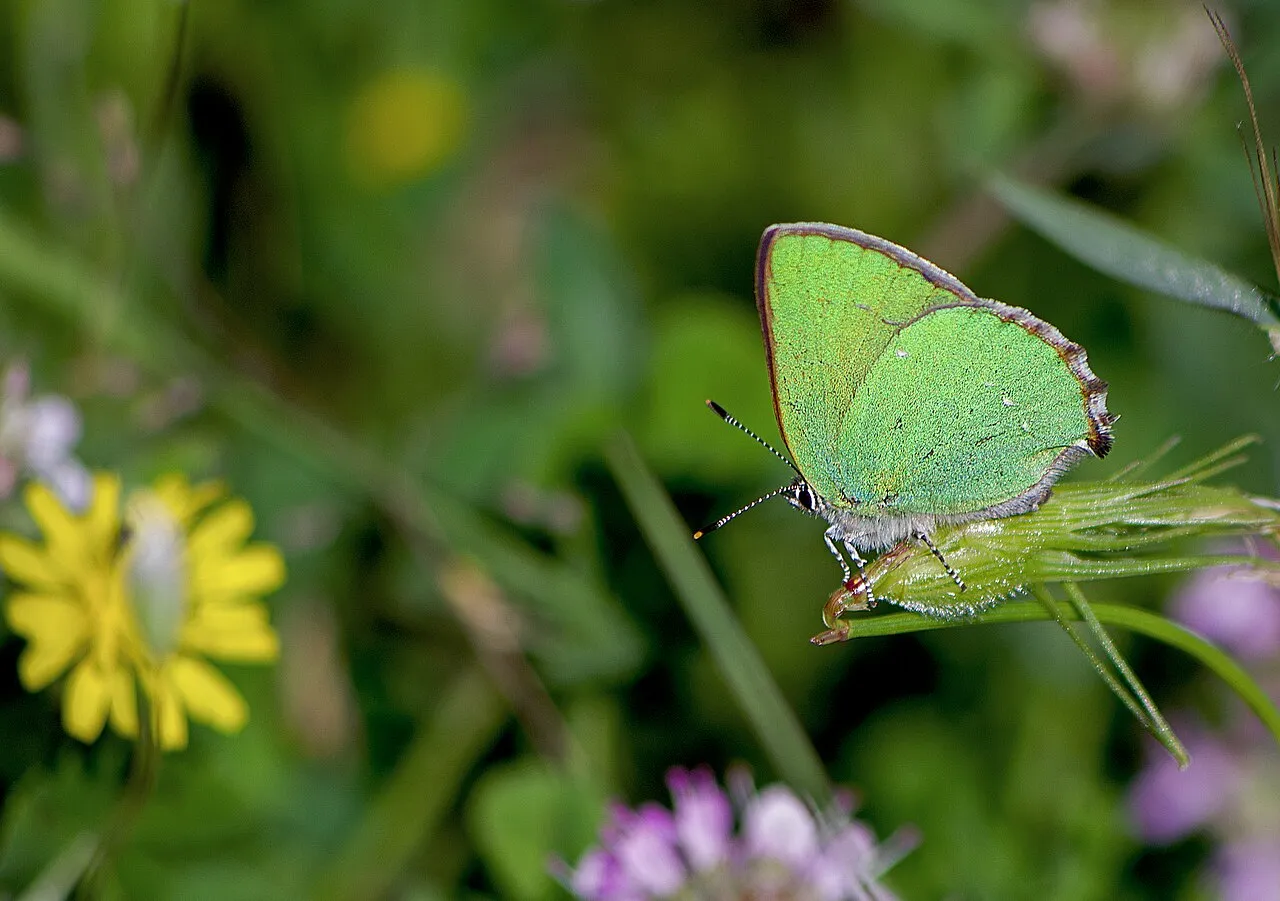
This is a small butterfly, with a wingspan of 31–40 mm, males running 33–40 mm and the slightly smaller females 31–38 mm. The sexes look different from above. The male has a blue gloss across the upperside with a narrow black border, while the female shows blue only at the base of the forewing and often on the hindwing cell, making her markings more limited and less vivid. The underside is the same leaden-grey in both sexes, crossed by a dark-edged white hairstreak line before the outer third of the wing, with weak yellow spots near the hindwing’s anal angle. Each hindwing carries a short tail with two orange spots at its base on the underside.
Range and habitat
The purple hairstreak is a butterfly of oak woodland on lowland plains and hills, but it also turns up in lanes, parks and other urban spots wherever oak trees grow. It keeps close to its host tree: males tend to stay high up in the canopy while females come down to lower branches to lay their eggs.
Life cycle and host plants
Caterpillars feed on oaks, including pedunculate oak (Quercus robur), sessile oak (Q. petraea), Turkey oak (Q. cerris) and evergreen oak (Q. ilex). Females lay their eggs singly, or occasionally in groups of two or more, usually at the base of a plump oak bud, choosing sheltered branches that catch full sun — typically on the southern side of a mature, often solitary tree. The species overwinters as an egg, with the caterpillar fully formed inside after about three weeks but not emerging until the following spring. Once hatched, the young caterpillar burrows into a flower bud to feed hidden from view, and later spins a silken retreat from which it feeds only at night. Pupation usually takes place in the leaf litter below the tree, where ants tend the pupae and bury them. There is one generation a year.
Behaviour and flight period
Unlike most butterflies, the purple hairstreak rarely comes down to flowers. Both sexes feed mainly on honeydew in the canopy, although females are occasionally attracted to flowers, among them brambles, buckthorns, hemp-agrimony and thistles. It is highly active in bright sunshine, and on warm, sunny afternoons it can be seen in large numbers flitting around the tree canopy and from tree to tree, with groups chasing one another a common sight, activity that peaks in late afternoon and early evening. That combination of height and timing makes the butterfly easy to overlook even where it is common; a patient watcher scanning a sunlit oak crown with binoculars will often do better than one searching at eye level. Adults are on the wing from late June through July and into August, with stragglers found into September, and numbers peaking in late July and early August; in Scotland, where the species is more local, the flight period runs later in the season.
Conservation
The species is assessed by the IUCN under the category shown in the facts box, taken from its Wikidata record.
Similar species
- Ilex hairstreak (Satyrium ilicis): another oak-feeding hairstreak found across southern and central Europe, best told apart by its browner upperside and the orange markings on its underside.
- Brown hairstreak (Thecla betulae): shares the same family and a liking for sheltered woodland edges, but its caterpillars feed on blackthorn rather than oak, and it flies later in the season.
_male_Turna_Ewa2f.webp)
_07-05-2006_1_ZJyP4Y.webp)
_Lycaena_virgaureae_-_Radawa_Poland_-_male_Z25L2d2.webp)