Contents
The large white, Pieris brassicae, is a common white butterfly of the family Pieridae. It ranges from Europe and North Africa to the Himalayas1, with populations also established in South Africa, and is one of the most widespread butterflies in the British Isles2, reaching as far north as Orkney and Shetland. Its closest relatives on these pages are the smaller small white, Pieris rapae, and the green-veined white, Pieris napi (see Similar species).
Identification
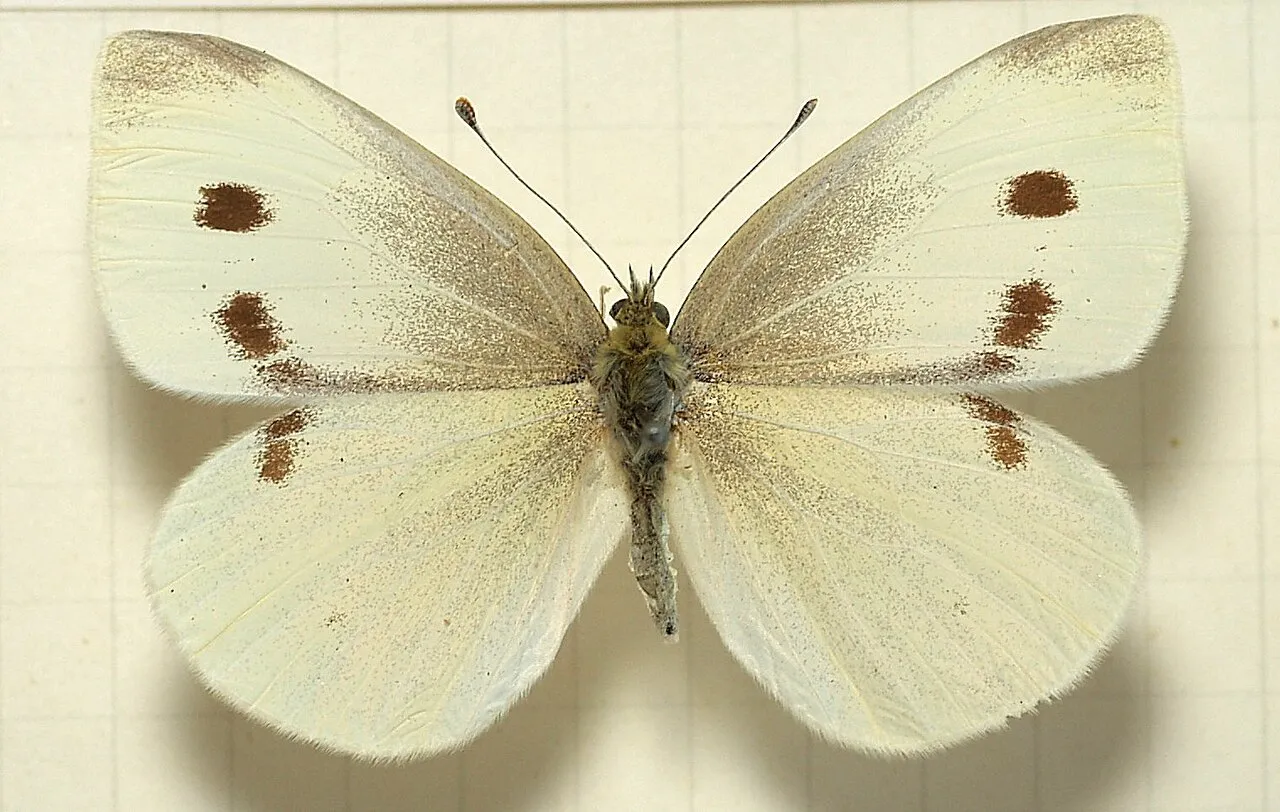
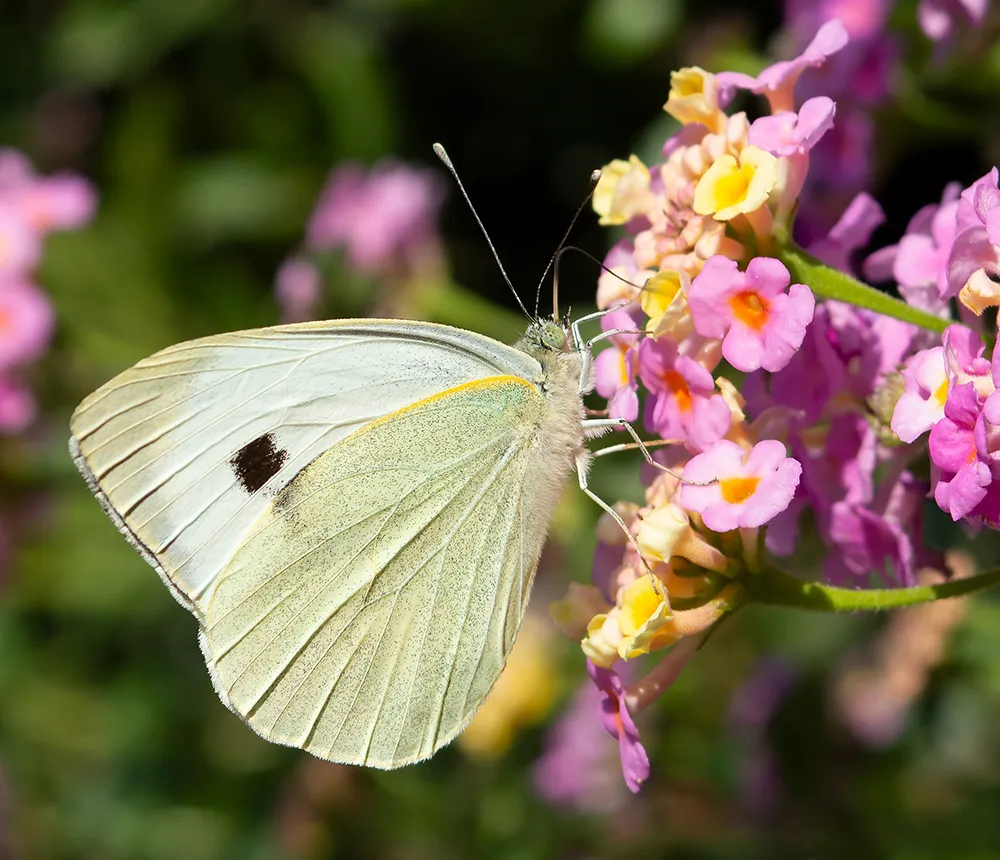
It is a medium-sized white butterfly, with a wingspan of 58 mm in males to 63 mm in females. The upperside is white with black tips on the forewings; the underside of each wing is a pale greenish colour that camouflages the resting butterfly against foliage. The sexes can be told apart: a female carries two black spots and a black dash on the forewing upperside, which the male lacks, and on the underside females show a light ochreous yellow1 on the hindwing, against an ochreous brown in males. The markings also shift with the season: spring-brood males have greyer wingtips than summer males, and spring females are more lightly marked than the blotched summer females2.
Range and habitat
The butterfly favours open spaces with cruciferous plants1: farmland, vegetable gardens, allotments, parks, meadows, open grassland and hedgerows. Butterfly Conservation likewise lists gardens and allotments where cabbages are grown among its favoured ground in Britain. The species also migrates to the British Isles from the continent in some years, on top of its resident population, and is a powerful flier2 able to cover large distances; Butterfly Conservation lists it as present across England, Scotland, Wales and Ireland3, and UK Butterflies counts it among the most widespread species in the British Isles, including Orkney and Shetland.
Life cycle and host plants
Caterpillars feed on cruciferous (Brassicaceae) plants: cabbage, Brussels sprouts, cauliflower, kohlrabi, oilseed rape, swede and turnip, as well as nasturtium, sea-kale and wild mignonette. Butterfly Conservation3 records the same preference for cultivated cabbage and Brussels sprouts, oilseed rape, nasturtium, wild mignonette and coastal sea-kale. Females lay their eggs in clusters of around 40 on the underside of leaves, at a rate of about four a minute, and a single female may lay up to 600 eggs in total. The caterpillars pass through five instars, starting pale yellow with brown heads and developing bright yellow-and-black markings by the final instar; large white caterpillars stay gregarious, feeding alongside their siblings on the outer leaves until fully grown, unlike small white caterpillars, which feed closer to the heart of the foodplant. They store toxic mustard oil glycosides1 from their host plants, which makes them distasteful to birds and other predators, their bright colouring serving as a warning; in Britain the caterpillars are also vulnerable to a parasitic ichneumon fly, Apanteles glomeratus, which lays its eggs inside young larvae. Before pupating, a caterpillar leaves the foodplant for a separate site such as a fence or tree trunk. The species overwinters as a chrysalis; an overwintering pupa takes around eight months to emerge, against around two weeks for a summer-brood pupa, and the species produces two generations a year2 in Britain and continental Europe, occasionally a third in favourable conditions.
The caterpillars’ appetite for brassica crops makes the large white a pest of cabbage crops1 across much of its range. In Britain and Ireland, though, Butterfly Conservation’s monitoring shows the species in decline, with distribution down 18% between 1973 and 2019 and abundance down 32% between 1976 and 20193; despite that fall, UK Butterflies still counts it among the most widespread species in the British Isles2.
Behaviour and flight period
In Britain and continental Europe there are two broods2: a spring generation flying from April with a peak in May, and a summer generation from July into early September, with a third possible in warm years. Mating is mostly monogamous, though some females mate more than once, and copulation is followed a few days later by the first batch of eggs1.
Similar species
- Small white (Pieris rapae): smaller, with a wingspan of 38 to 57 mm4 against the large white’s 58 to 63 mm; in North America the name “cabbage white” refers to this species1 rather than the large white.
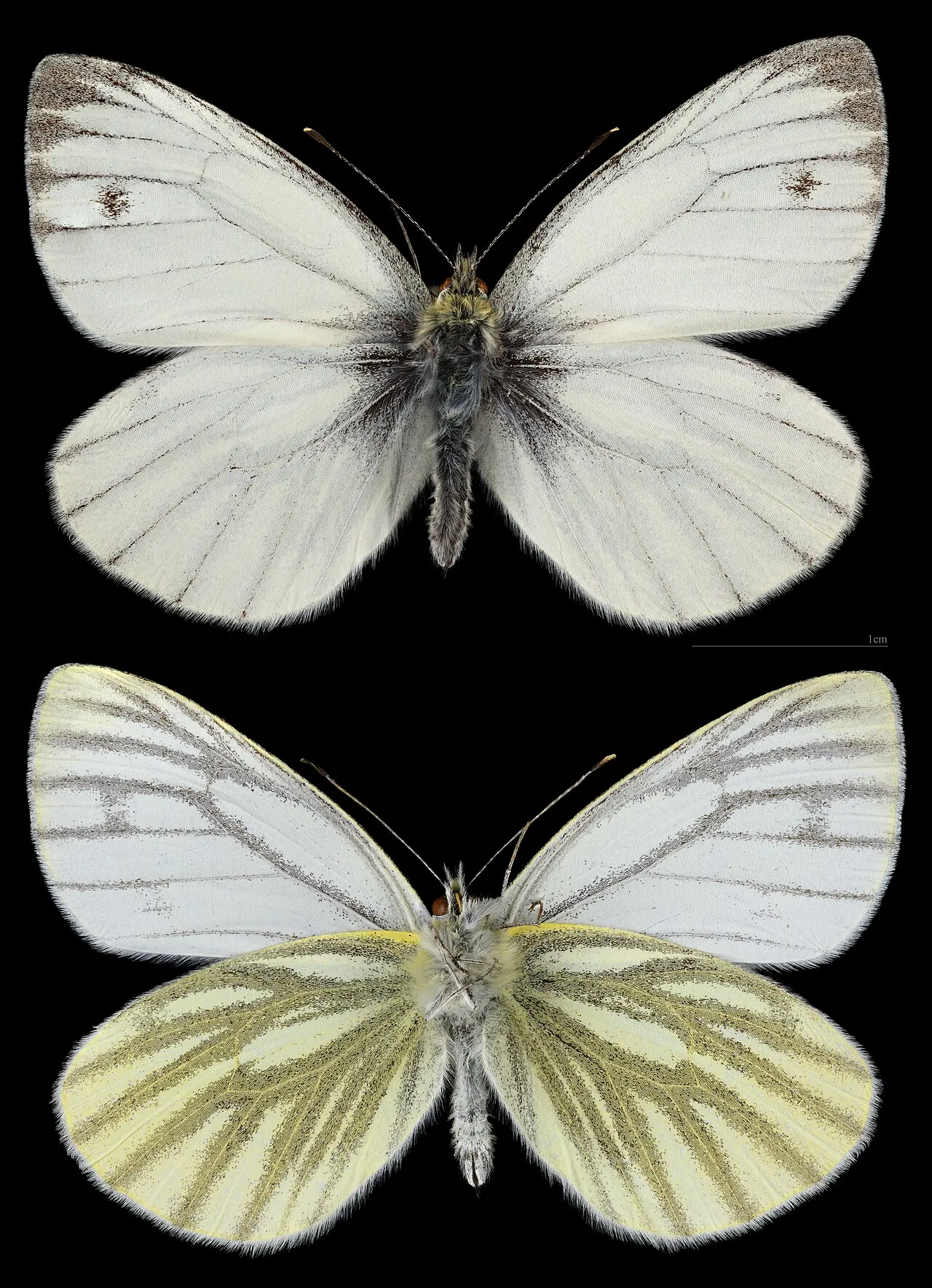
- Green-veined white (Pieris napi): smaller, with a wingspan of 40 to 52 mm5 and dark scales tracing the wing veins on the underside.